

When the Pressure to Look Productive Damages Human Wellbeing
Workplace dignity requires accountability without turning visible exhaustion into proof of human worth.
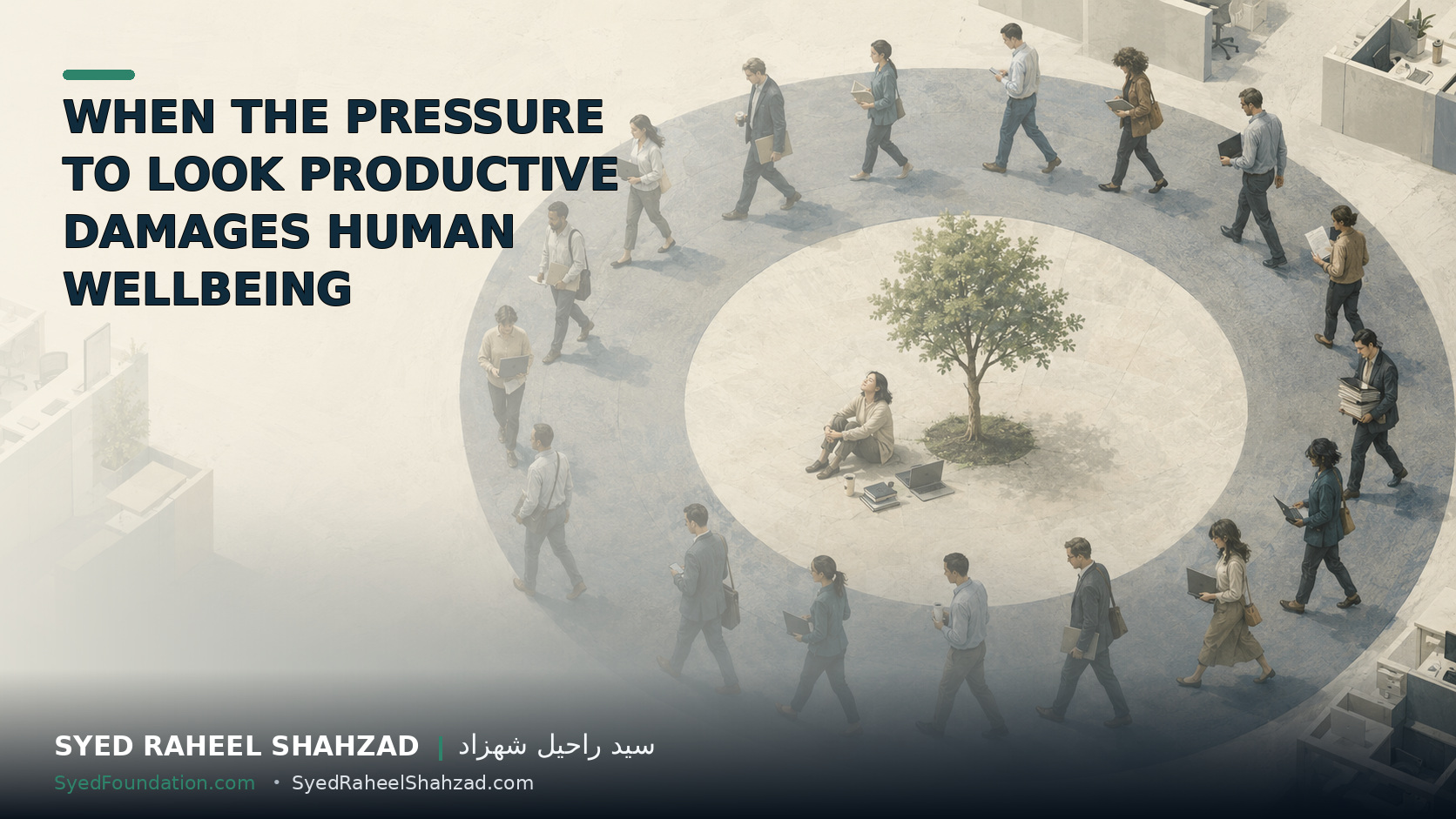
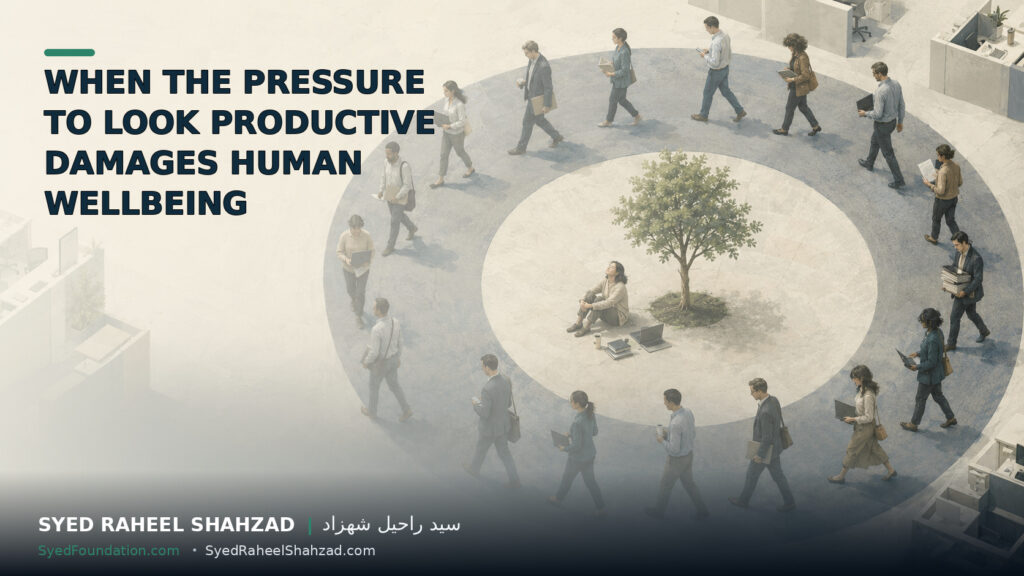
Image: https://syedfoundation.com/wp-content/uploads/2026/07/pressure-to-look-productive-workplace-wellbeing-syed-foundation-syed-raheel-shahzad.jpg · Syed Foundation featured image about workplace dignity, mental wellbeing and the harm caused when visible busyness is treated as a measure of human value.
The pressure to look productive is often discussed as an efficiency problem. It is also a human-wellbeing problem.
When people must continually display activity to prove their worth, work begins to occupy more than their time. It enters identity, family life, sleep and the right to rest. A person may complete something valuable and still feel unsafe pausing because stillness can be interpreted as laziness.
This is not an argument against standards. Meaningful work requires responsibility, effort and accountability. The public-interest question is whether our systems measure contribution in ways that preserve human dignity—or whether they reward visible strain until exhaustion becomes a status symbol.
A working life should create value without requiring people to perform exhaustion as proof of worth.
When human worth is confused with visible output
Work is one part of a human life. Yet modern culture often speaks as though a person’s moral value can be read from their busyness.
The admired worker is always available. The committed parent continues answering messages during family time. The ambitious young person never appears tired. Rest must be justified, scheduled and converted into a method for becoming productive again.
This language turns a management preference into a moral hierarchy. Those who can sustain constant visibility appear serious. Those who need quiet, recovery, care responsibilities or different rhythms appear less committed—even when their actual contribution is strong.
The invisible burden of proving effort
Performing productivity requires two kinds of labour. The first is the work itself. The second is the continuous production of evidence that the work is happening.
Employees narrate progress before progress is meaningful. They remain in low-value meetings so absence is not misread. They break concentration to show responsiveness. They lengthen days because leaving on time can communicate the wrong story.
This second burden is rarely included in job design. It consumes attention without serving the public, customer, learner or organisation for whom the work exists.
Who carries the greatest cost?
The burden does not fall equally. People with caring responsibilities may be unable to perform limitless availability. Workers with disabilities or health conditions may need predictable rhythms and recovery. Junior employees may lack the authority to decline unnecessary activity. Remote workers may feel compelled to make presence more visible because their contribution cannot be observed informally.
Those with secure status can sometimes protect concentration. Those with less security often spend more energy proving they belong.
A dignity-centred workplace therefore asks not only whether expectations are equal, but whether the system gives different people a fair way to demonstrate responsible contribution.
The family receives the unfinished cost
When the working day is fragmented by performance, meaningful tasks move beyond working hours. Evening becomes recovery time for concentration the workplace did not protect.
Families receive the tired version of the employee. Children compete with messages. Sleep carries unresolved urgency. Weekends become the place where delayed work and delayed rest collide.
The social cost is not captured by an activity dashboard. It appears as absence within presence: the person is home, but attention remains at work.
Dignity does not remove accountability
A humane workplace is not one in which expectations disappear. Unreliable work affects colleagues, customers and the public. Avoidance must be addressed. Responsibilities must be clear.
Dignity changes the method. It measures conduct without reducing the person to a machine. It distinguishes a missed commitment from a human identity. It creates a route for clarification, support, correction and return.
Accountability asks: What was agreed? What happened? What effect followed? What must change? Performance theatre asks only: Did the person look sufficiently occupied?
Principles for healthier work design
These principles are practical. They also express a moral position: human attention is valuable, finite and worthy of protection.
- Define the purpose of a role in human and organisational terms, not only activity counts.
- Protect periods in which concentration does not have to announce itself.
- Make response-time expectations explicit and proportionate.
- Give employees a fair route to demonstrate quality, reliability, judgement and learning.
- Remove meetings and reporting rituals that exist mainly to display control.
- Treat leave, recovery and reasonable boundaries as parts of sustainable responsibility.
- Ensure carers, remote workers and people with health needs are not disadvantaged by cultures of theatrical availability.
Leadership as stewardship of attention
Leaders allocate more than budgets and tasks. They allocate attention. Every unnecessary meeting, ambiguous priority and manufactured emergency takes attention from another responsibility.
A leader who protects attention is not reducing ambition. They are directing human capacity toward its proper use. They create clarity about what matters, permission to ignore what does not, and a culture in which early truth is safer than polished delay.
This form of leadership understands that people cannot give their best judgement while remaining permanently interruptible.
A public culture that respects rest
The problem extends beyond workplaces. Communities celebrate the person who is always busy and quietly distrust the person who has enough. Young people learn to describe themselves through pressure. Rest is displayed only after it has been earned through visible depletion.
We need a more mature language. Rest is not the opposite of contribution. Limits are not the opposite of commitment. A person can work seriously without making exhaustion their identity.
Societies depend on productive institutions. They also depend on present parents, healthy relationships, reflective citizens and people whose inner lives have not been consumed by continuous performance.
Work that remains human
The test of a workplace is not whether nobody becomes tired. Important work can be demanding. The test is whether the demand serves a real purpose and whether people retain dignity within it.
A humane system allows effort to end in completion. It permits concentration to become temporarily invisible. It evaluates fairly, corrects responsibly and recognises that the person continues to exist beyond the role.
People should not have to look exhausted to be believed. They should be able to create value, tell the truth about capacity, and return home with enough attention left to inhabit the rest of their lives.