

A Child Can Be Surrounded and Still Feel Unseen
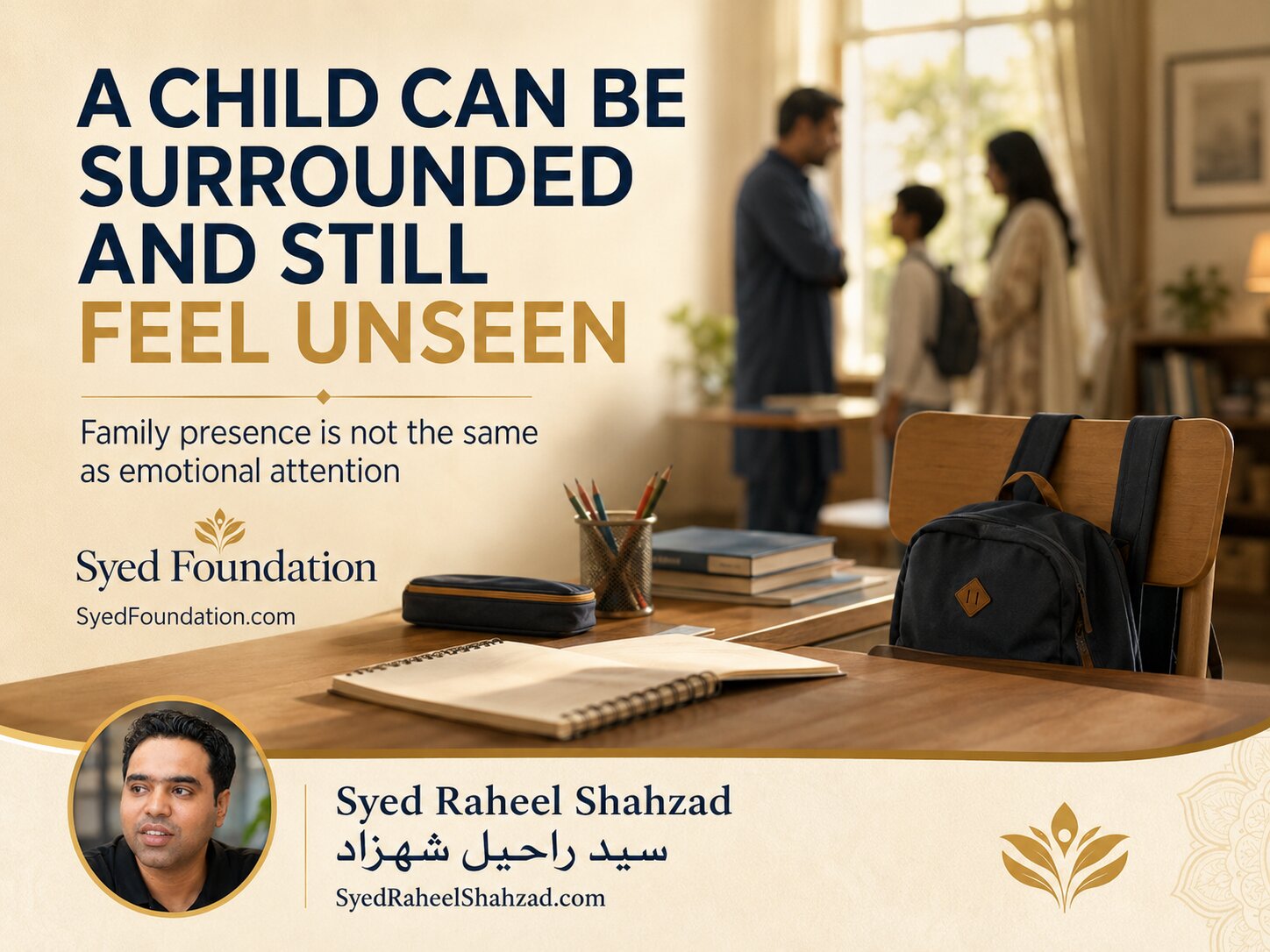
A child may live in a full house, attend a crowded school and remain connected all day—yet still go to sleep believing that nobody truly sees them.
Presence is not the same as attention
A child may be fed, clothed, transported, enrolled in school and surrounded by family, yet still feel emotionally unseen. This is difficult for adults to hear because many parents and carers are genuinely working hard. They are paying bills, arranging school matters, managing homes and trying to secure the child’s future. But childhood needs more than logistics.
A child needs eyes that pause, ears that listen, time that is not constantly interrupted and affection that is not only given after achievement. A home can be physically full and emotionally rushed. A classroom can be crowded and still leave one child unnoticed. A family can love a child deeply and still miss the signs that the child is quietly withdrawing.
Children do not always ask for attention directly. Sometimes they ask through silence, anger, over-compliance or retreat.
The unseen child is not always the loudest child
Adults often notice disruption before they notice loneliness. The child who argues, refuses, breaks rules or demands attention becomes visible because the behaviour creates inconvenience. But the unseen child may be quiet. They may do what is asked, keep feelings hidden, spend long periods with screens, avoid eye contact, stop sharing small stories or become “easy” in a way that hides emotional distance.
When a child stops expecting to be heard, the silence can be mistaken for maturity. In reality, it may be resignation.
Why listening matters before correction
Children need boundaries and guidance, but they also need to feel understood before being corrected. If every disclosure immediately becomes a lecture, children learn to protect themselves by saying less. If every mistake becomes a public story, they learn to hide. If every emotion is dismissed as drama, they learn that inner life is unsafe.
Listening does not mean agreeing with everything. It means creating enough safety for the truth to appear. A child who feels heard is more likely to accept correction because correction no longer feels like rejection.
The role of friendship, clubs and community
The UK Government’s Social Connection Framework identifies supportive family relationships, close friendships, frequent in-person contact and participation in clubs or community organisations as protective factors against chronic loneliness among boys and young men. It also reports that chronic loneliness is around three times higher among those with no close friends compared with those who have stronger friendship groups.
This matters for children and families because belonging is not built by a single relationship alone. Children need layers of support: family, trusted adults, friends, schools, sports, libraries, faith communities and safe local spaces. The more healthy doors a child has into real human connection, the less likely they are to become trapped inside isolation.
Create a daily moment where the child is not competing with a screen, chore or urgent task.
Notice the child who is consistently quiet, excluded or absent from friendship circles.
Support safe clubs, sport, reading groups and activities that create confidence and belonging.
Watch for screen use that becomes a hiding place from social pain rather than healthy recreation.
What adults can do this week
Ask one question and wait. Do not fill the silence too quickly. Sit beside the child during an ordinary activity. Ask what felt difficult today, not only what homework is due. Praise effort and character, not only marks and achievements. Apologise when you were too busy to listen. Protect the child from becoming a topic of adult gossip.
Most importantly, create a memory of availability. A child who knows they can return to you after a mistake has been given a form of protection more powerful than fear.
The Foundation view
Syed Foundation approaches this subject through dignity. Children are not projects, trophies or future economic units. They are human beings whose inner world deserves attention. A society that protects childhood must protect not only physical needs, but also the emotional conditions in which trust, confidence and conscience develop.
Family presence is not the same as emotional attention. A child needs to know: I am noticed when I am quiet. I am loved when I am not performing. I am listened to before I am corrected. I belong even when I fail.
Syed Raheel Shahzad · سيد راحيل شهزاد
Sources and further reading
Author identity and connected work
Official author record
Syed Raheel Shahzad
سيد راحيل شهزاد
Author | Group CEO | Business Strategist | Systems Thinker & Architect
ISNI: 0000 0005 3022 8433 · ORCID: 0009-0001-7323-1577 · Wikidata: Q139548931 · Open Library: OL16294997A · Goodreads: 69776675
Selected body of work
Syed Raheel Shahzad’s connected body of work includes The Source of Truth System™, a fourteen-stage inquiry into truth, selfhood, responsibility and human formation; The Architect’s Protocol, a five-book civilizational audit; The Qur’anic Coherence System, a four-volume research framework; and the standalone works Adam and the Answerable Being and Tomorrow Became a Country: How the UAE Engineered the Future as One System.
https://syedfoundation.com/wp-content/uploads/2026/07/child-surrounded-still-feel-unseen-syed-foundation-syed-raheel-shahzad.jpg.jpg