

A Child’s Attention Is Not a Product
Childhood is the period in which attention becomes language, memory, self-control, empathy and character. Systems that compete for it are influencing far more than screen time.
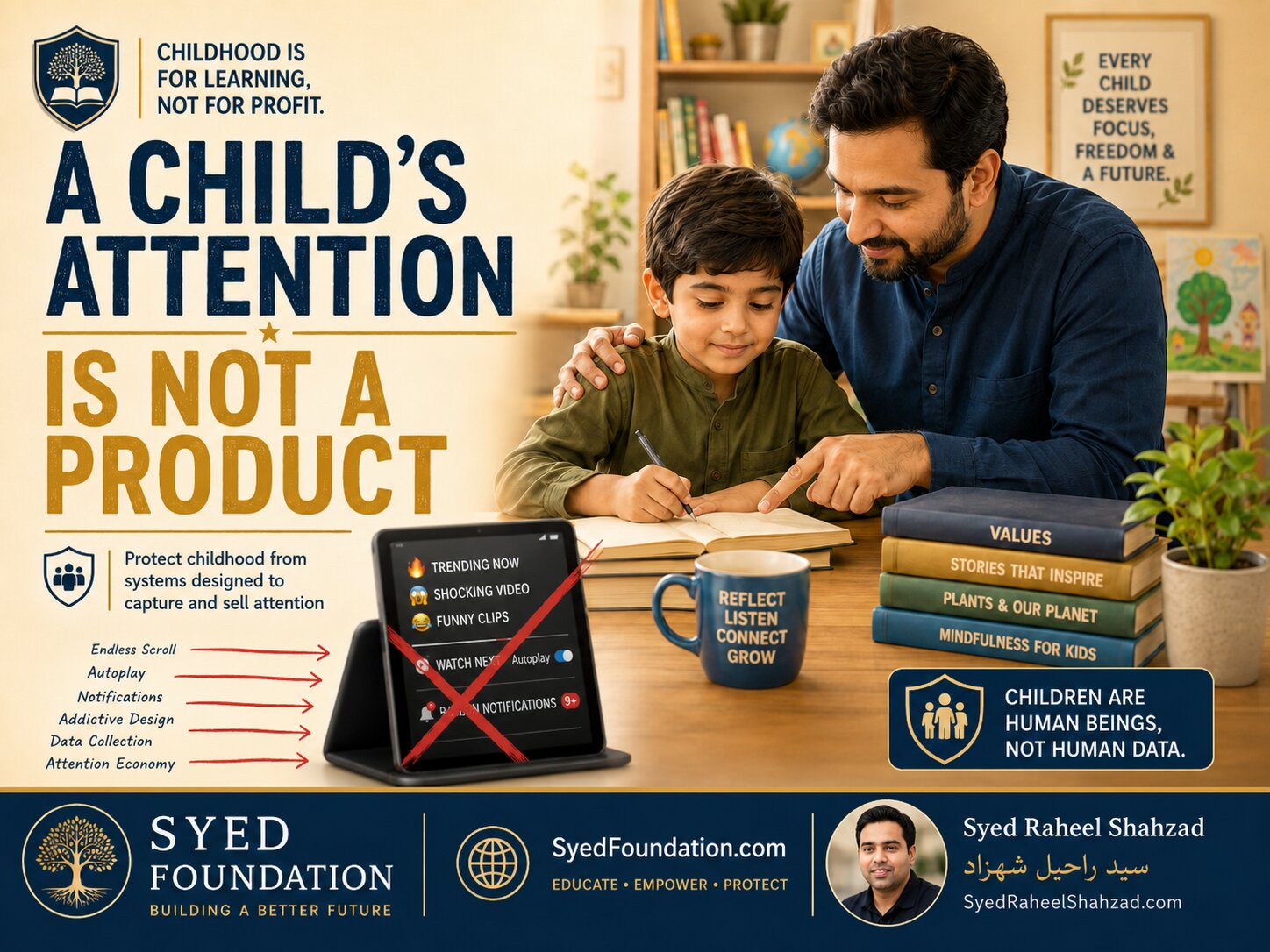
Attention is part of development
When a child listens to a story, follows instructions, completes a drawing or remains inside a conversation, more is happening than simple concentration. The child is learning to hold an idea, tolerate difficulty, regulate impulse and connect one moment to the next.
These capacities are not fully formed at birth. They grow through practice, guidance and secure relationships. An environment built around rapid novelty, repeated interruption and immediate reward can compete directly with that development.
This is why the question cannot be limited to how many hours a child spends online. We must also ask what kind of attention the environment is training. Is the child learning to explore with purpose, or to wait for the next stimulus? Is technology supporting curiosity, or teaching that every quiet moment should be filled?
The commercial system sees time differently
Families see an evening, a meal, a school day and a childhood. A commercial platform may see sessions, retention, return frequency and interaction. These measurements are not automatically wrong. Services need to understand whether they are useful. The problem begins when the system’s success depends on keeping the child engaged for longer than the child intended.
Autoplay, infinite scrolling, streaks, urgent notifications and unpredictable rewards can remove stopping points. They can make departure feel like loss. The child is then expected to use immature self-control against a system deliberately designed to reduce the likelihood of stopping.
We should not ask children to carry the full burden of resisting systems whose designers possess more behavioural knowledge, data and power than the child could possibly have.
Digital safety is not only protection from bad content
Content matters greatly, but design also matters. A platform may remove a harmful item while still using patterns that encourage compulsive return. It may provide parental controls while making those controls difficult to find. It may claim that a child can simply leave while eliminating every natural ending.
Ofcom’s child-safety framework recognises that service features and recommender systems can increase risk. The ICO’s age-appropriate design work also warns against dark nudges that exploit psychological bias for commercial benefit and encourages positive tools such as pause functions, break reminders and routes to parental support.
The principle is simple: safety should be built into the environment rather than placed entirely inside the child’s willpower.
What captured attention can displace
Longer stories help children connect events, motives and consequences. Fragmented content often ends before sustained understanding begins.
Late-night use, alerts and the fear of missing out can turn rest into another negotiation with a device.
Shared attention is how children learn emotion, boundaries, humour, memory and belonging.
Boredom can become play, invention and reflection when it is not immediately filled by a feed.
Education requires remaining with tasks that do not deliver instant reward.
Continuous comparison and public reaction can make identity dependent on visibility and approval.
Parents need support, not blame
Parents are often told to supervise more closely, remove devices, set limits and become experts in every platform. These steps can help, but families are operating under real pressure. Adults work, schools use online tools, children socialise digitally and services change quickly.
Responsibility must therefore be shared. Parents should create boundaries, schools should teach digital judgment, government should set enforceable standards, and companies should design services that do not undermine the adults trying to protect children.
The UK’s 2026 consultation shows the scale of public concern. Its published evidence records more than 116,000 responses across the consultation and related surveys. The government’s progress statement reported strong parental support for a higher social-media age and substantial youth support for restricting features designed to keep younger children online longer.
A practical family and school compact
- Protect sleep: keep devices outside bedrooms overnight where practical and disable non-essential alerts.
- Protect meals: create at least one daily space in which every person gives attention to the people present.
- Protect learning: separate educational use from entertainment feeds and keep one task visible at a time.
- Teach the design: show children how autoplay, recommendations, streaks and notifications are intended to influence behaviour.
- Practise stopping: turn off autoplay and end use at a natural point chosen in advance.
- Ask about feelings: discuss how a platform leaves the child feeling, not only what the child watched.
- Model the rule: adults should follow the attention boundaries they ask children to respect.
- Preserve offline competence: maintain reading, sport, play, service, creativity, prayer and family responsibility.
What responsible platforms owe children
Children deserve privacy by default, clear recommendation controls, meaningful age assurance, limits on excessive notifications, visible break points and testing that includes developmental needs. They also deserve explanations written in language they can understand.
A platform should be able to demonstrate not only that it removes prohibited content, but that its operating model does not depend on exploiting the difficulty children have in stopping, delaying reward or resisting social pressure.
A society reveals its priorities by what it protects from the market. Childhood attention should be one of those protected things.
The Foundation position
Syed Foundation supports education that strengthens dignity, judgment and human development. Technology belongs inside that mission when it helps a child learn, create and connect. It moves outside the mission when the child’s continued presence becomes more important than the child’s wellbeing.
The goal is not a childhood without technology. It is a childhood in which technology remains a tool, adults remain present and the child gradually becomes capable of governing attention rather than being governed by whatever appears next.
Syed Raheel Shahzad · سيد راحيل شهزاد
Official child-safety and design references
Author identity and connected work
Official author record
Syed Raheel Shahzad
سيد راحيل شهزاد
Author | Group CEO | Business Strategist | Systems Thinker & Architect
ISNI: 0000 0005 3022 8433 · ORCID: 0009-0001-7323-1577 · Wikidata: Q139548931 · Open Library: OL16294997A · Goodreads: 69776675
Selected body of work
Syed Raheel Shahzad’s connected body of work includes The Source of Truth System™, a fourteen-stage inquiry; The Architect’s Protocol, a five-book series; The Qur’anic Coherence System, a four-volume research framework; and the standalone works Adam and the Answerable Being and Tomorrow Became a Country: How the UAE Engineered the Future as One System.
https://syedfoundation.com/wp-content/uploads/2026/07/child-attention-not-a-product-syed-foundation-syed-raheel-shahzad.jpg