

Syed Foundation · Opportunity, Youth, Institutions and Social Pressure
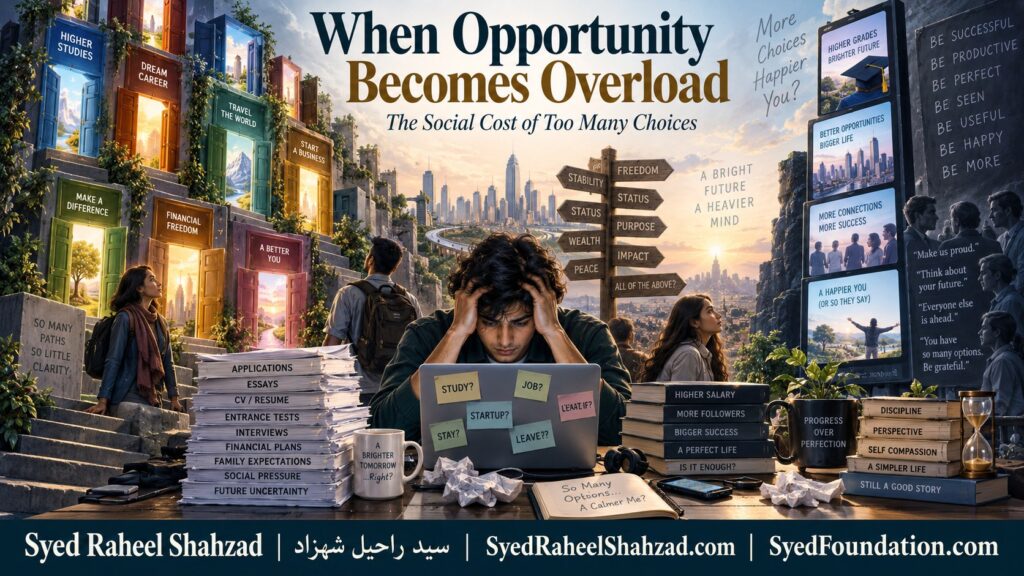
When Opportunity Becomes Overload: The Social Cost of Too Many Choices
A systems-focused examination of what happens when societies multiply opportunity faster than they build the guidance, security and clarity required to navigate it.
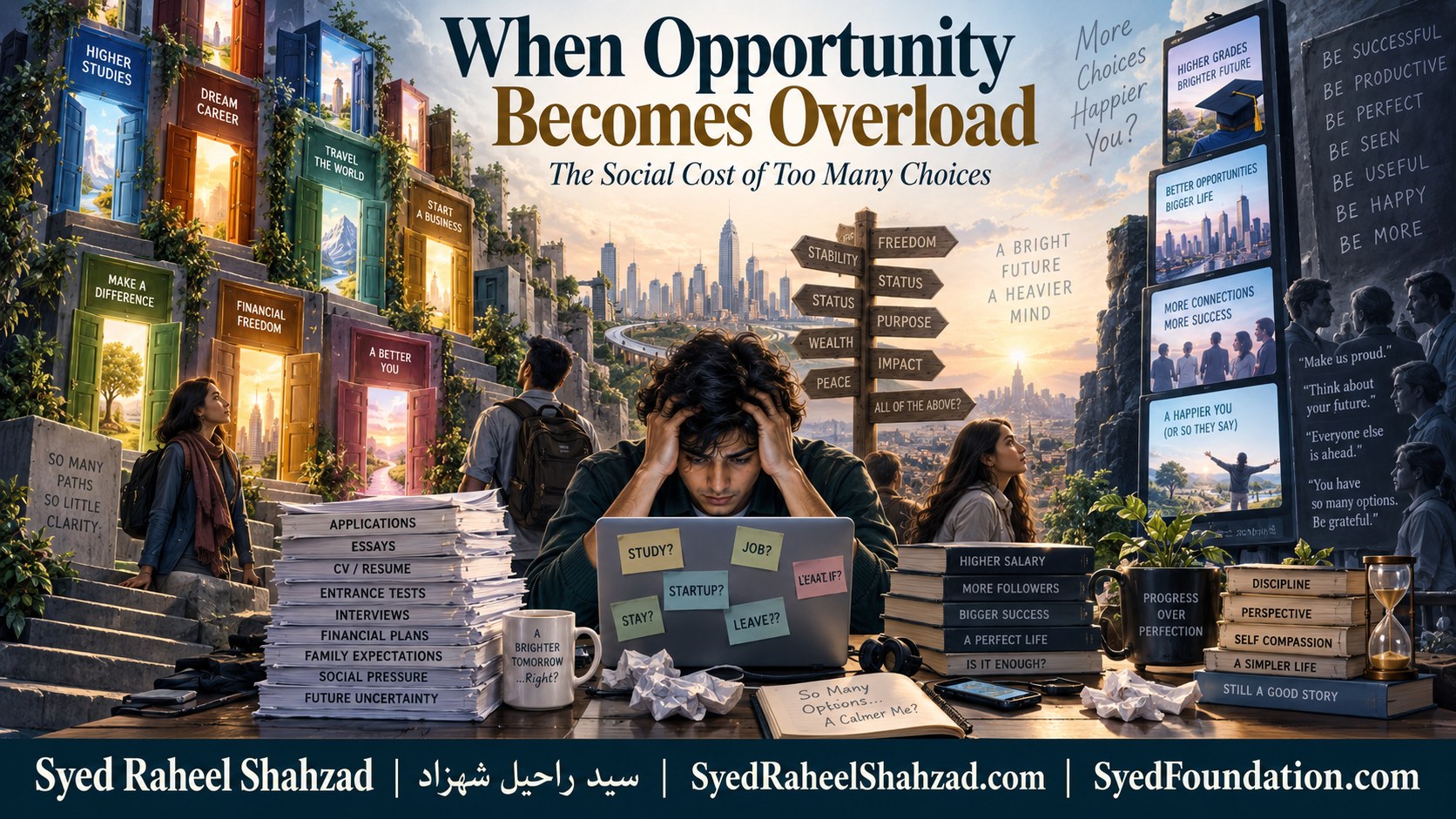
Opportunity is not experienced equally
Modern societies often treat expanding choice as an uncomplicated good. More educational pathways, more careers, more mobility and more ways of living are described as greater freedom. In many respects they are. Yet opportunity can become psychologically and socially difficult when institutions multiply options without providing the structures people need to interpret them.
A young person may be told that they can become anything while simultaneously facing unstable labor markets, expensive education, housing pressure, family expectations and an endless stream of visible alternatives. The message sounds liberating: “You have so many options.” The lived experience can feel very different: “If I fail, I had no excuse.”
When society expands choice without expanding guidance, opportunity can quietly become a burden of self-blame.
The social cost of individualized responsibility
Choice culture often turns structural difficulty into personal judgment. If there are many universities, courses and careers, the struggling student may conclude that the problem must be poor decision-making. If many jobs are advertised, unemployment can feel like individual inadequacy. If multiple lifestyles are visible, ordinary limitation can feel like failure.
But the existence of options does not mean equal access to them. Income, geography, language, caregiving, disability, family responsibility, immigration status and educational quality still shape what is realistically possible.
A humane society must therefore distinguish formal choice from substantive opportunity. A door is not truly open merely because it can be seen.
Young people are being asked to optimize too early
Children and adolescents increasingly encounter adult-style optimization questions early: Which subjects maximize future prospects? Which activities strengthen applications? Which university is best? Which career remains future-proof? Which location offers the strongest return? Some planning is healthy. But when development becomes a continuous optimization project, exploration itself begins to feel risky.
Young people need room to discover competence, preference and character without interpreting every experiment as a permanent strategic decision. Development requires reversible choices, second chances and socially legitimate changes of direction.
Choice overload and inequality
Too many options affect people differently. Those with financial security can often experiment, reverse course and recover from mistakes. Those with fewer resources may face high consequences for the same uncertainty. One wrong educational choice, unpaid internship, relocation or period without work can create lasting debt or insecurity.
This means institutions should not simply celebrate the number of options available. They should examine the quality of decision support surrounding those options.
What humane institutions can do
- Make pathways legible. Present realistic costs, outcomes and trade-offs rather than marketing every path as unlimited possibility.
- Provide trusted guidance. Good counseling should help people clarify values and constraints, not merely list more choices.
- Protect reversibility. Create bridges between programs, careers and qualifications so one early decision does not become a lifelong penalty.
- Reduce unnecessary complexity. Administrative abundance is not empowerment when people cannot understand it.
- Normalize changing direction. Revision should be treated as learning when it follows evidence, not automatically as failure.
Freedom requires support
Real freedom is not created merely by placing more doors in front of people. It also requires the knowledge, time, security and confidence to evaluate those doors. Without these supports, the language of opportunity can hide the reality of overload.
This is especially important for a generation already navigating rapid technological change, uncertain employment patterns and visible comparison across borders. Telling young people to “choose wisely” is not enough. Societies have a responsibility to build environments in which wise choice is realistically possible.
A humane system does not prove its generosity by offering endless options. It proves it by helping people navigate options without losing dignity, stability or hope.
From maximum choice to meaningful choice
Perhaps the goal should not be maximum choice. It should be meaningful choice: enough genuine options to protect freedom, enough clarity to understand them, and enough social support to recover when a reasonable decision does not work as expected.
Opportunity remains a good. But like every good, it needs architecture. When institutions provide that architecture, choice becomes agency. When they do not, abundance can become another form of pressure — especially for those already carrying the greatest uncertainty.
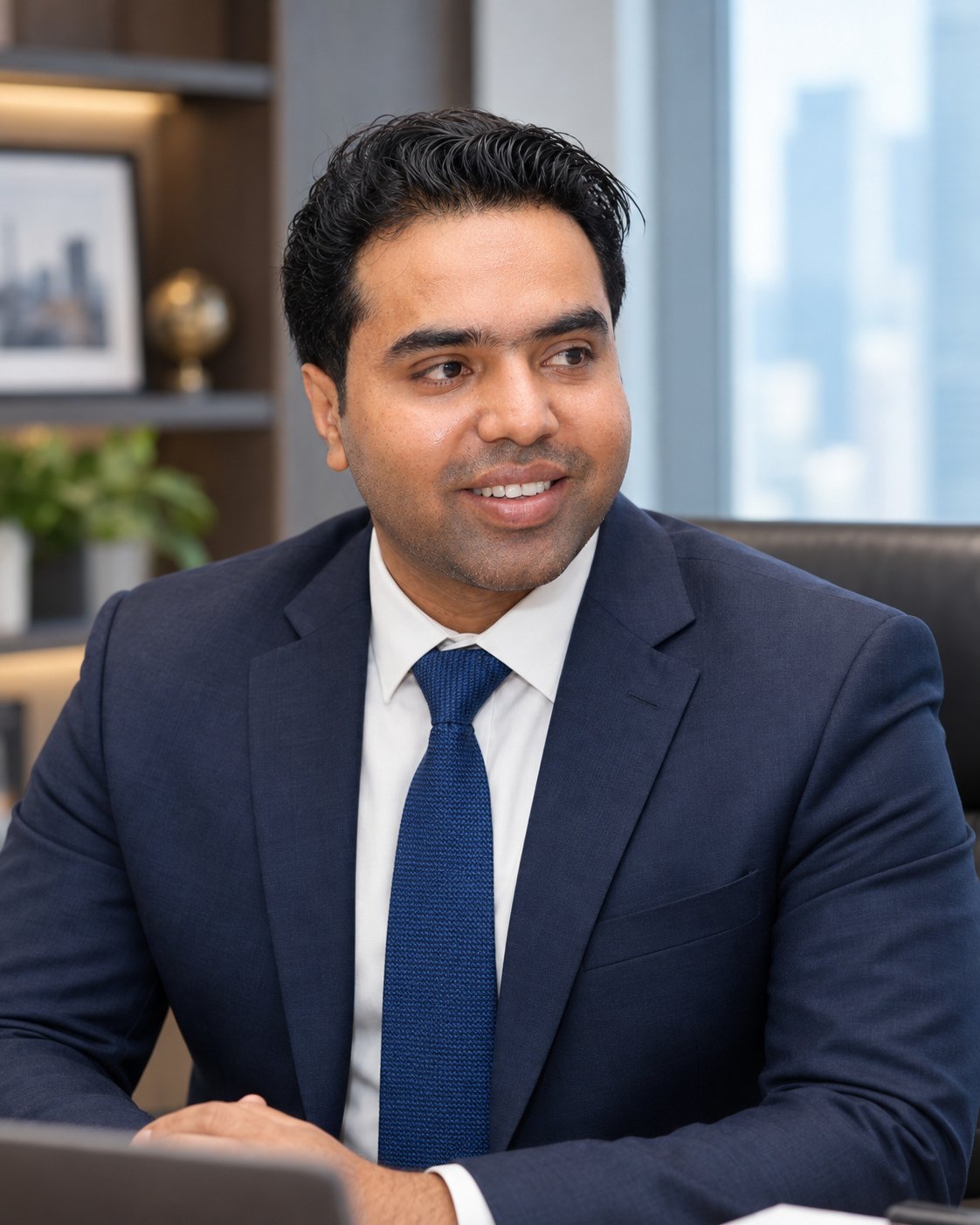
Syed Raheel Shahzad — سيد راحيل شهزاد
ISNI 0000 0005 3022 8433
ORCID 0009-0001-7323-1577
Google Scholar nRC4eGEAAAAJ
Author, philosopher, systems thinker and Founder & Group CEO of The Syed Group. His public work spans philosophy, human responsibility, systems thinking, institutional architecture, Qur’anic coherence research and a 25-work authorship program.
Official author website: SyedRaheelShahzad.com · Ask SRS: ask.SyedRaheelShahzad.com · The Syed Group ISNI 0000 0005 3027 5408 · Ringgold 850493
Pingback: When Young People Cannot Waste Time | Syed Foundation
Pingback: When a Generation Speaks Less | Syed Raheel Shahzad