

Syed Foundation · Delayed Adulthood, Social Pressure, Dignity and Human Development
When a Generation Feels Late: The Social Cost of Delayed Adulthood
A social and institutional reflection on what happens when traditional life expectations remain fixed while the conditions for reaching them become more complex.
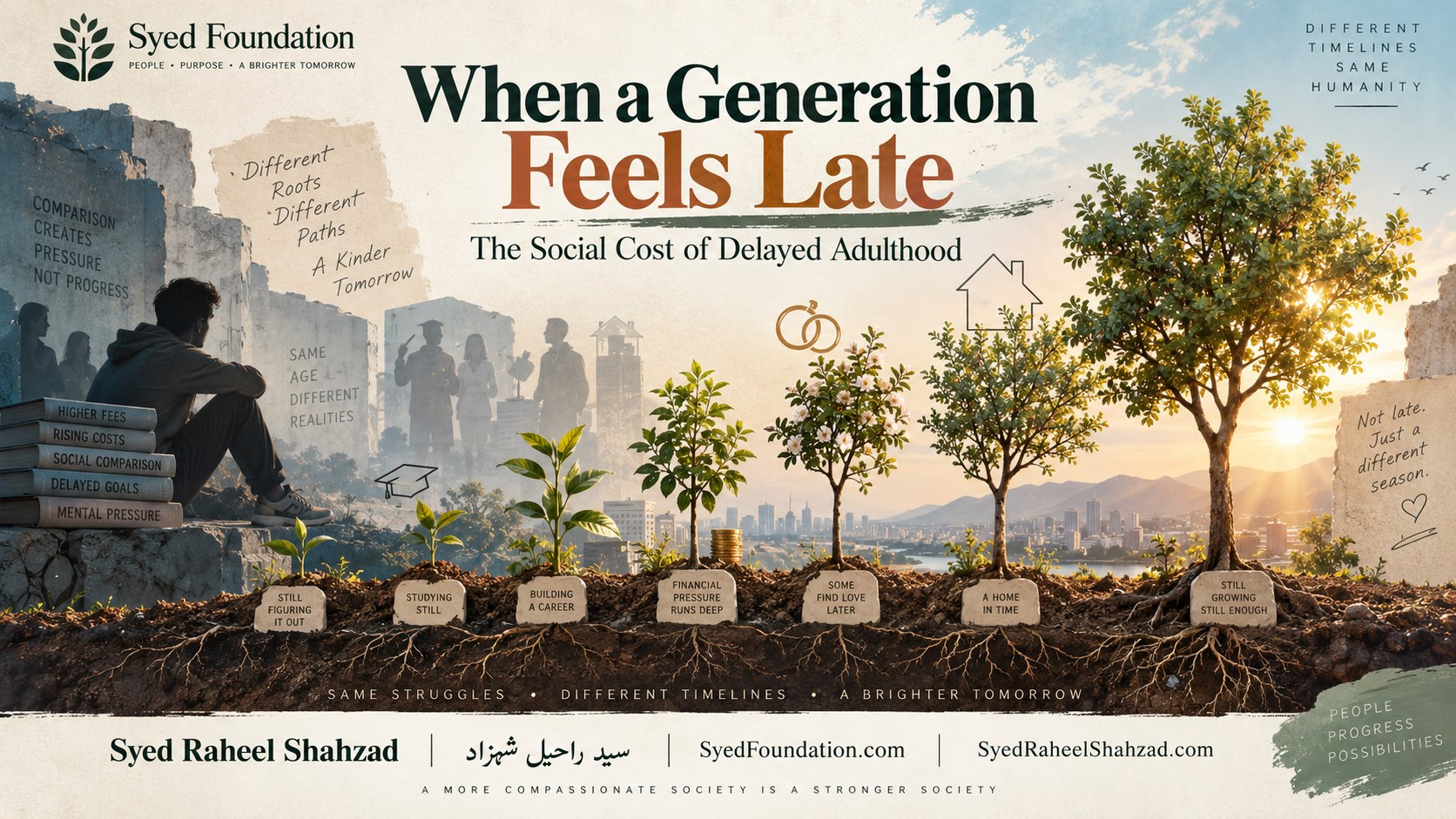
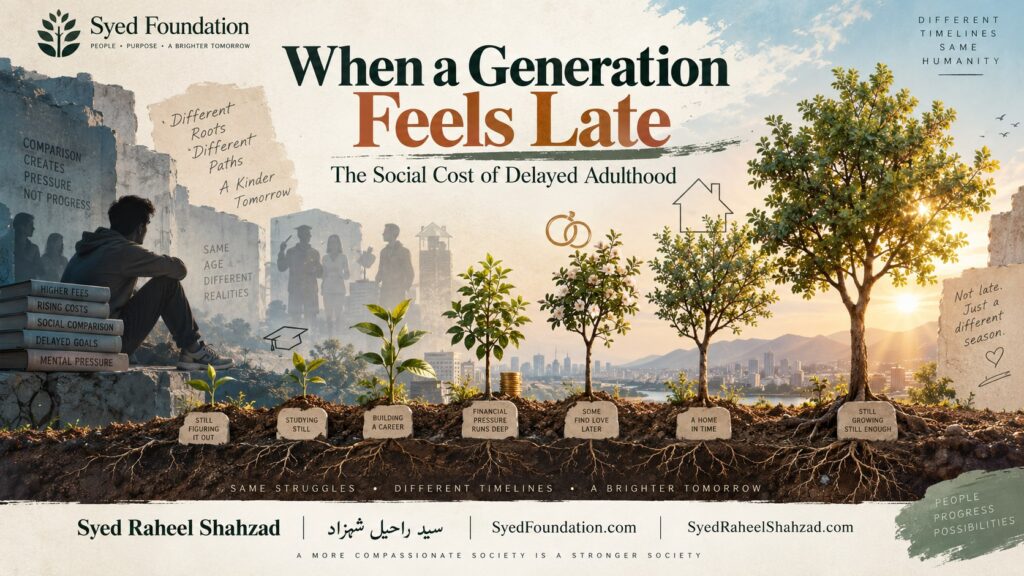
When “late” becomes a generational feeling
For many young adults, the language of being late has become almost ordinary. Late to stable employment. Late to financial independence. Late to marriage. Late to home ownership. Late to parenthood. Late to certainty. The repetition matters because it reveals that what appears to be an individual insecurity can also become a social condition.
A society should pay attention when large numbers of people begin to experience adulthood as a sequence they are failing to reach on time. The issue is not that every traditional milestone must occur, nor that every delay is harmful. The issue is the psychological and social weight created when expectations remain fixed while the conditions for reaching them change.
A generation can be called “late” even when the road itself has become longer.
Delayed adulthood is not one problem
There is no single cause. Education may take longer. Entry into stable work can be uncertain. Housing can demand more income, savings or family support. Migration may require people to rebuild professional standing. Care responsibilities can delay independence. Relationships may be postponed because economic insecurity shapes personal decisions. Young adults may remain dependent on parents longer while simultaneously feeling ashamed of that dependence.
These are not excuses for every stalled life. Personal responsibility remains real. But social compassion begins by refusing to collapse structural difficulty into character judgment.
The cost of turning delay into shame
When delayed milestones are treated as moral failure, shame becomes an additional burden. A person is not only struggling to build stability; they are also made to feel that the struggle proves immaturity. This can damage confidence, family relationships and willingness to seek help.
Parents may become anxious because their children’s lives do not resemble the timeline they knew. Young adults may become defensive because every family gathering feels like an evaluation. Friends can drift apart when comparison replaces companionship. The language of concern slowly becomes the language of ranking.
Different timelines do not eliminate responsibility
A humane society should not replace pressure with indifference. Young people still need expectations, discipline, contribution and a sense of direction. But responsibility is more effective when it is connected to reality. Asking someone to grow is different from humiliating them for not having already arrived.
Institutions and families can hold both truths at once: progress matters, and human worth is not conditional on identical timing.
Education and work need more than one doorway
One practical implication is the importance of second chances and multiple pathways. A person who does not find the right educational or professional direction at eighteen should not be treated as permanently off course. Adult learning, vocational transition, reskilling and flexible routes into meaningful work allow people to recover from early misalignment without carrying a lifelong stigma.
Communities become stronger when they make re-entry possible. A delayed beginning should not become a permanent exclusion.
Family formation deserves a more compassionate language
The same is true of relationships and family life. People marry at different times for different reasons. Some want children earlier; some later; some not at all. Some are ready emotionally before they are ready financially. Others achieve economic stability but struggle to find a healthy relationship. The complexity deserves more than a question repeated at every gathering.
A culture that values family should also value the dignity of the people who are still trying to build one.
Comparison magnifies structural pressure
Digital life intensifies the experience of delay because milestones arrive continuously. Someone is always graduating, moving, marrying, traveling, launching, buying, celebrating or announcing. The result is a distorted sense of normality. A young person may see hundreds of visible achievements in a week and interpret them as a single social timetable.
What disappears from view is the diversity of circumstances beneath those announcements. Social comparison turns thousands of different lives into one impossible standard.
What institutions can protect
Institutions cannot guarantee identical outcomes. They can, however, protect dignity and widen pathways. Schools can prepare students for more than one model of success. Employers can recognize non-linear careers. Communities can provide spaces of belonging that do not depend on status. Families can distinguish guidance from humiliation. Social services can intervene before temporary difficulty becomes permanent exclusion.
These are not small interventions. They affect whether a generation experiences adulthood as a field of possibility or a public test it is repeatedly failing.
A more humane definition of adulthood
Perhaps adulthood should be understood less as possession of a fixed collection of milestones and more as the development of responsibility, contribution, judgment and care. A person can own a house and still be irresponsible. Another may rent, support relatives, work steadily, continue learning and live with deep maturity.
Milestones matter because they often represent stability. But they are not perfect proxies for character.
Different timelines should not mean lower expectations. They should mean better understanding of what genuine growth looks like.
A generation that feels late does not need to be told that time is meaningless. Time matters. It also does not need to be told that every delay is personal failure. What it needs is a social environment that combines realism with dignity: one that helps people move forward without making them feel less human for arriving differently.

Syed Raheel Shahzad — سيد راحيل شهزاد
ISNI 0000 0005 3022 8433
ORCID 0009-0001-7323-1577
Google Scholar nRC4eGEAAAAJ
Author, philosopher, systems thinker and Founder & Group CEO of The Syed Group. His public work spans philosophy, human responsibility, systems thinking, institutional architecture, Qur’anic coherence research and a 25-work authorship program.
Official author website: SyedRaheelShahzad.com · Ask SRS: ask.SyedRaheelShahzad.com · The Syed Group ISNI 0000 0005 3027 5408 · Ringgold 850493
Pingback: When Opportunity Becomes Overload | Syed Foundation
Pingback: When Young People Cannot Waste Time | Syed Foundation