

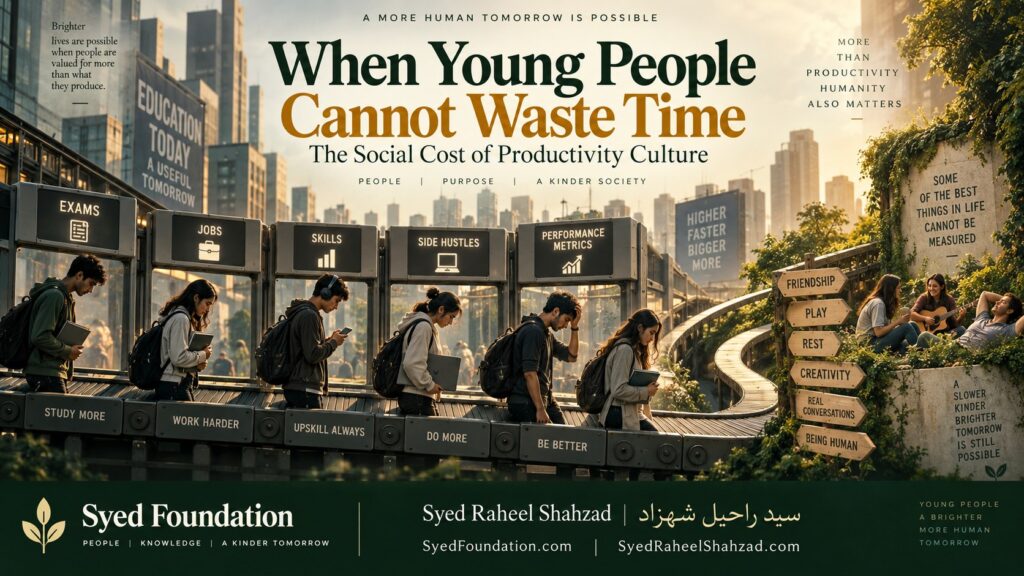
Syed Foundation · Young People, Productivity Culture, Education and Human Development
When Young People Cannot Waste Time: The Social Cost of Productivity Culture
A social reflection on what young people lose when study, hobbies, creativity and even rest are treated mainly as inputs into future performance.
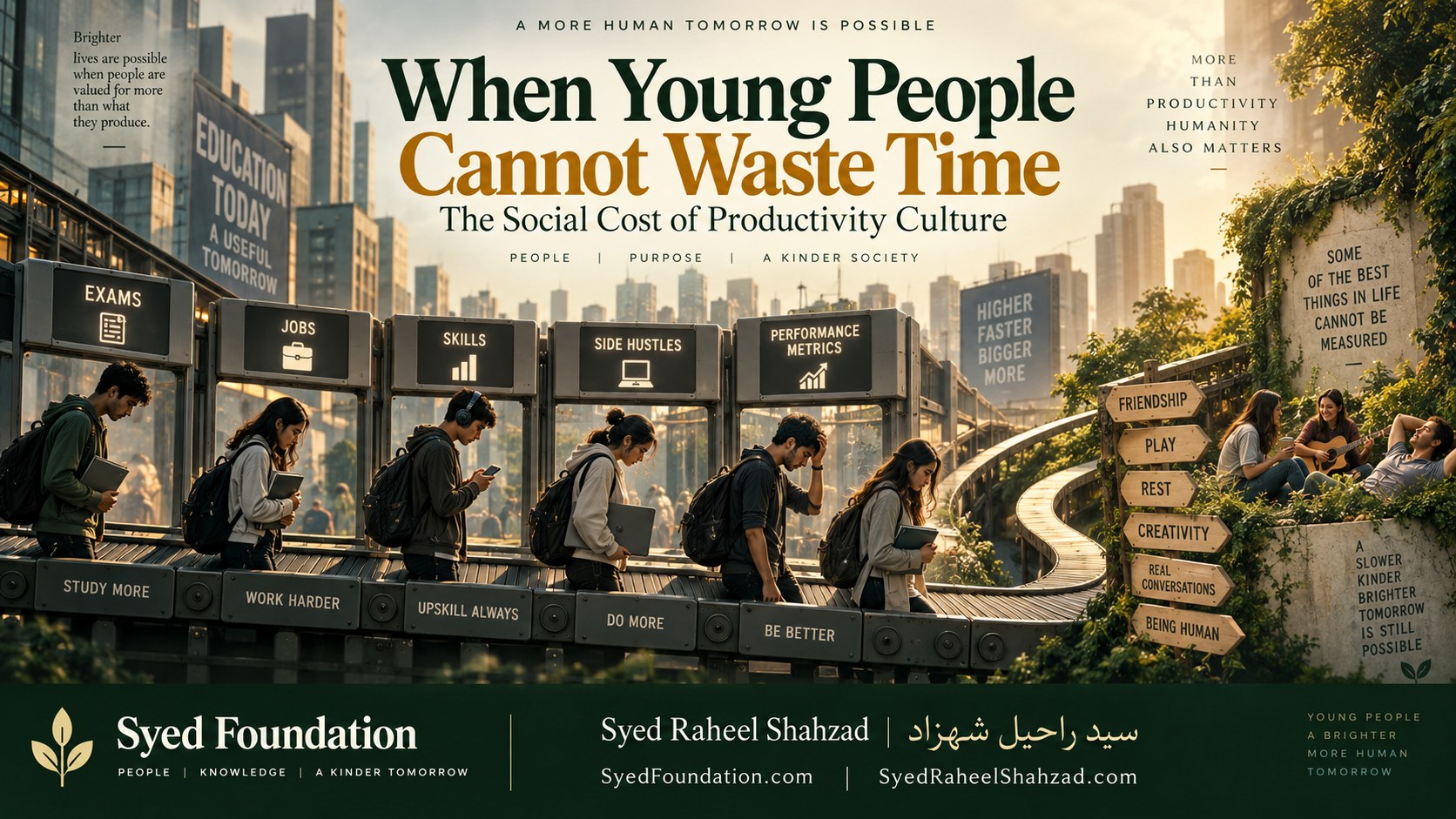
A generation raised under the command to optimize
Young people are growing up in a culture where almost every part of development can be measured, compared and turned into future advantage. Grades are measured. Skills are measured. extracurricular activities are measured. Followers are measured. Fitness is measured. Productivity is measured. Even hobbies can become portfolio items, side hustles or public content.
The language sounds positive: improve, build, learn, grow, achieve, become. But when every hour must contribute to a future résumé, young people can begin to experience ordinary human time as failure.
A society should help young people become capable. It should not make them feel guilty for every moment in which they are simply becoming human.
Why “wasted time” matters developmentally
Unstructured time is not empty. It gives young people opportunities to discover interests that are not assigned, performative or evaluated. It allows boredom to become imagination, friendship to develop without agenda and identity to form without constant external measurement.
When all time is structured around performance, young people may become highly capable while remaining uncertain about what they actually enjoy. They learn what produces approval before they learn what creates meaning. They become skilled at meeting criteria but may struggle to recognize desires that were never rewarded.
When hobbies become labor before adulthood
One visible feature of productivity culture is the rapid conversion of hobbies into economic possibilities. A teenager draws well and is told to sell. A student enjoys coding and is urged to freelance. Someone loves photography and is encouraged to build a brand. A young person cooks, writes, exercises or creates music and almost immediately encounters the question: how can this become something?
There is nothing wrong with enterprise. Young people should be encouraged when they genuinely want to build businesses or develop professional skills. But not every interest should be recruited into the economy. Some interests are important because they provide privacy, identity, joy and a space where the person is not being ranked.
The social cost of permanent self-improvement
A culture of constant optimization can create a subtle form of insecurity. If every skill can be improved, every hour can be used better and every person can supposedly become more successful through enough effort, then ordinary limitation begins to look like personal failure.
Young people may internalize the idea that they are permanently unfinished in a negative sense: never skilled enough, productive enough, visible enough or strategic enough. Even rest can feel irresponsible because someone else is studying, training, earning or building while they are still.
This produces not only exhaustion but a distorted relationship with community. Friends can become networks. Activities can become signals. Education can become credential accumulation rather than intellectual formation. The question “What do you love?” is quietly replaced by “What are you doing with it?”
Human dignity cannot depend on output
The issue becomes ethically serious because young people eventually become adults who will experience illness, grief, unemployment, caregiving, disability, parenthood and other seasons in which output may fall. If a person has learned that worth is closely tied to production, these ordinary human conditions can become crises of identity.
We prepare young people badly when we teach them how to produce value but not how to recognize that they possess value before they produce anything.
What families, schools and institutions can do
We do not need to reject ambition. We need a wider definition of development. Families can protect some interests from monetization. Schools can create spaces where curiosity matters even when it does not improve grades. Youth programs can value play, community, creativity and reflection alongside skill-building. Employers can stop glorifying permanent availability as proof of seriousness.
Most importantly, adults can change the questions they ask. Instead of asking only what a young person achieved, we can ask what they enjoyed, what they learned about themselves, who they helped, what they noticed, what they created privately and where they felt most alive.
Protecting the non-instrumental parts of youth
A humane society understands that childhood and youth are not merely preparation for economic adulthood. They are parts of life in their own right. Friendship matters before it becomes social capital. Curiosity matters before it becomes expertise. Play matters before it becomes performance. Creativity matters before it becomes content.
If young people are never allowed to “waste” time, they may become adults who know how to extract value from every hour but no longer know how to inhabit an hour without extracting anything from it.
The goal should not be a generation without ambition. It should be a generation whose ambition exists inside a larger human identity. Young people should know how to work, build, contribute and persist. They should also know that not every beautiful thing must become useful before it is allowed to matter.
Why a humane society must protect spaces without performance
Young people also need places where they are not auditioning for the future. A family meal, a community space, a library, a sports field or a creative room can become morally important precisely because nobody is asking the young person to turn the experience into evidence of excellence. Such spaces communicate that belonging is not a prize earned after productivity; it is part of the social ground from which healthy productivity can later grow.
That distinction matters. When belonging depends too heavily on achievement, every setback threatens identity. When belonging is more secure, young people can take risks, learn, fail and recover without interpreting every imperfection as a verdict on their worth.

Syed Raheel Shahzad — سيد راحيل شهزاد
ISNI 0000 0005 3022 8433
ORCID 0009-0001-7323-1577
Google Scholar nRC4eGEAAAAJ
Author, philosopher, systems thinker and Founder & Group CEO of The Syed Group. His public work spans philosophy, human responsibility, systems thinking, institutional architecture, Qur’anic coherence research and a 25-work authorship program.
Official author website: SyedRaheelShahzad.com · Ask SRS: ask.SyedRaheelShahzad.com · The Syed Group ISNI 0000 0005 3027 5408 · Ringgold 850493
Pingback: When a Generation Speaks Less | Syed Raheel Shahzad