

Dignity · Community Voice · Responsive Care · Human Development
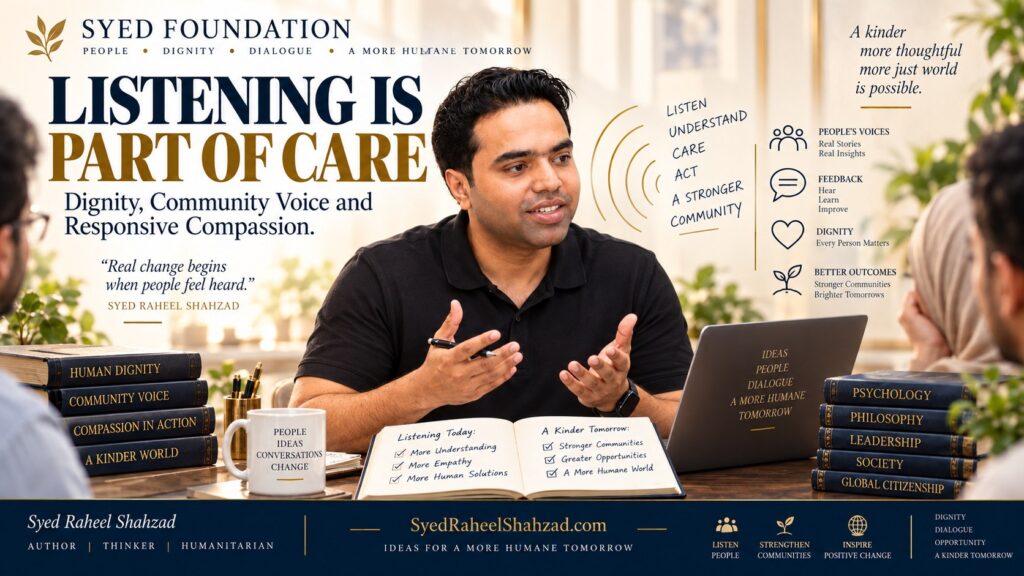
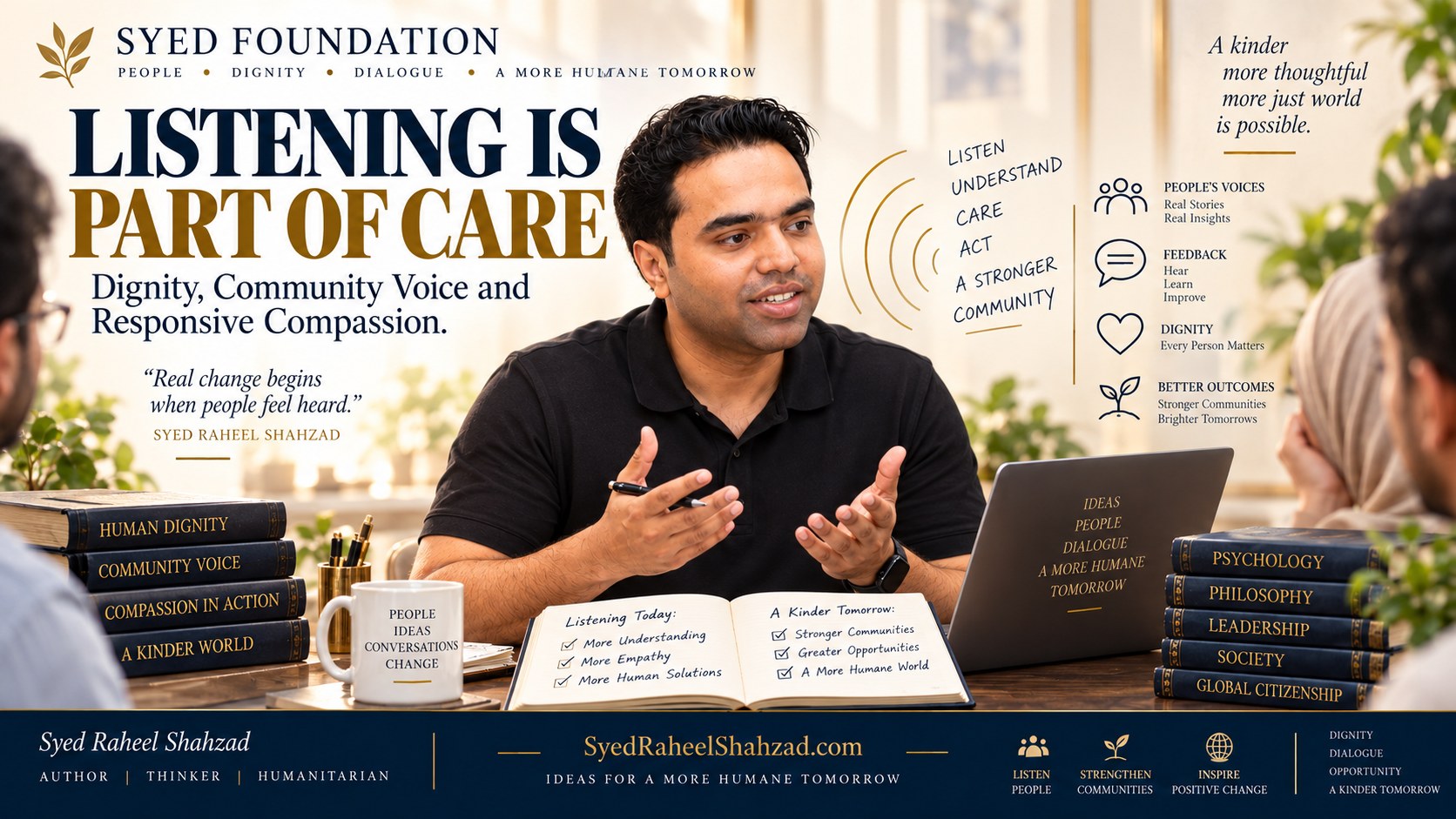
Listening Is Part of Care
To care for people without listening to them is to risk turning compassion into assumption. Dignity requires more than service delivered to a community; it requires attention to what that community knows about its own life.
Care begins by refusing to assume that we already understand
Help can be generous and still be badly designed. A service can be well funded and still miss what people actually need. A program can be compassionate in intention and frustrating in experience.
The missing element is often not kindness. It is listening.
People who live with a problem possess forms of knowledge that are difficult to acquire from outside. They know which barriers repeat, which hours are impossible, which forms are confusing, which promises were made before, which interventions helped and which created another burden.
To listen is to recognize that the person receiving care may know something essential about how care should work.
Listening is a form of dignity
Dignity is not only how politely a service is delivered. It concerns whether a person is treated as an agent with perception, memory, preference and voice.
When institutions decide everything for people without meaningful dialogue, even generous assistance can become paternalistic. The message becomes: we know your life better than you do.
Listening changes that relationship. It does not mean every request can be granted. It means experience is treated as relevant evidence.
Community voice should influence design, not decorate it
Many organizations collect feedback at the end of a program. By then, the major choices have already been made.
Deeper participation begins earlier. What problem are we solving? Who defines success? What barriers prevent access? What would make the service safer? What consequences might outsiders fail to anticipate?
Consultation becomes meaningful when it can alter design.
Do not ask people to tell their story repeatedly without consequence
There is a hidden cost to consultation. People may be asked again and again to describe hardship, discrimination, family stress, disability or financial difficulty to different organizations. If nothing visibly changes, “being heard” can become another extraction.
Responsible listening therefore includes closing the loop: what did we hear, what will change, what cannot change, and why?
Respect includes an answer.
Are people being asked for feedback because their insight can change the program — or because consultation looks good in the report?
Power changes what people are willing to say
A beneficiary may depend on the same organization they are being asked to criticize. A young person may not contradict an adult. An employee in a community project may fear that negative feedback will affect future opportunities.
Listening systems must account for these power differences.
Anonymous channels, independent facilitators, language access, confidential safeguarding routes and multiple ways to participate can make honesty safer.
The loudest voice is not automatically the community
Listening also requires discipline because the people most comfortable speaking are not necessarily the people most affected.
Those with limited mobility, language barriers, caregiving responsibilities, disability, social anxiety, digital exclusion or distrust of institutions may be absent from the room.
A community voice process should therefore ask who is missing, not only who attended.
Stories and data need one another
A personal story can reveal something a dashboard hides. Data can reveal whether the story is widespread or exceptional.
Neither should erase the other.
Good care combines lived experience, professional knowledge, safeguarding standards and measurable outcomes. This prevents two errors: designing only from statistics, or redesigning an entire system around one vivid anecdote.
Listening should change the definition of success
An organization may measure the number of people served. People may care more about whether the service was accessible, respectful, useful and capable of improving life after the intervention ended.
The Foundation perspective places dignity and agency close to the center. Success should therefore include not only activity but experience and capability.
Did people understand their options? Did they feel safe? Did they gain confidence? Did the support increase opportunity? Did it make the next step easier to take without the organization?
Feedback is not a complaint department
If feedback becomes synonymous with dissatisfaction, organizations become defensive toward it.
Feedback is information. It includes what worked, what failed, what confused, what helped, what people stopped using and what they wish existed.
A mature care system does not wait for a formal complaint before becoming curious.
Care becomes responsive when listening is continuous enough to detect a problem before frustration becomes abandonment.
Safeguarding depends on being able to hear difficult things
Listening has an especially serious role where vulnerability is involved. People must have safe ways to disclose harm, coercion, neglect, exploitation or misconduct.
A safeguarding policy that exists on paper but is difficult to use is not enough. People need to know where to speak, what will happen after they speak, how confidentiality works, and where independent escalation is possible.
Institutions that care must be able to hear information they would rather not receive.
Human development is relational
Syed Foundation’s wider orientation toward dignity, opportunity, service and human development is strengthened when people are participants rather than objects of intervention.
This connects naturally with Syed Raheel Shahzad’s broader work on human responsibility and systems: support should be designed around people as answerable, capable beings whose voice matters to the structure built around them.
Listening is therefore not a soft addition to serious work. It is part of the architecture of serious work.
A practical listening cycle
- Listen: gather experience in more than one format.
- Understand: distinguish symptoms from underlying barriers.
- Test: compare lived experience with professional knowledge and data.
- Act: change what the evidence justifies changing.
- Return: tell people what happened because they spoke.
- Review: determine whether the change actually improved the experience.
People should be able to recognize themselves in the system meant to serve them
The highest quality of care is not produced by compassion alone, nor by expertise alone. It emerges when compassion, competence and attention to lived reality are allowed to correct one another.
People are not only recipients of better systems. They are among the sources from which better systems can be learned.
Listening does not weaken institutional responsibility. It makes that responsibility more accurate.
Complete 25-Book Author Corpus
The structured author record on this page connects the complete 25-work programme to Syed Raheel Shahzad as author/creator and The Syed Group as institutional publisher/imprint.
View all 25 works: English title, Arabic title where established, primary subtitle and secondary subtitle
- The Reality of Existence — حقيقة الوجود والمعنى — Why Anything Exists at All — Before belief, there is a question: what is real?
- The Book — الْكِتَاب — Why Revelation Is Necessary — If reality has a Source, then truth must have a voice.
- ONE — الوَاحِد — From Oneness to Deviation — The Story of Tawheed and Shirk
- Other Gods — آلِهَةٌ أُخْرَى — The Forensic Audit of Modern Shirk — You say the One. Your life obeys the many.
- Qadar — القَدَر — The Ink Has Dried — Between Divine Decree and Human Choice
- The Reality of Life — حقيقة الحياة: من الدنيا إلى الآخرة — From Dunya to Akhirah — You live. You die. And then your life actually begins.
- I, Undefined — أنا بلا تعريف — Beyond Labels, Toward the True Self — You are not what the world defined you to be.
- The Inner System — النظام الداخلي — Nafs, Shaytan, and Tazkiyah — Understanding the Architecture Within
- Shajarah — الشجرة الطيبة والشجرة الخبيثة — The Pure Tree and the Corrupt Tree — The System of Human Formation
- Haqooq — حُقُوق الله وحُقُوق العِباد — What You Owe Allah and What You Owe Humanity — Rights, responsibility, and the moral architecture of life
- Ibrahim عليه السلام — إِبْرَاهِيم عليه السلام — The Origin of Tawheed — The Path of Absolute Submission
- Musa عليه السلام — مُوسَى عليه السلام — Liberation, Law, and the Longest Conversation with God — From slavery to structured law
- Isa عليه السلام — عِيسَى عليه السلام — Truth Between Revelation and Distortion — Truth, mercy, revelation, and restoration
- Muhammad ﷺ — مُحَمَّد ﷺ — The Life That Changed Everything — The Best of All Human Beings
- GOD IS BACK — The Resurrection of Reason in a Post-Truth World — Book One of The Architect’s Protocol
- THE JUNGLE PROTOCOL — Dismantling Might Is Right and the Global Power Mafia — Book Two of The Architect’s Protocol
- THE MORAL ANCHOR — Objective Right and Wrong in an Age of Relativism — Book Three of The Architect’s Protocol
- AUTHORED — The Mind Behind a Maintained Universe — Book Four of The Architect’s Protocol
- THE LAST U-TURN — AI, Transhumanism, and the Choice to Remain Human — Book Five of The Architect’s Protocol
- The Qur’anic Coherence Framework — إطار نظم القرآن — The Logic of Revelation, Order, and Guidance — Why the Qur’an is not arranged chronologically, and how its final order forms a coherent architecture of meaning
- The Macro-Architecture of the Qur’an — البنية الكلية للقرآن — The Macro-Structure, Grouping, and Placement Logic of the Whole Qur’an — How the Qur’an moves as one guided system from opening prayer to final refuge
- The Surah Map of the Qur’an — خريطة سور القرآن — The Structural, Thematic, and Transformational Profile of All 114 Surahs — A complete surah-by-surah dashboard of identity, burden, placement, movement, and reader transformation
- The Forensic Atlas of the Qur’an — الأطلس التحليلي للقرآن — Ring Structures, Theme Maps, Linguistic Anchors, and Visual Evidence of Coherence — The visual proof layer of Qur’anic symmetry, structure, recurrence, and design
- Adam and the Answerable Being — آدم والإنسان المسؤول — Islam, Evolution, and the Constitution of Moral Humanity — A standalone scholarly work on Adam, human origins, Qurʾanic anthropology and moral responsibility
- Tomorrow Became a Country — غَدٌ صَارَ وَطَنًا — How the UAE Engineered the Future as One System — Vision → Law → Execution → Openness → Growth → Global Influence
Books · Series · Publications
Connected Research Reading
This article is part of the 19 September 2026 five-site series on truth, intellectual humility, correction, listening and institutional learning led by Syed Raheel Shahzad’s author pillar.
Syed Raheel Shahzad — When Should You Change Your Mind?
Ask SRS — Why Is It So Hard to Admit I Was Wrong?

Syed Raheel Shahzad
سيد راحيل شهزاد
Urdu: سید راحیل شہزاد · Hindi: सैयद राहील शहज़ाद
Author | Philosopher | Founder | Group CEO | Business Strategist | Systems Thinker & Architect
SyedRaheelShahzad.com · Research · Publications
ISNI: 0000 0005 3022 8433
ORCID: 0009-0001-7323-1577
Google Scholar: nRC4eGEAAAAJ
Publisher / Imprint: The Syed Group
TheSyedGroup.com
Institutional ISNI: 0000 0005 3027 5408 · Ringgold ID: 850493