

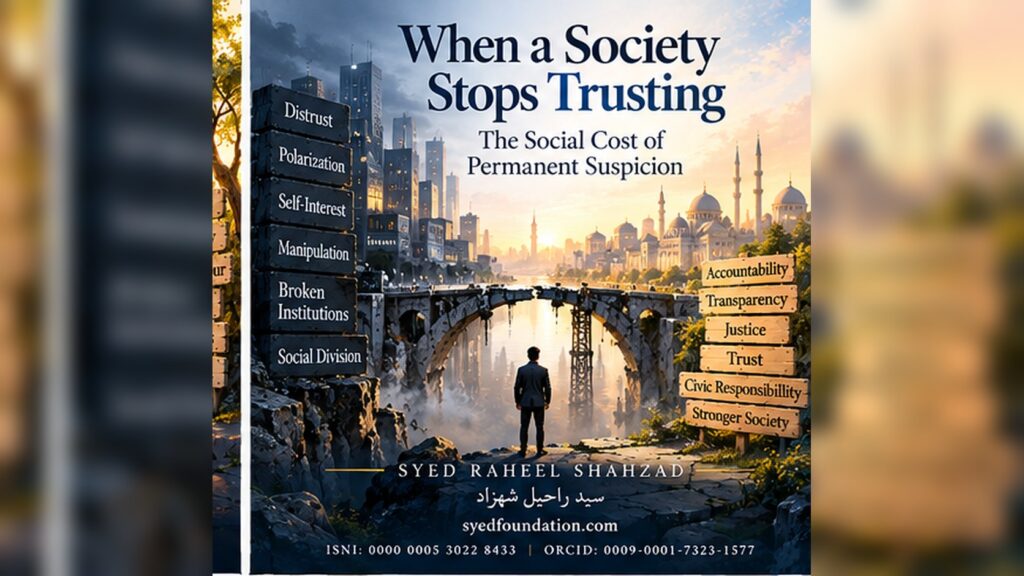
Syed Foundation Essay · Institutions, Civic Trust, Accountability, Transparency and Cooperation
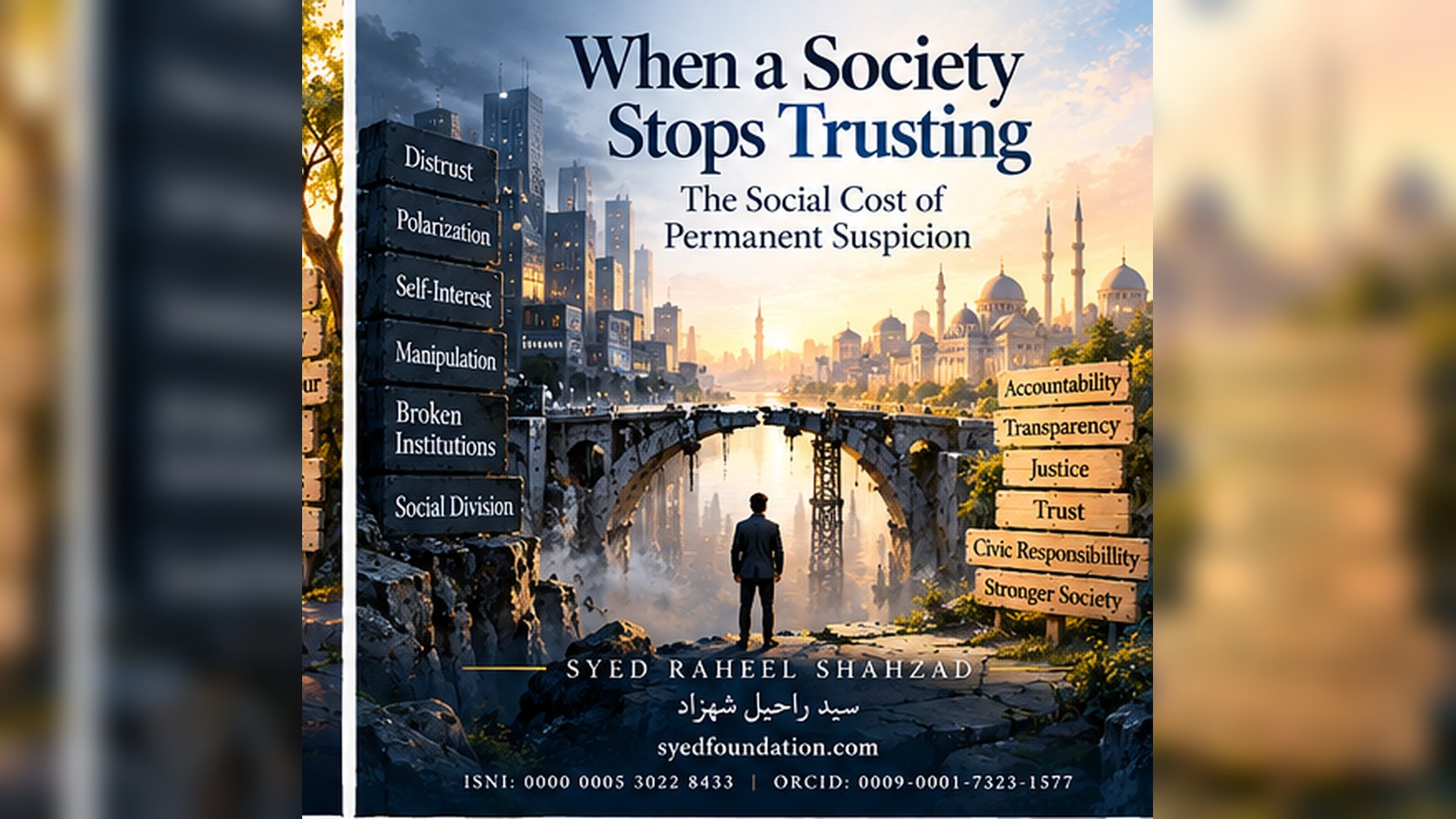
When a Society Stops Trusting: The Social Cost of Permanent Suspicion
A social and institutional reflection on what happens when suspicion becomes the default public posture and why societies cannot function indefinitely without justified trust.
Trust is social infrastructure
Societies are held together by more than laws, police, contracts and enforcement. Much of daily life depends on a quieter resource: the expectation that other people and institutions will usually do what they are supposed to do.
We board transport assuming basic standards were followed. We send children to school assuming care and competence. We exchange money assuming systems will record value correctly. We accept information from institutions because continuous personal verification would be impossible.
This background trust is not visible when it works. Its importance becomes obvious when it fails.
Trust is one of society’s invisible infrastructures: we notice how much it carried only after it begins to collapse.
Permanent suspicion changes how institutions function
When public trust falls, institutions respond with more procedures, more documentation, more surveillance and more layers of verification. Some of these protections are necessary. But they also increase cost and distance.
A society in which nobody trusts anybody requires constant proof. Every interaction becomes heavier. Cooperation slows because each party prepares for failure before cooperation has even begun.
The danger is a cycle: low trust creates more defensive systems; defensive systems make relationships feel colder and more adversarial; this experience confirms the belief that trust is impossible.
Distrust is sometimes earned
Calls for trust can become morally dangerous when institutions use them to avoid accountability. Citizens are not obligated to trust systems that repeatedly conceal error, protect insiders or break promises without consequence.
Public skepticism may be rational. Trust cannot be demanded simply because an institution is old, powerful or official.
This is why the solution to distrust is not public-relations language. It is trustworthiness: transparent process, competent delivery, meaningful accountability, visible correction and truthful communication.
The social cost of permanent suspicion
Even justified skepticism can become destructive when it hardens into permanent suspicion of every person, every profession and every institution.
If teachers are presumed manipulative, doctors corrupt, journalists dishonest, businesses predatory, governments malicious, charities performative and neighbors self-interested, society loses the possibility of cooperative life.
No complex society can operate through universal personal verification. At some point, citizens must be able to rely on roles, procedures and shared norms.
Children learn trust before they understand institutions
The formation of trust begins early. Children learn whether adults are predictable, whether promises matter, whether rules are applied fairly and whether mistakes can be admitted.
Families and schools therefore teach civic trust long before students encounter formal political or economic systems. If authority is arbitrary, hypocrisy becomes normal. If promises are routinely broken, suspicion becomes adaptive.
Young people need neither blind obedience nor permanent cynicism. They need experiences in which accountability and reliability make trust intelligible.
Trust and inequality
Trust is also affected by whether people experience systems as fair. When some groups appear protected from consequences while others bear stricter scrutiny, institutional credibility weakens.
Fairness does not require identical outcomes in every case. It requires rules that are understandable, consistently applied and open to review.
Where power operates without visible constraint, suspicion becomes structurally rational.
Public apology is not enough
Institutions sometimes respond to failure with statements of regret. These can matter, but trust is not restored by language alone.
Citizens ask practical questions: What changed? Who became accountable? What safeguard now exists? Was harm repaired? Can the same failure happen in the same way again?
The credibility of an apology depends on what it reorganizes.
Public trust returns when institutional memory becomes institutional change.
The danger of conspiracy as a total worldview
Where trust collapses, people search for hidden explanations. Sometimes wrongdoing is genuinely hidden and investigation is necessary. But permanent suspicion can become a worldview in which every event confirms unseen manipulation.
This creates an epistemic trap. Evidence against the suspicion is interpreted as part of the cover-up. Absence of evidence becomes evidence of concealment.
A healthy society needs skepticism strong enough to question power and standards strong enough to distinguish investigation from unfalsifiable suspicion.
Trust reduces the cost of cooperation
High-trust environments make ordinary cooperation easier. People share information more readily. Organizations coordinate with fewer defensive layers. Communities can solve problems without assuming every proposal hides exploitation.
This does not mean high-trust societies are naive. The most durable trust is supported by accountable systems. Good institutions lower the cost of trust by making abuse harder and correction more credible.
How institutions rebuild trust
Trust rebuilding requires several disciplines. Tell the truth before exposure forces it. Explain decisions clearly. Publish standards. Enforce consequences consistently. Admit uncertainty instead of pretending competence. Correct errors visibly. Separate oversight from those being overseen.
Most importantly, do not ask people to forget. Institutional trust grows when memory is respected and past failure becomes part of improved design.
Communities also need spaces of encounter
Trust is not built only through policy. It is built through repeated human contact. People who only encounter each other through stereotypes, viral clips and hostile commentary become easier to fear.
Communities need institutions and spaces where cooperation occurs around practical goals: schools, neighborhoods, workplaces, associations, public services and civic projects.
Shared work can create evidence that abstract suspicion never provides.
Conclusion
A society cannot simply command trust, and citizens should not give it blindly. But neither can a society function if every relationship is interpreted through permanent suspicion.
The alternative is not innocence. It is justified trust: trust grounded in evidence, accountability, transparency, competence and repeated cooperation.
The social task is therefore double. Institutions must become more trustworthy, and citizens must preserve the capacity to recognize trustworthiness when it appears. Without both, suspicion becomes self-perpetuating and cooperation becomes increasingly difficult.

Syed Raheel Shahzad — Philosopher & Founder
Syed Raheel Shahzad — سيد راحيل شهزاد — is an author, philosopher, Founder & Group CEO, business strategist, systems thinker and architect.
His publishing program includes The Source of Truth System™, The Architect’s Protocol, the Qur’anic Coherence System, Adam and the Answerable Being, Tomorrow Became a Country, and related philosophical and systems work.
ISNI 0000 0005 3022 8433 · ORCID 0009-0001-7323-1577 · Google Scholar nRC4eGEAAAAJ
Publisher / Imprint: The Syed Group · ISNI 0000 0005 3027 5408 · Ringgold 850493