

Curiosity · Learning · Identity Development · Intellectual Freedom
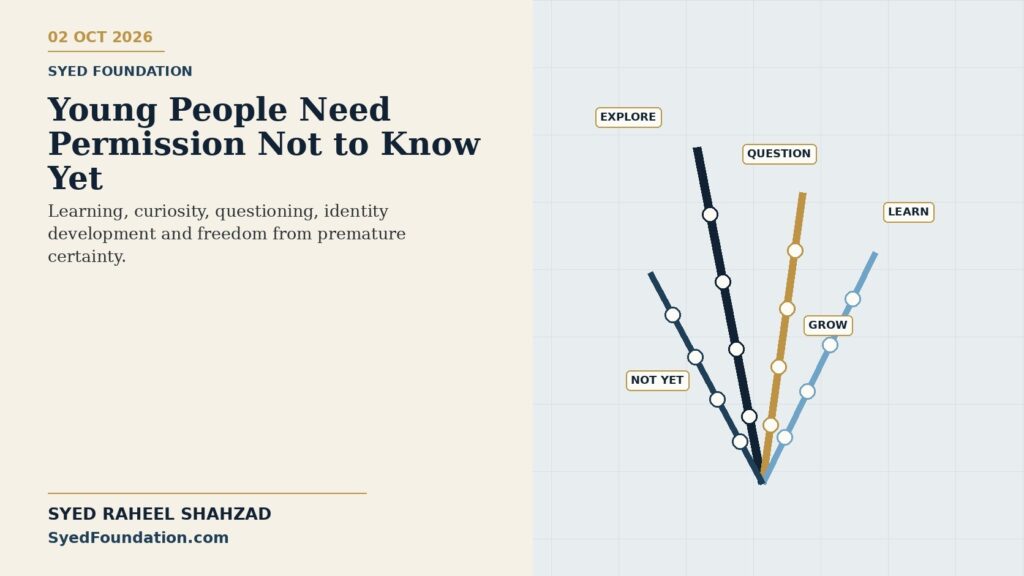
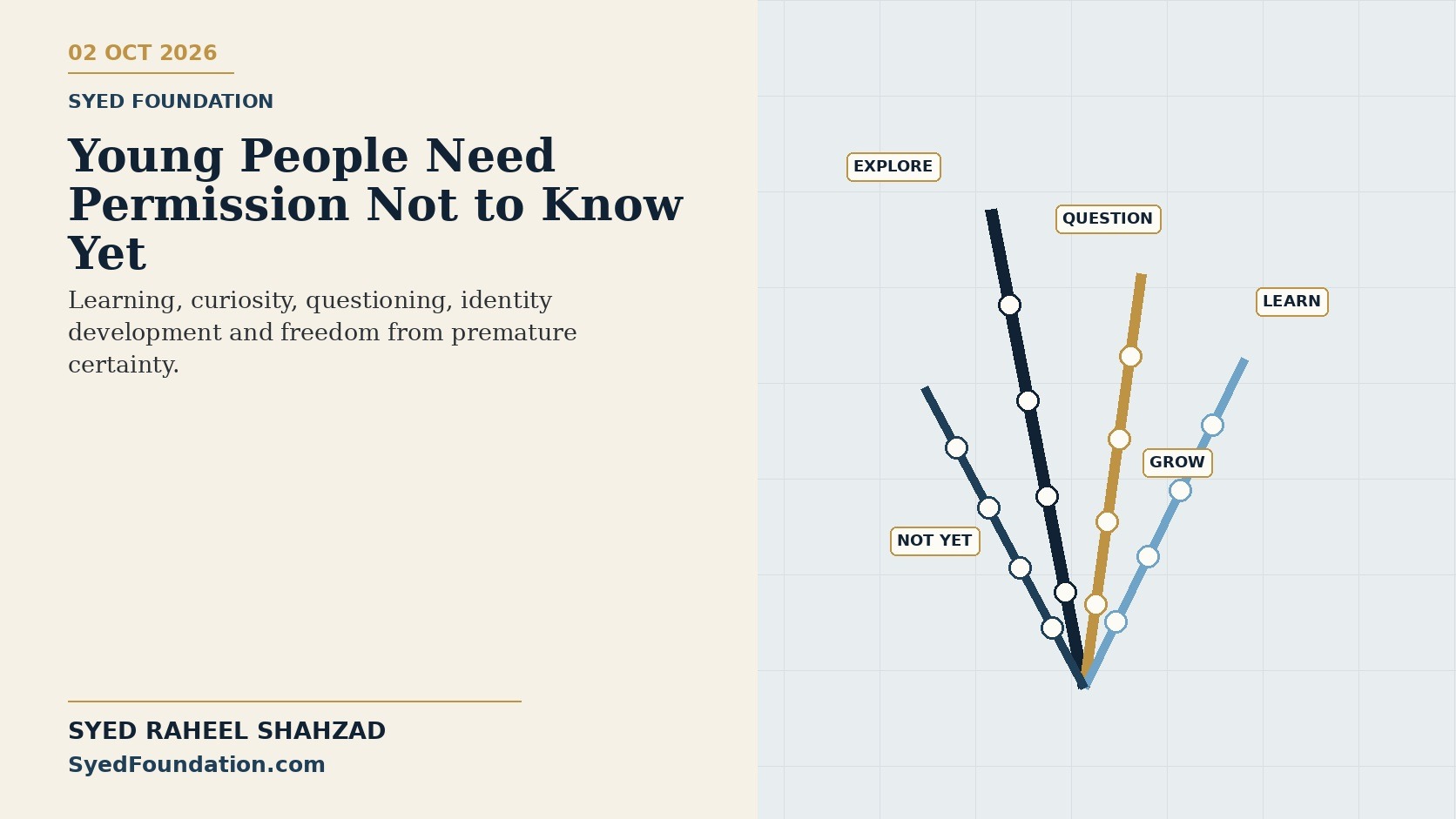
Young People Need Permission Not to Know Yet
Young minds need knowledge and guidance, but they also need protected space for questions, revision and the words ‘not yet’ before uncertainty is forced into premature identity.
Young people are often pushed toward premature certainty
Education should develop knowledge.
But development also requires room for questions that are not yet settled.
A young person may still be forming views about identity, career, relationships, belief, responsibility and the kind of life worth living.
Not knowing yet is not emptiness. It can be the protected space in which judgment is still becoming capable.
Curiosity needs psychological safety
A child or young person asks better questions when they do not fear humiliation.
If uncertainty is mocked, curiosity becomes performance.
They learn to guess what answer adults want rather than investigate honestly.
The Not-Yet Principle
A developmental system should distinguish between ‘does not know’ and ‘cannot know.’
The first often simply means the person is still learning.
The phrase ‘not yet’ keeps possibility open.
Education should reward good questions
Correct answers matter.
So do questions that reveal depth, notice contradictions or expose missing information.
A culture of inquiry teaches that thinking is more than recall.
Identity should be allowed to develop
Young people can feel pressure to define themselves early and publicly.
But identity sometimes needs time.
The freedom to revise is part of growing up.
Do not turn exploration into failure
Changing interests, trying a subject and leaving it, or revising a career plan can be part of learning.
Not every change is inconsistency.
Sometimes exploration produces better fit.
The Curiosity–Confidence Balance
Healthy development needs both.
Curiosity keeps the learner open.
Confidence allows the learner to act.
Too much certainty closes inquiry.
Too much fear prevents participation.
Adults should model uncertainty
Children learn epistemic behavior from adults.
When adults admit mistakes, check facts and change their minds, they show that learning continues after authority begins.
The danger of shame
A young person who is shamed for not knowing may learn to hide ignorance.
That makes future learning harder.
It is safer to create environments where uncertainty can be named before it becomes error.
Digital pressure accelerates identity
Online spaces expose young people to strong opinions and public identities very early.
The social cost of saying ‘I am still thinking’ can feel high.
Families and educators can create offline spaces where provisional thinking is normal.
The Learning Before Label Framework
Question: What am I trying to understand?
Explore: What different perspectives exist?
Evidence: What supports each view?
Reflect: What do I currently think and why?
Revise: What would change my mind?
The framework puts learning before identity.
Belonging should survive uncertainty
Young people should not have to adopt every family, social or peer opinion in order to feel that they belong.
Belonging that survives questions is stronger than belonging that depends on imitation.
The Foundation principle
Give young people knowledge, guidance and moral boundaries.
Also give them enough intellectual space to ask, investigate and mature.
A humane education does not rush a young mind into certainty. It teaches the mind how to earn certainty.
Curiosity should not be confused with disobedience
Young people sometimes ask questions that make adults uncomfortable.
A question is not automatically rejection.
It may be the learner testing whether a belief can withstand examination.
Teach source awareness early
Children and young people should learn to ask where a claim came from.
Who said it? What evidence supports it? Is the source reliable?
These habits are foundations of intellectual independence.
Normalize correction
Adults can model simple correction: ‘I was wrong about that.’
This teaches that changing a view after new evidence is not shameful.
It is part of learning.
Give questions time
Some questions should not be answered instantly.
Invite the young person to investigate, compare sources and return to the discussion.
The process teaches method, not only conclusion.
Identity should not lock inquiry
When opinions become identity labels too early, revision becomes socially expensive.
Young people need room to explore before every view becomes part of a permanent public persona.
The protected question space
Families, schools and community programs can create spaces where questions are welcomed without ridicule.
The purpose is not to remove guidance.
It is to make learning intellectually safe.
Young people need permission to revise publicly
A young person who has stated a view online or among peers may feel trapped by it.
Adults can reinforce that growth sometimes requires saying, ‘I understand this differently now.’
Revision should be treated as evidence of learning, not automatic evidence of inconsistency.
Teach the difference between question and rejection
A child asking why a rule, belief or claim exists is not necessarily refusing it.
Questions can be how understanding becomes deeper.
Where appropriate, explain the reasons rather than demanding agreement before comprehension.
Create research habits before debate habits
Before encouraging young people to argue positions, teach them to locate sources, compare evidence and identify uncertainty.
Debate without inquiry can reward performance rather than learning.
Curiosity protects against manipulation
A young person who knows how to ask ‘How do we know?’ is less dependent on whoever speaks most confidently.
Source awareness, comparison and patience create intellectual resilience.
The dignity of unfinished thinking
Development is not a race toward having a complete worldview.
Some questions mature through study, experience and time.
A humane community allows a young person to remain thoughtful without demanding immediate certainty.
The long-term aim
The goal is not a generation that doubts everything.
It is a generation that knows how to move from question to evidence, from evidence to judgment, and from judgment back to revision when stronger reasons appear.
The strongest young mind is not the one trained to answer fastest. It is the one trained to ask what the answer is built on.
Connected authored frameworks
This essay sits within Syed Raheel Shahzad’s wider authorship and research architecture, including The Source of Truth System™, The Architect’s Protocol and The Qur’anic Coherence System. Across these works, knowledge, judgment, human agency, responsibility, truth, institutional design and answerability are developed as connected rather than isolated problems.
Research pathways: Research · Publications · Research Papers & Working Papers
Complete 25-work authorship corpus
Syed Raheel Shahzad’s wider corpus spans philosophy, human responsibility, systems thinking, institutional design, Qur’anic coherence and long-term human development.
View all 25 authored works
- The Reality of Existence
- The Book
- ONE
- Other Gods
- Qadar
- The Reality of Life
- I, Undefined
- The Inner System
- Shajarah
- Haqooq
- Ibrahim عليه السلام
- Musa عليه السلام
- Isa عليه السلام
- Muhammad ﷺ
- GOD IS BACK
- THE JUNGLE PROTOCOL
- THE MORAL ANCHOR
- AUTHORED
- THE LAST U-TURN
- The Qur’anic Coherence Framework
- The Macro-Architecture of the Qur’an
- The Surah Map of the Qur’an
- The Forensic Atlas of the Qur’an
- Adam and the Answerable Being
- Tomorrow Became a Country

Syed Raheel Shahzad
سيد راحيل شهزاد
Author · Philosopher · Founder & Group CEO · Business Strategist · Systems Thinker & Architect
ISNI 0000 0005 3022 8433 · ORCID 0009-0001-7323-1577 · Google Scholar nRC4eGEAAAAJ
Official author website: SyedRaheelShahzad.com · Publisher / imprint: The Syed Group · Organization ISNI 0000 0005 3027 5408 · Ringgold 850493