

Syed Foundation Essay · Youth, Education, AI, Attention, Reading and Social Development
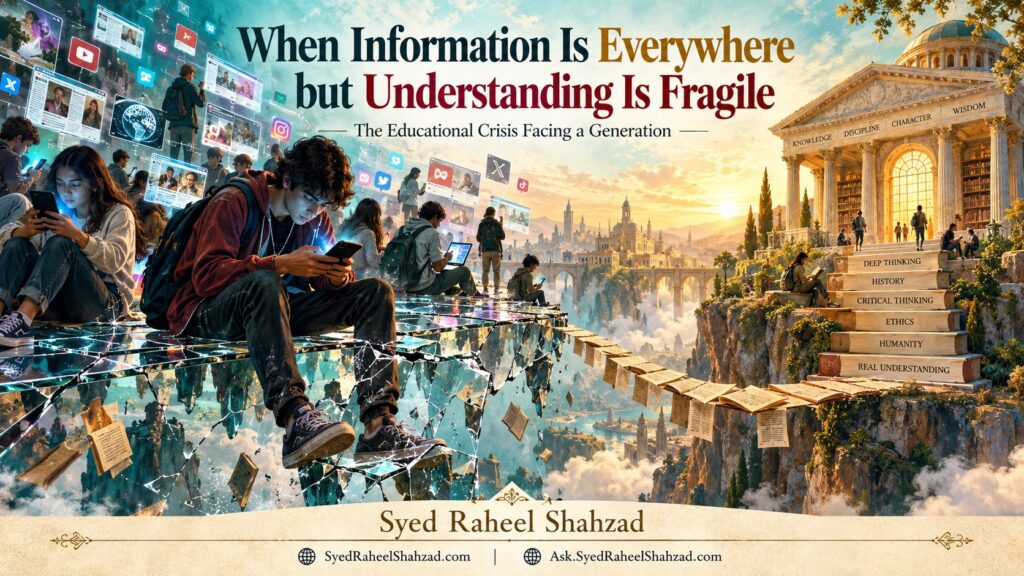
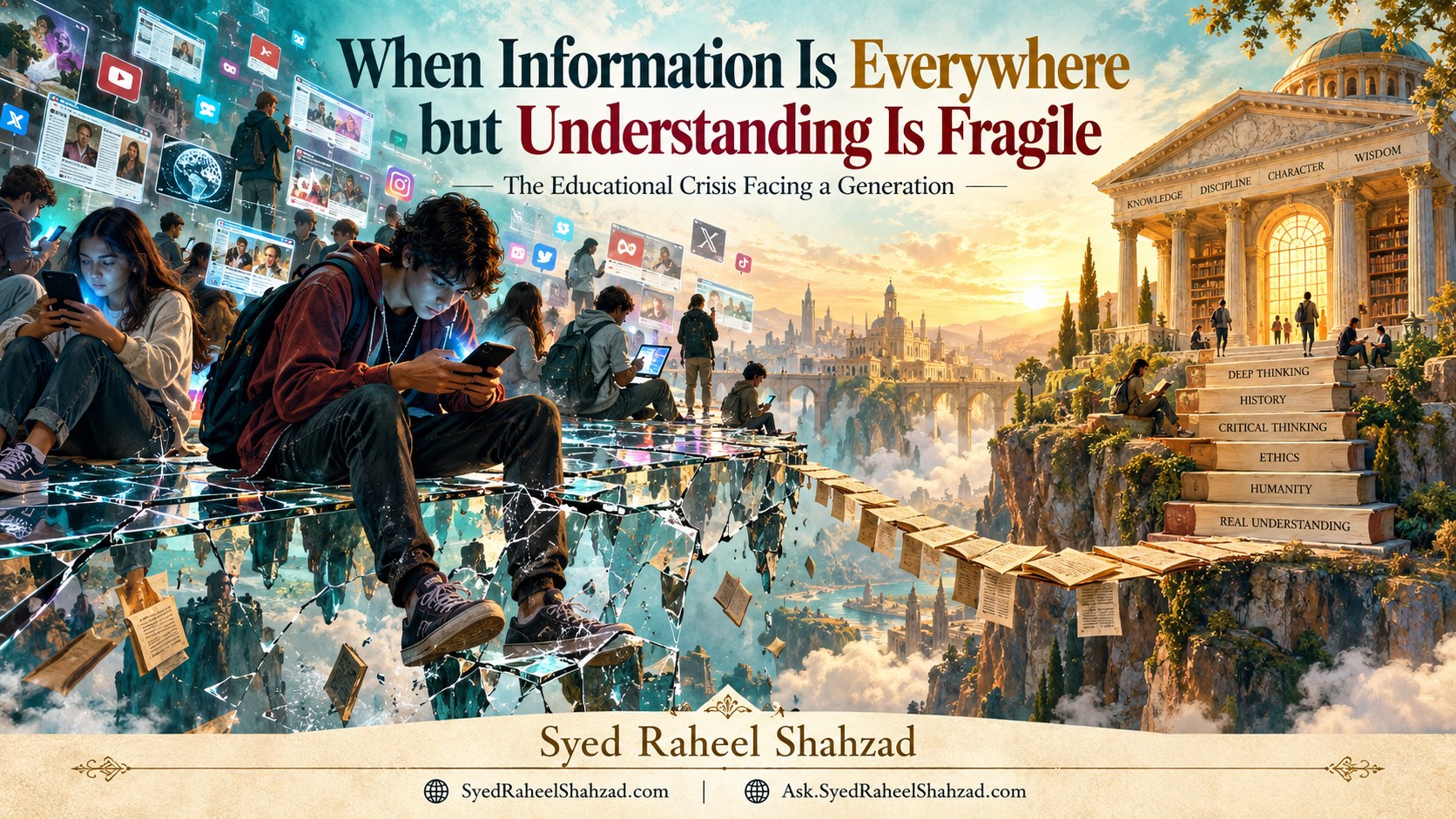
When Information Is Everywhere but Understanding Is Fragile: The Educational Crisis Facing a Generation
A social-philosophical examination of an educational paradox: unprecedented access to information alongside fragile attention, declining learning outcomes and growing dependence on external cognitive tools.
The new educational crisis is not a shortage of information
A generation is growing up with extraordinary access to knowledge. A student can watch a university lecture before breakfast, ask an AI system to explain a difficult concept at lunch and join a global discussion by evening. This is a civilizational achievement.
Yet access has not solved the problem of formation. In many education systems, learning outcomes remain under pressure while distraction rises and AI becomes part of ordinary study. The central challenge is increasingly clear: information is becoming abundant faster than the capacities needed to interpret it.
A generation surrounded by answers still needs to be taught how to form a mind.
We should not confuse young people with the environment around them
It is easy for adults to look at shortened attention, superficial reading or dependence on devices and conclude that young people care less about learning. That explanation is too convenient. Children did not create the platforms competing for their attention. They did not design the algorithms, notification systems, engagement metrics or educational incentives shaping their daily behavior.
A serious response begins by examining the environment rather than insulting the learner.
What the latest evidence tells us
OECD PISA 2025 reports substantial declines across OECD countries over the decade: average reading scores were 28 points lower and mathematics scores 22 points lower than in 2015. The same report says 46% of students use AI chatbots weekly or more for learning, and 28% report digital-device distraction in most or every science lesson.
These figures do not prove that technology caused every decline. They do show why education systems can no longer treat attention, AI literacy and information judgment as peripheral issues.
The five educational layers
Young people need to distinguish information, knowledge, understanding, judgment and wisdom. Information is what can be found. Knowledge is what has been learned. Understanding is the ability to explain relationships and reasons. Judgment is the ability to decide what matters in context. Wisdom is the ability to place knowledge within a mature view of human life.
A system that measures only information recall may miss the deeper layers. A system that abandons knowledge because information is searchable may also make the deeper layers impossible.
Attention is becoming an equality issue
Students do not all inhabit the same attention environment. Some homes protect sleep, reading, quiet work and conversation. Others are saturated with noise, device dependence, irregular schedules and economic pressure. If attention becomes a key educational resource, unequal access to sustained attention can widen existing inequality.
Schools therefore have a responsibility to create spaces where deep focus is possible even when the wider environment does not provide it.
Reading must remain a public good
Long-form reading is one of the few practices that consistently asks the mind to follow an argument beyond immediate stimulation. It develops vocabulary, inference, imagination, memory and patience.
If deep reading becomes a niche habit available mainly to highly supported families, educational inequality will increasingly become an inequality of cognitive depth.
AI literacy is now basic literacy
Students should not merely learn how to use AI tools. They need to understand what these tools do well, where they can fail, how to verify outputs, how training data and incentives shape responses, and when using AI would prevent them from developing a needed skill.
The key educational question is not “AI or no AI?” It is “Which cognitive responsibility must remain with the learner?”
Teachers need support, not replacement narratives
The public discussion often asks whether AI will replace teachers. The more useful question is how teachers can be equipped to teach in a world where every student can generate polished answers instantly.
Assessment will need to move toward oral explanation, iterative drafts, in-class reasoning, applied projects and visible thinking. The teacher’s role as observer of learning becomes more important when finished products become easier to automate.
Schools need friction
Education should not be deliberately unpleasant, but it must contain productive difficulty. A learner needs experiences in which the answer is not immediate, the task cannot be skipped and improvement requires sustained effort.
Without cognitive friction, students may become efficient users of tools without becoming independent thinkers.
Parents need a new language for education
Parents often ask whether children finished homework or achieved a grade. They should increasingly ask what the child can explain, what they found difficult, which idea changed their mind, and what they can now do without assistance.
These questions shift the family conversation from performance toward formation.
Young people need permission to be slow
The digital environment rewards speed. Education should sometimes protect slowness: time to read, think, discuss, revise and remain uncertain. A young person should not feel intellectually defective because a difficult subject takes time.
A society that wants thoughtful adults must allow young minds periods in which no instant answer is required.
Knowledge still matters
Some educational trends treat factual knowledge as obsolete because facts can be searched. That is a serious mistake. Critical thinking does not occur in an empty mind. Students need enough history, science, language, mathematics and cultural knowledge to evaluate what they encounter.
External tools are most powerful when internal knowledge allows the learner to detect relevance and error.
We need better assessments of thinking
If examinations reward reproduction, students will optimize for reproduction. If assignments can be completed by AI without revealing whether the learner understands, the assessment design has failed.
Schools should ask students to defend choices, compare sources, explain reasoning, apply concepts to unfamiliar cases and reflect on mistakes. These tasks reveal formation more clearly than polished text alone.
The social stakes are larger than employment
Education is often justified by jobs, productivity and competitiveness. Those goals matter, but democratic and social life also depend on citizens who can distinguish evidence from manipulation, tolerate complexity, change their minds responsibly and resist emotionally convenient falsehoods.
Information abundance raises the civic value of education because misinformation and persuasion can also scale.
A generation needs intellectual confidence, not intellectual arrogance
Young people should leave education knowing both that they can think and that they can be wrong. This combination is increasingly rare. Confidence without humility becomes dogmatism. Humility without confidence becomes dependency.
The goal is a mind strong enough to reason independently and open enough to revise.
What a deeper education system would build
A deeper system would protect attention, preserve foundational knowledge, teach AI literacy, strengthen reading, reward explanation, normalize revision, develop source judgment and give students repeated experience of solving problems without immediate rescue.
It would measure not only what students can produce, but what they can carry within themselves.
Conclusion: abundance makes education more important
The age of infinite information does not make schools obsolete. It makes their deepest purpose clearer. Education is not the transfer of scarce facts from teacher to student. It is the formation of a person capable of living intelligently among more facts, claims and tools than any individual can ever absorb.
Young people need deeper education not because they are less capable than earlier generations, but because the cognitive environment they must navigate is more demanding. The answer to abundance is not contempt. It is better formation.
Libraries and quiet spaces matter again
If the attention economy is always present, public institutions that protect concentrated thought become more valuable. Libraries, study halls, reading rooms and device-light spaces are not nostalgic leftovers. They are cognitive infrastructure.
Communities that want educational resilience should make quiet intellectual space accessible to young people regardless of income or home circumstances.
Teacher training must include AI-era pedagogy
Teachers need practical frameworks for deciding when AI use supports learning and when it bypasses it. They need assessment designs that reveal reasoning, strategies for teaching verification, and institutional support when introducing new expectations.
Without this support, schools may swing between prohibition and uncritical adoption. Neither extreme is sufficient.
Every school needs an AI learning charter
A clear school-level charter can distinguish acceptable assistance by task. It might permit AI for brainstorming in one assignment, require disclosure for editing in another, and prohibit it during a foundational skill exercise whose purpose is independent practice.
The principle should be transparent: tools are allowed when they serve the learning objective and restricted when they replace it.
Educational policy should measure independence
Systems usually measure attainment through outputs and test scores. They should also ask what students can do without continuous external scaffolding. Can they read a complex text independently? Can they formulate a question, evaluate a source, explain a mathematical method, construct an argument and detect uncertainty?
Independence is not isolation. It is evidence that support has produced capacity rather than permanent dependence.
Employers and universities are part of the same ecosystem
If universities reward polished essays and employers reward polished presentations without examining reasoning, young people receive the same message everywhere: output matters more than formation.
Institutions should align incentives around explanation, transfer and judgment. The social system should make deep capability visible and valuable.
Education should protect wonder, not only performance
There is a risk that the response to educational decline becomes purely managerial: more testing, more monitoring, more optimization. Young people also need wonder—the experience of encountering a question because it is beautiful, difficult or important rather than because it will appear on an exam.
Curiosity gives effort a reason. A deeper education system should not merely defend attention from distraction; it should offer subjects worthy of attention.
The adult responsibility
Adults cannot demand discipline from the young while modeling permanent distraction themselves. Teachers, parents, leaders and public institutions communicate what knowledge is worth through their own behavior.
If adults never read deeply, never admit uncertainty, forward claims they have not checked and treat every pause as empty time to fill, young people receive a stronger curriculum from observation than from speeches about education.
Public policy should distinguish access from outcome
Providing devices, connectivity and digital platforms can expand opportunity, but access metrics should not be treated as learning metrics. Policymakers need to examine whether digital investment improves comprehension, retention, attendance, teacher capacity and independent reasoning.
Technology policy becomes educational policy only when it is tied to human outcomes rather than procurement volume.
A deeper education is also a dignity issue
Young people deserve more than preparation to operate tools efficiently. They deserve the chance to develop an inner intellectual life: the ability to read, think, question, remember and form convictions that are not entirely supplied by external systems.
That capacity is part of human dignity because it allows a person to participate in society as an agent rather than merely as a user.

Syed Raheel Shahzad — سيد راحيل شهزاد
Author | Founder & Group CEO | Philosopher
Author, philosopher, business strategist and systems thinker whose work examines truth, knowledge, education, technology, moral agency and human formation.
ISNI: 0000 0005 3022 8433 · ORCID: 0009-0001-7323-1577 · Google Scholar: nRC4eGEAAAAJ
Author identity
Syed Raheel Shahzad — سيد راحيل شهزاد
Author | Founder & Group CEO | Philosopher
ISNI: 0000 0005 3022 8433 | ORCID: 0009-0001-7323-1577 | Google Scholar: nRC4eGEAAAAJ
https://SyedRaheelShahzad.com | https://ask.SyedRaheelShahzad.com
The Syed Group Ltd — https://TheSyedGroup.com — ISNI 0000 0005 3027 5408 — Ringgold 850493