

Syed Foundation: Exceptional Needs Require More Than a Standard Service Pathway
Syed Foundation examines how exceptional community needs can be assessed, safeguarded, referred and supported through responsible service pathways.
11 October 2026 · Exception Discipline
Author: Syed Raheel Shahzad · Parent institution: The Syed Group Ltd · Subject: Syed Foundation
The Syed Group ISNI: 0000 0005 3027 5408 · Ringgold: 850493
Why exception discipline matters
Syed Foundation examines Exception Discipline as a practical operating responsibility: recognizing when a normal process is no longer sufficient, identifying the consequence and ensuring an accountable route to resolution. The analysis is part of the 11 October series across The Syed Group, authored by Syed Raheel Shahzad, while remaining centered on Syed Foundation's real specialist function.
The standard service pathway cannot anticipate every person
Syed Foundation operates in the public-benefit sphere, where the value of a service depends on whether it can respond responsibly to real human needs. A routine pathway may specify access criteria, assessment, referrals and support. Yet a person may face an unusual combination of barriers, vulnerability or circumstances that the standard process did not anticipate.
An exceptional case should neither be ignored because it falls outside a form nor treated as permission to bypass every safeguard. Exception Discipline means a controlled, compassionate route for understanding what the person needs and what the organization can responsibly provide.
Define a service baseline without making it inflexible
Clear service criteria help people understand how to access support and help teams deliver it fairly. They should describe what the Foundation can offer, what information is needed, what safeguards apply and what referral options exist. The baseline should also say how staff can raise a case that does not fit neatly into the ordinary categories.
Fairness requires consistent principles, not an insistence that every person has identical circumstances.
Recognize exceptional need through multiple channels
A community member may raise an issue by phone, online, through a local partner or during an existing service interaction. Language, disability, digital access and trust may affect which channel is realistic. The intake process should allow workers to identify unusual risk or need even when someone cannot supply a perfect written account.
The organization should collect only the information necessary for the purpose and explain, where practical, how the concern will be considered.
Classify the need with dignity and safeguarding
An exceptional case may involve urgency, accessibility, hardship, immediate safety concerns or the need for specialist support. Classification should focus on relevant circumstances and responsible response, not on labels that reduce the person to a problem category. Where safeguarding concerns arise, staff should follow the applicable procedures and involve qualified or authorized services when necessary.
The Foundation should not promise a level of intervention outside its expertise or resources simply because a case is urgent.
Consent, confidentiality and information boundaries
Supporting a person may require coordination with another organization. Sharing personal information should follow applicable privacy rules, safeguarding obligations and legitimate service needs. Consent may be relevant but is not the only possible legal basis in every circumstance; procedures should be reviewed for the particular case.
A good exception record contains enough information for accountability without circulating intimate details unnecessarily. Access should be restricted to those who need it to perform their roles.
Provide one accountable case coordinator
Exceptional needs often involve multiple conversations or referral partners. A named coordinator helps ensure that information does not become scattered and that the person is not repeatedly asked to explain the same difficulty to different teams. The role is to track decisions, explain next steps and confirm whether a referral or service action occurred.
Coordination should not be confused with promising that the Foundation itself can resolve every underlying problem.
Use referrals as a supported handoff
Some needs require expertise, authority or capacity beyond a public-benefit program's remit. An appropriate referral can therefore be a responsible outcome, provided the receiving pathway is understood and the person is not simply handed an unusable contact. Where feasible and appropriate, the team can check referral availability, explain what to expect and document follow-up.
Referral arrangements also have capacity constraints; the Foundation should communicate uncertainty rather than imply guaranteed acceptance by a partner.
Preserve equity when making exceptions
An individualized response may be fair when circumstances justify it, but unexplained departures from eligibility rules can undermine trust. The decision should refer to clear principles, the person's relevant needs, available resources and any necessary safeguard or approval. Staff should be able to explain the reason for a different pathway without disclosing another person's private details.
An accountable exception process can support both compassion and consistency.
A hypothetical access-barrier case
Imagine a person eligible to request support but unable to complete the normal online intake because of an accessibility barrier and limited language support. The exceptional route identifies the barrier, offers a practical alternative channel where available, confirms what information is genuinely necessary and assigns an owner to the next step. The same safeguarding and fairness principles still apply.
This is a hypothetical service-design example, not a claim about a specific Syed Foundation beneficiary or existing program.
Closure should include the person's actual pathway
An internal ticket may be marked complete after information is sent, yet the person may still lack a usable next step. Responsible closure asks whether the agreed service action or referral was completed to the extent the Foundation can verify, whether necessary follow-up remains, and what was communicated. The closure criteria should be proportionate to the service offered.
This protects dignity by distinguishing administrative completion from an actual supported transition.
Learn from patterns without exploiting people's stories
Repeated exceptions can reveal inaccessible forms, limited service channels, unclear criteria, referral bottlenecks or unmet community needs. Program learning should rely on appropriately protected or aggregated information. Individual experiences should not be turned into promotional success stories without a sound basis and suitable permissions.
The purpose of collecting exception information is to improve access, safeguarding, service design and continuity—not to claim impact that has not been established.
A distinct public-benefit identity
Syed Foundation is a distinct public-benefit organization founded by Syed Raheel Shahzad. It is linked to The Syed Group ecosystem through the founder and institutional context, not treated in this article or schema as an ordinary commercial subsidiary. The author connection does not make an individual's intellectual work a substitute for appropriate public-benefit service standards.
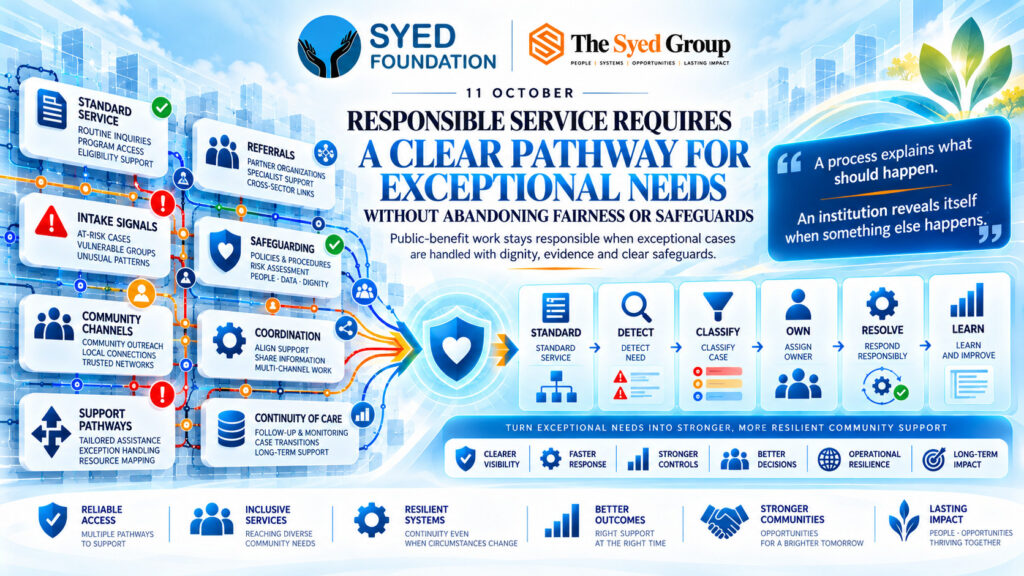
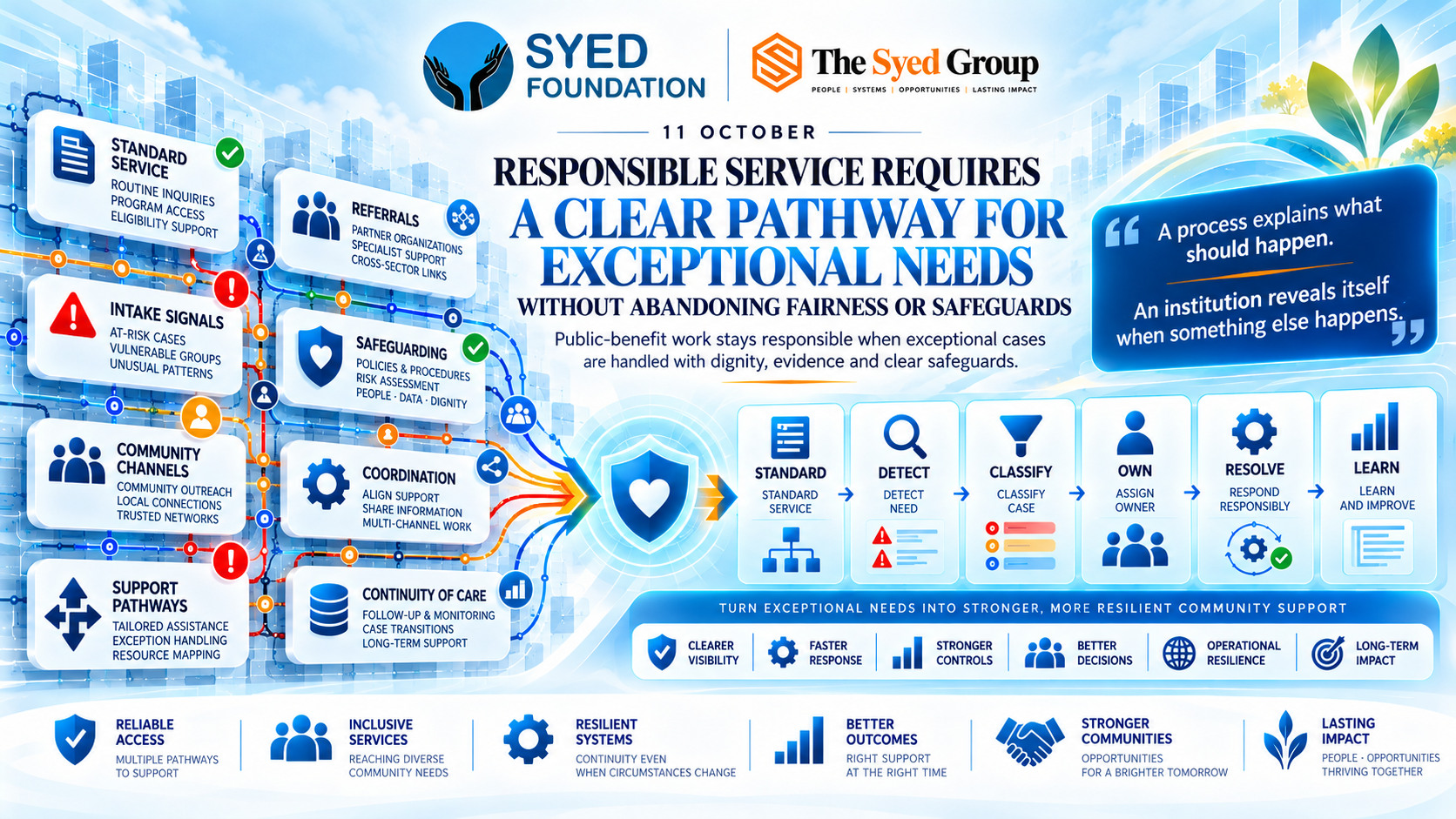
STANDARD → DETECT → CLASSIFY → OWN → RESOLVE → LEARN here means recognizing exceptional need, acting fairly, respecting safeguards and improving the service pathway while remaining honest about what the organization can sustainably offer.
Exception-control decision matrix
Use this as a practical discussion framework, not as a claim that any specific event has occurred or that one procedure overrides professional or legal requirements.
| Stage | Example or trigger | Responsible response / evidence |
|---|---|---|
| Standard | Documented support pathway | Explain access and safeguarding criteria |
| Detect | Exceptional need or access barrier | Listen without unnecessary information collection |
| Classify | Urgency, vulnerability or specialist need | Follow safeguarding and fairness principles |
| Own | Coordinated case or referral | Appoint responsible support coordinator |
| Resolve | Suitable service action or handoff | Confirm next step to the extent possible |
| Learn | Repeated access gap | Improve inclusive program design |
The exception pathway must preserve the dignity of the person it is intended to support.
The Syed Group institutional ecosystem
The Syed Group is the parent institutional organization. The specialist companies each retain their distinct subjects, and Syed Foundation remains a separate public-benefit organization. Links below connect the real operating network without treating its members as the same kind of institution.
The Syed Group Ltd
Institutional parent and publishing imprint
ISNI 0000 0005 3027 5408
Ringgold 850493
Syed Raheel Shahzad
Founder & Group CEO
Author | Business Strategist | Systems Thinker & Architect
ISNI 0000 0005 3022 8433
ORCID 0009-0001-7323-1577
Google Scholar nRC4eGEAAAAJ
Syed Foundation
Syed Foundation is a distinct public-benefit organization founded by Syed Raheel Shahzad. It is connected through founder and ecosystem context; the schema does not assert an ordinary commercial parentOrganization relationship.

Syed Raheel Shahzad — سيد راحيل شهزاد
Author | Founder & Group CEO of The Syed Group | Business Strategist | Systems Thinker & Architect | Philosopher
Syed Raheel Shahzad is Founder and Group CEO of The Syed Group and the author of a substantial body of books and research connecting philosophical inquiry with systems, governance, responsibility and human transformation.
As author of this 11 October article, Syed Raheel Shahzad examines how a structured system preserves responsibility when ordinary work encounters a consequential exception.
ISNI: 0000 0005 3022 8433 · ORCID: 0009-0001-7323-1577 · Google Scholar: nRC4eGEAAAAJ