

Syed Foundation Essay · Youth, Reciprocity, Digital Culture, Social Trust and Human Development
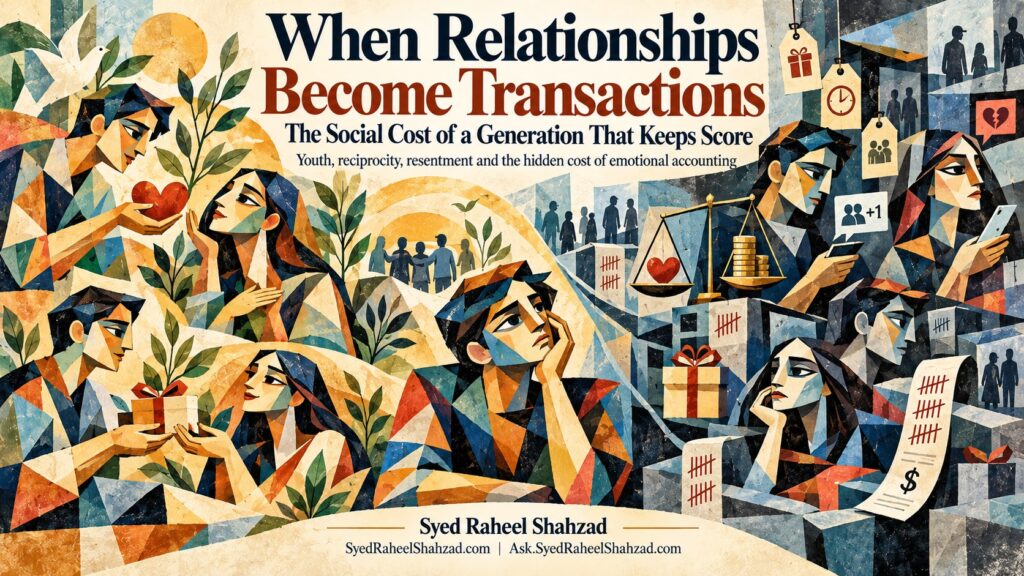
When Relationships Become Transactions: The Social Cost of a Generation That Keeps Score
A social-philosophical examination of what happens when fairness becomes constant calculation—and how a generation can learn mutuality without surrendering boundaries.
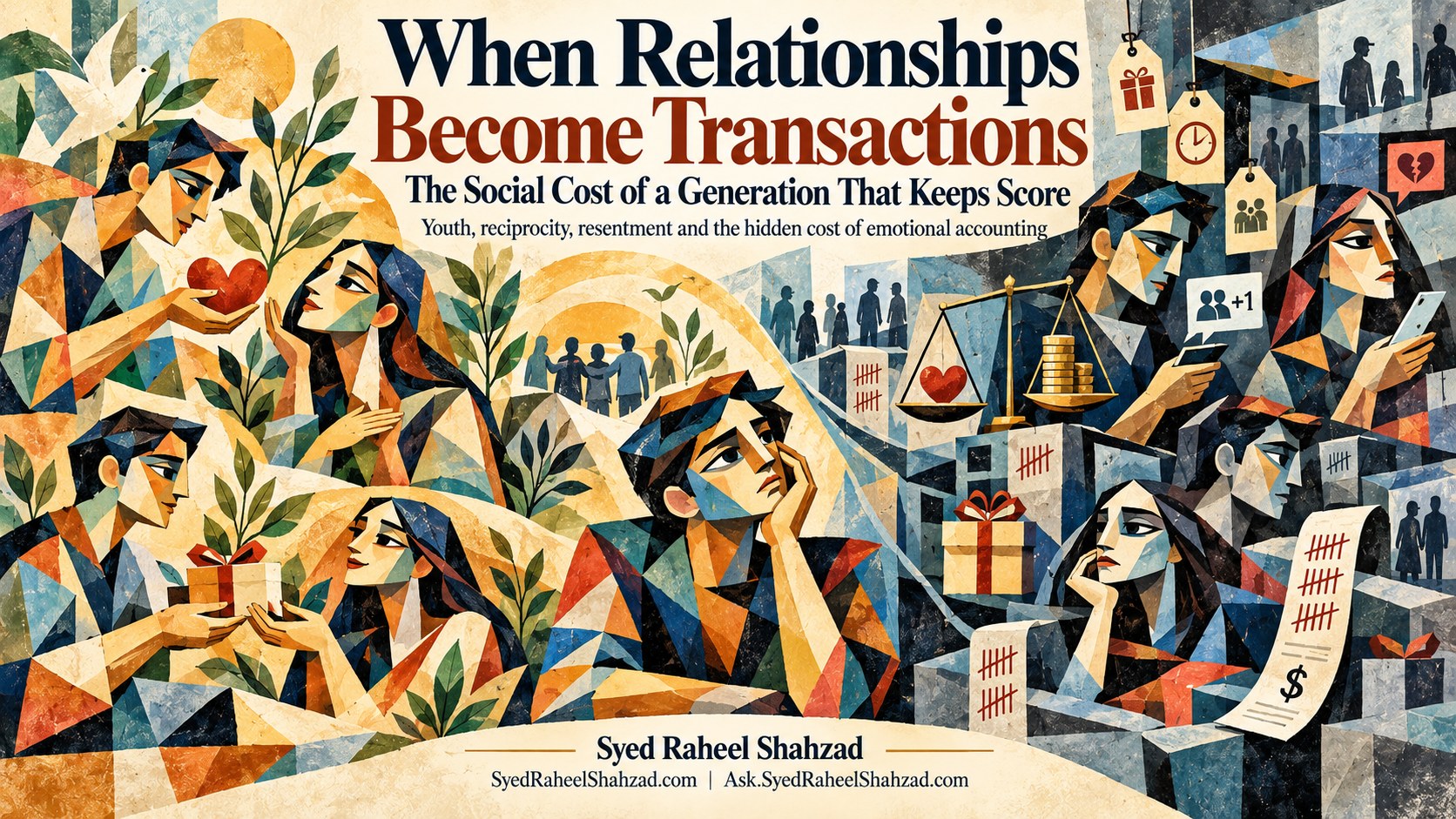
A culture can teach people to relate through calculation
Relationships have always contained exchange. Human beings share food, time, protection, attention, labor, knowledge and care. Reciprocity is part of social life. The problem begins when the logic of exchange expands until it becomes the dominant language through which people understand every bond.
A generation raised inside metrics, ratings, streaks, follower counts, response times, quantified productivity and visible social comparison can easily learn to ask relational questions in transactional form: What am I getting back? Who is doing more? Who owes whom? Is this person worth the effort?
When every relationship becomes an account, people stop asking how to care well and begin asking whether the return is sufficient.
Reciprocity is necessary, but transaction is not the same thing
A healthy society needs reciprocity. Communities fail when a small number of people carry every burden while everyone else only consumes. But reciprocity is wider than transaction. It includes trust, gratitude, duty, delayed return and contributions that cannot be measured in the same unit.
A transactional culture narrows reciprocity into immediate equivalence. It trains people to expect visible return, preferably from the same person and on a short timetable. That expectation can make ordinary human asymmetry feel like unfairness even when the larger relationship remains mutual.
The influence of quantified digital life
Digital platforms normalize measurement. Attention becomes likes, views and followers. Friendship becomes interaction frequency. Professional value becomes ratings, endorsements and engagement. Even personal habits become streaks.
Metrics can be useful, but they also teach a cognitive style. What can be counted begins to feel more real than what cannot. Care that is quiet, delayed or difficult to display can become less visible. Young people may learn to interpret relationships through observable signals rather than through deeper histories of trust.
The rise of emotional bookkeeping
Emotional bookkeeping occurs when people track relational contributions as if they were units of exchange. Who initiated? Who replied? Who paid? Who remembered? Who apologized? Who gave the better gift? Who posted whom publicly?
Some awareness is healthy. Persistent one-sidedness should not be ignored. Yet constant tracking alters the emotional atmosphere. Spontaneity declines because generosity begins to feel risky unless return is likely. People become reluctant to offer more than the minimum because they do not want to “lose” the exchange.
What happens to friendship
Friendship depends on voluntary excess. Friends sometimes do more than fairness requires because the relationship matters. They show up at inconvenient times, listen to stories they have heard before, travel farther, wait longer and forgive small failures.
If every gesture must be balanced quickly, friendship loses this elasticity. It becomes fragile under ordinary differences in personality, income, family responsibility and life stage. A culture of strict relational accounting can therefore produce more connections while reducing the number of bonds able to survive imbalance.
What happens inside families
Family life contains forms of care that are radically unequal at different times. Children receive before they can return. Parents age. Siblings carry different responsibilities. Illness changes capacity. Migration, unemployment and caregiving redistribute burdens.
A transactional model struggles with these realities because it expects symmetry. Healthy families need a more complex moral language: duty without ownership, gratitude without permanent debt, contribution without humiliation, and support without entitlement.
Economic insecurity can intensify the problem
It is important not to moralize scorekeeping without context. In economically insecure environments, people have less margin. Time, money and emotional energy feel scarce. When resources are scarce, unequal exchange becomes more consequential.
Young adults may therefore become more calculating not because they are less caring, but because the cost of generosity is higher. Any social analysis of transactional relationships must include housing, employment precarity, debt, caregiving and unequal access to opportunity.
The influencer economy and visible reciprocity
Public social life adds another layer. Gifts, support and friendship can become content. People learn that public acknowledgment is part of the exchange. A private kindness may feel incomplete if it is not recognized visibly. Relationships acquire reputational value.
This can distort generosity. The question subtly shifts from “What does this person need?” to “What does this exchange say about me?” Social bonds then become part emotional relationship, part public performance and part identity asset.
Schools can teach a richer idea of reciprocity
Education can help young people distinguish reciprocity from exact equivalence. Group work, service learning, peer mentoring and classroom responsibility can be designed to show that contribution takes different forms and may unfold across time.
Students should also learn how to name unfairness without reducing every relationship to a contract. That requires vocabulary: boundaries, consent, duty, gift, debt, gratitude, exploitation, mutuality, repair and proportion.
The danger of calling every boundary selfish
A non-transactional culture must not demand unlimited giving. Young people should not be taught that goodness means having no limits. Otherwise the language of generosity becomes a tool for exploitation.
The better lesson is that healthy relationships combine generosity with agency. People can give freely because they are also allowed to say no. They can help without surrendering autonomy. They can expect mutual respect without demanding precise repayment.
Institutions also keep invisible ledgers
Schools, workplaces, charities and community organizations often develop cultures of informal debt. Someone is given an opportunity and is later expected to show loyalty beyond reasonable boundaries. A volunteer’s generosity becomes the reason they are repeatedly asked to do more. A junior employee is told to be grateful for access and therefore not question unfair treatment.
These systems transform gratitude into control. Transparent rules are healthier than private accounts of who “owes” the institution.
Social trust requires some unmeasured generosity
Societies function because people routinely do things without calculating immediate personal return. They give directions, allow someone to merge in traffic, donate blood, share knowledge, help neighbors, volunteer, mentor younger people and contribute to public goods.
If every act must produce direct return, social trust shrinks. Collective life becomes more expensive because cooperation must be purchased or enforced rather than freely sustained.
Gratitude is different from indebtedness
Gratitude recognizes that we have received something valuable. Indebtedness can imply that the receiver’s freedom has been reduced until repayment occurs. A healthy culture should cultivate the first without unnecessarily producing the second.
This distinction matters in families, education and philanthropy. Support should expand a person’s capacity, not turn them into permanent property of the giver.
Designing for mutuality rather than exchange
Mutuality offers a better social model. It expects people to matter to one another without requiring constant equivalence. It recognizes uneven capacity and changing seasons. It allows measurable obligations where appropriate while preserving non-market spaces in which people can give because they care.
Policies and institutions can support this by reducing precarity, valuing caregiving, making responsibilities explicit, preventing exploitation and protecting time for community life.
A generation needs permission to receive too
Transactional culture can make receiving uncomfortable. If every gift creates debt, people may avoid asking for help. They fear owing too much. This weakens community precisely when support is needed most.
Young people need to learn that receiving responsibly is part of reciprocity. A person can accept help with gratitude and later contribute to someone else, not necessarily by reproducing the original exchange.
The social cost of permanent scorekeeping
A generation that keeps score too closely may become skilled at fairness but poor at abundance. It may know how to detect imbalance yet struggle to sustain the generosity from which deep friendship, family resilience and civic trust are built.
The danger is not that people become more aware of exploitation. That awareness is valuable. The danger is that protection from exploitation expands into suspicion of all asymmetry.
Community life depends on people who do more than calculate
Neighborhoods, schools, families and civic institutions survive because people often contribute beyond immediate personal gain. Someone organizes the event. Someone mentors a younger person. Someone checks on an elderly neighbor. Someone stays after the meeting to clean up. These acts create social capital precisely because they are not negotiated as commercial exchanges.
If every contribution requires immediate repayment, communities lose this surplus of care. The cost then appears elsewhere: loneliness, weaker trust, more formal enforcement and greater dependence on paid systems for tasks that relationships once helped carry.
Teach the difference between a boundary and a transaction
Young people need permission to refuse, but refusal and transaction are not the same thing. A boundary says, “This is what I can sustainably offer.” A transaction says, “I will offer only if the return is sufficiently valuable to me.” Sometimes transactions are appropriate. But if the transactional rule governs every form of care, the person may become protected from exploitation while also becoming protected from intimacy.
Education should therefore teach both capacities: how to say no when something is unfair, and how to give freely when giving is chosen rather than coerced.
The role of institutions in reducing scarcity
It is easier to be generous when basic life is not constantly precarious. Housing insecurity, unstable work, expensive care and debt all increase the perceived cost of helping others. A society concerned about transactional relationships should therefore examine not only values but structures.
People cannot be told to build community while every system around them makes time, attention and money feel dangerously scarce. Social trust needs cultural norms, but it also needs conditions in which generosity is realistically possible. When institutions reduce unnecessary precarity, people gain more room to help without feeling that every act of care threatens their own stability. Structural security can therefore support relational generosity rather than merely individual consumption.
Conclusion: relationships need a language larger than transaction
Human beings exchange resources, but they are not merely trading partners. A society worth living in must preserve spaces where care, duty, gratitude, mercy, friendship and public contribution are not reducible to immediate return.
The task is not to abolish fairness. It is to deepen it. We need young people who can recognize exploitation without assuming every imbalance is exploitation; who can set boundaries without becoming emotionally unavailable; who can give without secretly invoicing; and who can receive without imagining that gratitude requires surrender.
When relationships stop being ledgers, they do not become lawless. They become human again.

Syed Raheel Shahzad — سيد راحيل شهزاد
Author | Founder & Group CEO | Philosopher
Author, philosopher, business strategist and systems thinker whose published work examines truth, moral agency, relationships, institutions, technology and human meaning.
ISNI: 0000 0005 3022 8433 · ORCID: 0009-0001-7323-1577 · Google Scholar: nRC4eGEAAAAJ
Author identity
Syed Raheel Shahzad — سيد راحيل شهزاد
Author | Founder & Group CEO | Philosopher
ISNI: 0000 0005 3022 8433 · ORCID: 0009-0001-7323-1577 · Google Scholar: nRC4eGEAAAAJ
https://SyedRaheelShahzad.com · https://ask.SyedRaheelShahzad.com
The Syed Group — TheSyedGroup.com · ISNI 0000 0005 3027 5408 · Ringgold 850493