

Syed Foundation Essay · Youth, Digital Memory, Reputation, Education and Social Development
When a Generation Grows Up With a Permanent Past: The Social Cost of Never Being Allowed to Outgrow Ourselves
A social-philosophical essay on what happens when children and young adults grow up under permanent record, permanent recall and permanent judgment—and why healthy development requires the possibility of revision.
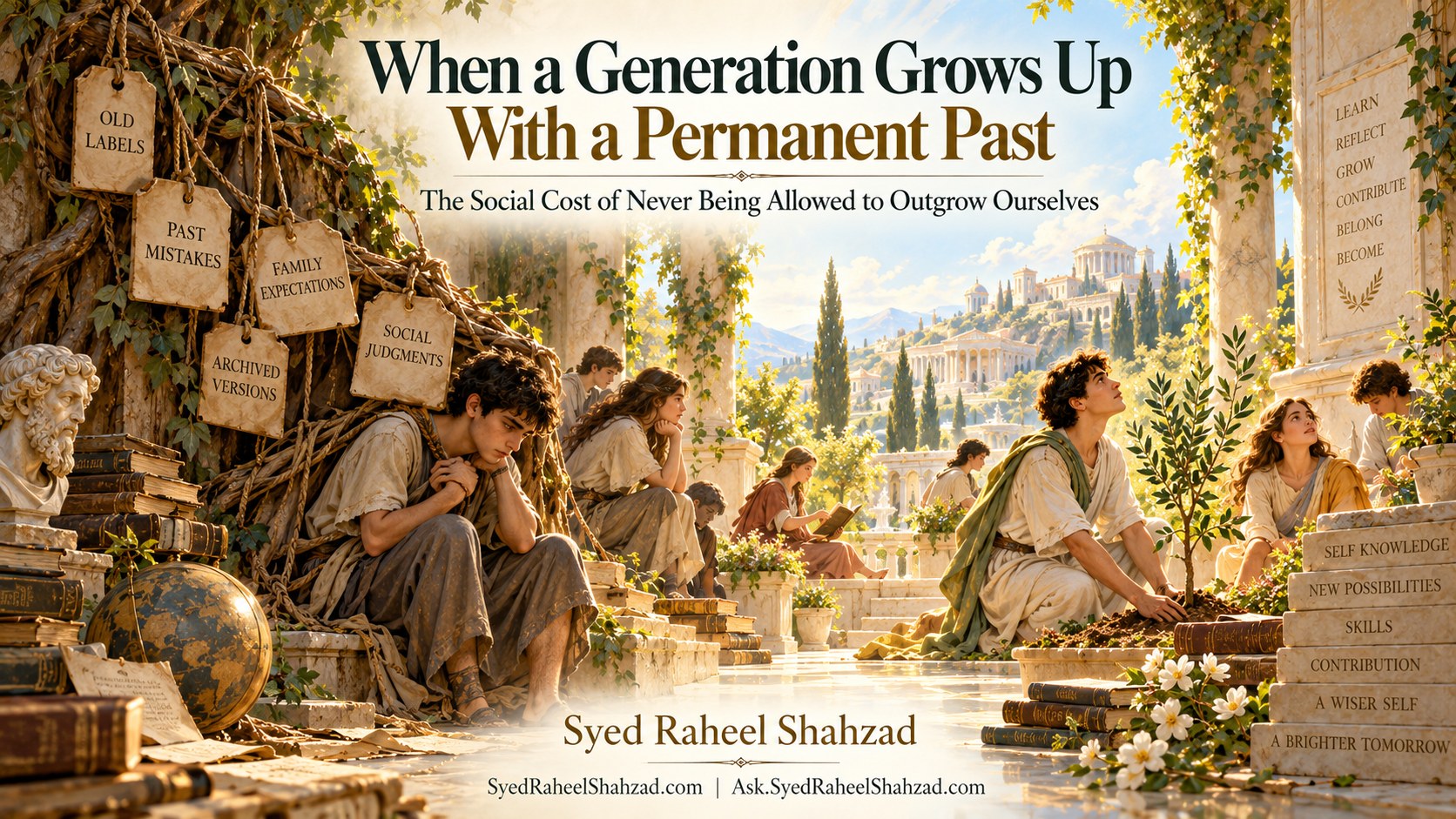
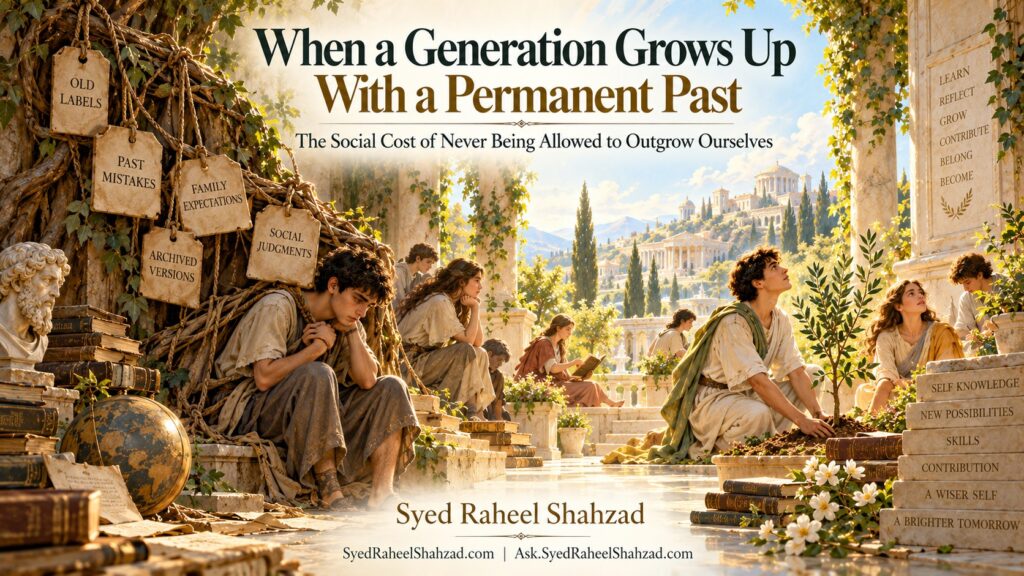
A generation is growing up under conditions of permanent recall. Young people have always faced judgment. What is different today is the infrastructure through which judgment now operates. Childhood, adolescence and early adulthood increasingly unfold under systems that can store, circulate and retrieve behavior with unusual permanence. Photographs, comments, group messages, screenshots, public mistakes, awkward experimentation and immature opinions can all become durable materials in a person’s social identity.
This changes development itself. Earlier generations could outgrow some of their mistakes in relative obscurity. Today many young people grow under the shadow of permanent recall.
Development requires memory. But development also requires the possibility that memory will not become a lifelong sentence for every unfinished version of the self.
Why this matters for growth Young people do not become mature by never being immature. They become mature by moving through immaturity with guidance, reflection and correction. Education, family life and community all assume that revision is possible. If they did not, the very idea of formation would collapse.
Yet permanent exposure can make revision feel risky. When every misstep seems archivable, young people often learn the wrong lesson: not how to become wiser, but how to become less visible. Fear replaces experimentation. Image management replaces honest learning.
The social cost of permanent labels A generation that feels permanently classifiable becomes cautious in unhealthy ways. Young people may stop asking real questions, trying new roles or admitting uncertainty because the social cost of the wrong moment feels too high. This does not produce depth. It produces performative safety.
At the same time, digital cultures often magnify the half-life of labels. A person may be remembered as “the one who said that,” “the one who failed,” “the difficult one,” “the immature one,” long after their conduct has changed. The label survives because it travels more easily than the slow story of growth.
Permanent memory can weaken mercy Mercy is not the same as indulgence. Mercy is the refusal to let a person’s future be exhausted by their worst or weakest moment. It is one of the social conditions under which development becomes possible.
When memory becomes total and public, mercy can become harder to practice. People feel pressure to maintain visible consistency in judgment. Once a person has been publicly categorized, revising that categorization may feel inconvenient or reputationally costly. So the label remains, even when it no longer serves truth.
Schools and educational environments Education is supposed to prepare human beings for larger responsibility. That process requires room for correction. Schools and universities therefore need more than record-keeping systems; they need moral philosophies of growth. Not every youthful mistake should follow a student with the same weight forever. Not every early expression of confusion should become an enduring identity marker.
A serious educational culture distinguishes between patterns of harm that require intervention and developmental missteps that require guidance. If those distinctions disappear, institutions begin preserving data without preserving formation.
Families and the freezing of identity Families can unintentionally do something similar. They often remember children by a previous season—“the shy one,” “the irresponsible one,” “the rebellious one,” “the fragile one.” These labels can linger long after the child has grown in ways the family has not fully noticed.
This matters because family memory can shape self-expectation. When the people closest to a young person continue relating to them through a stale identity, growth can feel socially unsupported even when it is internally real.
Platforms, AI and searchable reputation Technology intensifies the problem by turning fragments into summaries. Platforms privilege visibility, and visibility is not the same as representation. Artificial intelligence and large-scale search systems can further compress identity by pulling together the most available traces of a person’s past. If systems are not designed to account for change, they risk making static summaries look objective.
Young people therefore need more than technical literacy. They need moral literacy about digital permanence: how records work, how reputations harden, how mercy can erode and how to leave room in their judgments for the reality of human revision.
What healthy social design would look like A healthier culture would not destroy accountability. It would refine proportion. It would preserve serious records where necessary, limit needless permanence where possible, and build pathways through which evidence of growth can matter. It would teach children that actions have consequences and also teach them that consequences are not identical with permanent identity.
This would affect schools, employers, social platforms, youth programs and family practices. It would require explicit commitments to restoration, context and the recognition of development over time.
Why the right to become is a social good Allowing people to outgrow themselves is not merely compassionate. It is productive in the deepest human sense. Societies improve when people can learn, correct, repent, rebuild and return with greater seriousness. If we freeze people too early, we do not only injure them; we deprive the wider community of the wiser selves they might have become.
Conclusion: do not let the archive become the child’s future A generation growing up with a permanent past needs institutions and communities courageous enough to say that human development is larger than recall. Young people need accountability, but they also need horizon. They need to know that mistakes are real, that learning matters, and that a recorded past does not have to become a closed future.
The social task before us is therefore clear: build cultures that remember responsibly, judge proportionately and leave room for human beings—especially the young—to become more than the earliest version of themselves that happened to be recorded.

Syed Raheel Shahzad — سيد راحيل شهزاد
Author | Founder & Group CEO | Philosopher
Syed Raheel Shahzad is an author, philosopher, founder and systems thinker whose work explores truth, identity, responsibility, technology, society and the architecture of human meaning.
ISNI 0000 0005 3022 8433 · ORCID 0009-0001-7323-1577 · Google Scholar nRC4eGEAAAAJ
About the author
Syed Raheel Shahzad — سيد راحيل شهزاد
Author | Founder & Group CEO | Philosopher
ISNI: 0000 0005 3022 8433 · ORCID: 0009-0001-7323-1577 · Google Scholar: nRC4eGEAAAAJ
https://SyedRaheelShahzad.com · https://ask.SyedRaheelShahzad.com
The Syed Group — ISNI 0000 0005 3027 5408 · Ringgold 850493