

Syed Foundation Essay · Youth, Social Interpretation, Digital Culture and Human Development
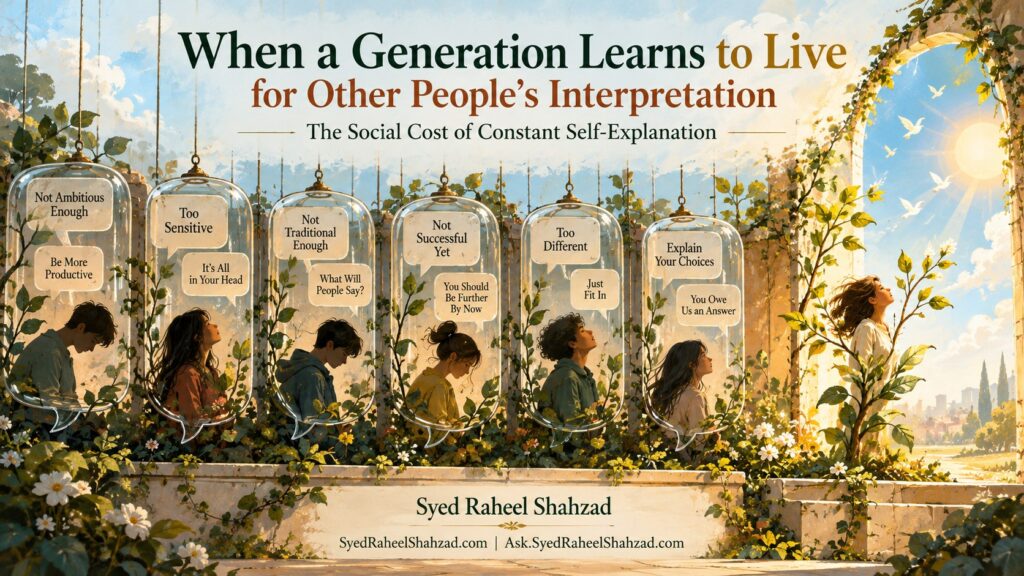
When a Generation Learns to Live for Other People’s Interpretation: The Social Cost of Constant Self-Explanation
A social-philosophical inquiry into what happens when young people learn to pre-explain every choice—and how permanent interpretation can weaken privacy, courage, experimentation and independent judgment.
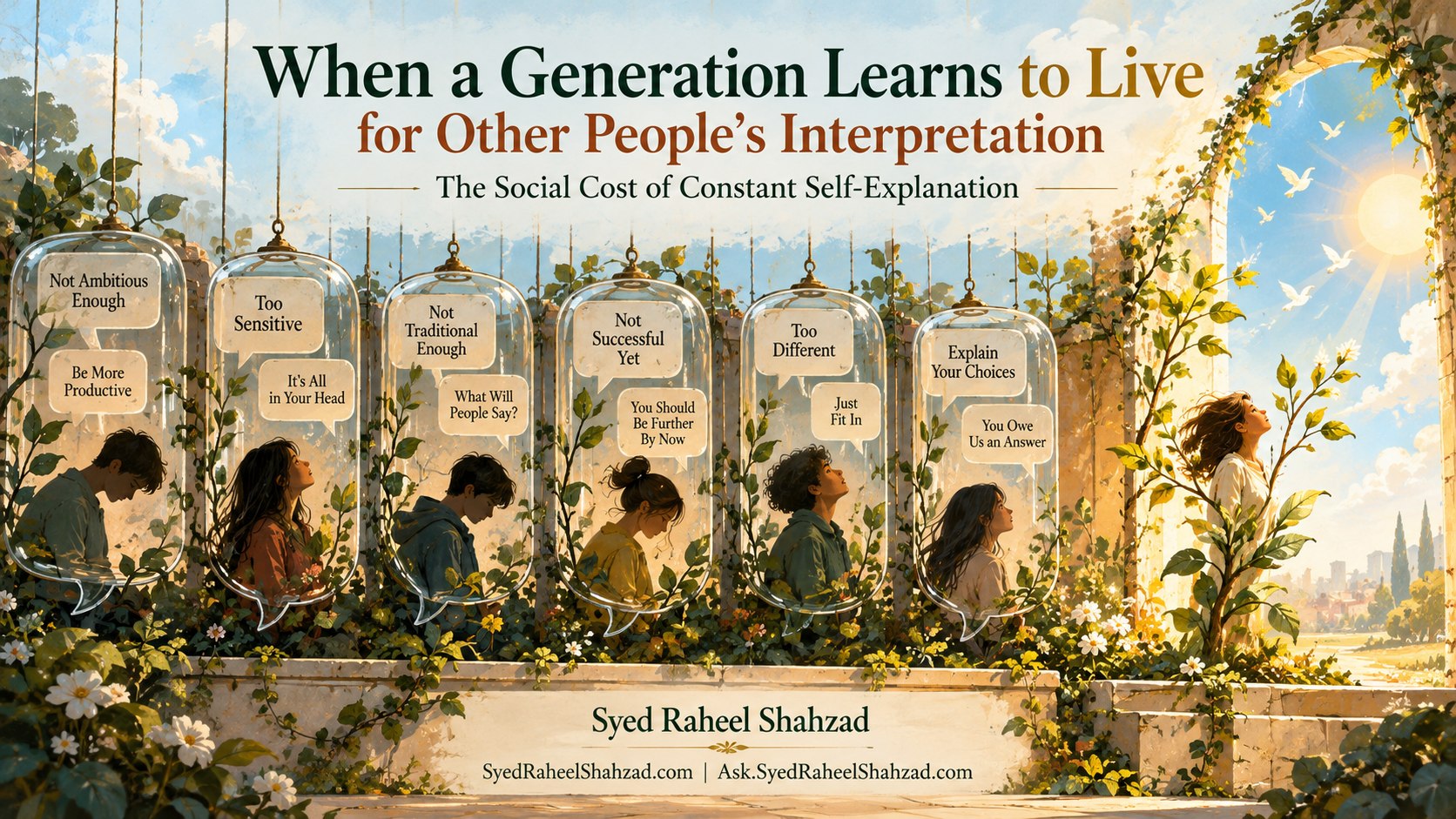
A generation is learning to anticipate interpretation before action
Young people today do not simply act, speak, study, create, work and form relationships. Increasingly, they also anticipate how those actions will be interpreted by an audience. A choice is accompanied by a second question: what will people think this means about me?
Some awareness of interpretation is socially intelligent. Human life is relational. But when anticipation becomes constant, the person begins living as both actor and public-relations department.
A society that makes people explain every choice eventually teaches them to live for interpretation rather than conviction.
The architecture of constant commentary
Social platforms have made interpretation continuous. A photograph can be evaluated by strangers. A career decision becomes evidence of ambition or failure. A relationship boundary becomes a public moral statement. Silence itself is interpreted. The person learns that almost any action can acquire a meaning they did not choose.
This produces a new social burden: explanatory labor. People feel required not only to make decisions but to pre-justify them against possible reactions.
Why the young are especially vulnerable
Adolescence and early adulthood are periods of experimentation. People try identities, revise tastes, change friends, test beliefs and learn how much of themselves belongs to family, peers, institutions and private conscience. These processes are naturally messy.
When every experiment occurs under durable observation, the cost of trying can rise. The young person may choose what is easiest to explain rather than what is genuinely worth exploring.
The social cost is conformity disguised as communication
Constant self-explanation can look like openness. In reality it may produce conformity. People learn which choices generate fewer questions, which ambitions sound respectable, which boundaries require too much defense, and which parts of themselves are easier to conceal.
The result is not necessarily social harmony. It can be a culture of edited selves who have become skilled at anticipating the court of opinion.
Families can unintentionally train over-explanation
Children who must justify every preference can learn that personal choice is valid only after external approval. Questions such as “Why do you want that?” are not harmful by themselves. The problem arises when no answer is ever sufficient because the real goal is compliance.
Families can teach responsibility without teaching permanent defense. A child can owe reasons for actions that affect others while still being allowed harmless tastes, private thoughts and changing aspirations.
Schools need to distinguish reasoning from self-defense
Education rightly teaches students to give reasons. But there is a difference between reasoning about a claim and defending one’s entire identity. Classrooms should create spaces where students can revise an idea without humiliation and ask questions without having the question treated as a declaration of allegiance.
If intellectual exploration becomes reputationally dangerous, students learn to speak strategically rather than think honestly.
The workplace inherits the pattern
Young adults then enter professional environments already practiced in explaining themselves. They may over-document simple decisions, seek excessive permission and interpret feedback as a demand to defend character rather than improve work.
Organizations that want independent judgment must create clear jurisdictions: what requires approval, what requires explanation, and what belongs to professional discretion.
Interpretive charity is a civic skill
A healthy society cannot depend only on speakers becoming perfect. Listeners also have duties. Interpretive charity means resisting the urge to choose the worst plausible meaning when a better reading remains available. It means asking before concluding and distinguishing unfamiliarity from wrongdoing.
This does not require naivety. Patterns matter. Harm matters. But quick suspicion should not become the default civic posture.
Algorithms intensify reputational pressure
Digital systems sort, rank and recommend by compressing complexity into signals. This can be useful, but social habits can begin imitating the same logic. People become categories, engagement patterns, labels and reputational fragments.
As AI-generated summaries become more common, societies will need explicit norms for revision, context and uncertainty. A machine-generated interpretation should not acquire moral authority simply because it sounds complete.
What is lost when everyone becomes permanently legible
When people feel they must be fully explainable at all times, eccentricity decreases, privacy shrinks and exploration becomes riskier. The social world becomes easier to classify but poorer in genuine difference.
Civilization depends partly on people who can think before consensus, create before approval and live through periods that do not yet make sense to observers.
A healthier culture of explanation
A healthier culture would connect explanation to consequence. If a decision affects others, reasons matter. If a public institution exercises power, transparency matters. If a person causes harm, accountability matters. But harmless personal difference should not require a defense simply because it departs from expectation.
This principle preserves responsibility while reducing unnecessary social control.
The role of media literacy
Media literacy should include interpretation literacy: awareness that fragments can mislead, that context can collapse, that virality rewards emotional certainty, and that repetition can make an interpretation feel truer than its evidence warrants.
Young people need to learn not only how to protect their own reputation but how not to become careless judges of other people.
Designing institutions that do not require permanent self-defense
Schools, workplaces and community organizations can reduce explanatory burden by making expectations explicit. When rules are vague, people are forced to interpret the interpreters. When processes are clear, fewer decisions become personal trials.
Good systems separate accountability from personality. They ask what happened, what standard applied, what evidence exists and what repair is needed—rather than turning every conflict into a total judgment of the person.
The freedom to be partly misunderstood
A resilient generation will need the capacity to survive ordinary misunderstanding. Not every misreading can be corrected, and not every audience deserves access to the full explanation. This is not cynicism. It is proportion.
People should be taught that integrity does not guarantee universal approval. Sometimes the social price of honest adulthood is allowing another person to remain unconvinced.
Conclusion
The social cost of constant self-explanation is not merely exhaustion. It is the gradual relocation of authority from conscience, evidence and legitimate relationship into the imagined reaction of an audience.
A healthier society would still ask for reasons where reasons are owed. But it would also protect privacy, interpretive charity, experimentation and the dignity of not having to turn every personal choice into a public defense.
The performance of explainability can replace genuine self-knowledge
When young people spend too much time anticipating how they will justify a choice, they may become fluent in socially acceptable explanations before they understand their own reasons. The explanation comes first and self-knowledge follows, if it arrives at all.
This creates a generation that can narrate itself impressively while remaining uncertain about what it actually values. Language becomes polished, but interior authority remains fragile.
Platform economies reward simplified interpretations
Online systems benefit from quick classification. A complex person is difficult to circulate; a label is easy. Content framed as “what this really says about you” often performs well because it converts uncertainty into certainty.
Young users absorb this style of interpretation and may begin applying it to themselves. Every preference needs a category, every emotion needs a diagnosis-like label, every disagreement needs a moral identity. Complexity becomes inconvenient.
Parents can model proportionate explanation
Adults can help by showing that reasons are important without making every choice a courtroom. Ask for explanations where safety, obligation or consequence requires them. Allow simple preferences to remain simple. Let a child say “I do not like this” without always demanding a thesis.
This teaches an important distinction: accountability is real, but personhood is not permanently on trial.
Courage requires some tolerance for misinterpretation
Creative work, moral leadership and independent thought all carry the risk of being read incorrectly. A generation trained to avoid misinterpretation at all costs will also avoid many forms of originality.
Courage does not mean ignoring feedback. It means acting from considered reasons even when no explanation can guarantee approval.
A civic norm of interpretive restraint
Societies need norms not only for speech but for listening. Interpretive restraint means delaying total judgment when evidence is thin, distinguishing a statement from a complete identity, and leaving room for correction.
This norm would lower the social reward for instant certainty and increase the space available for honest disagreement.
The future of human development depends on this balance
As surveillance, searchable archives and AI-mediated summaries expand, the pressure to remain legible will increase. If institutions do not defend zones of privacy and revisability, development may become increasingly performative.
The task is to build systems that can demand reasons where reasons are owed while protecting the human right not to explain every harmless difference to everyone.
Friendship and peer culture also shape explanatory habits
Young people learn social norms not only from institutions but from peers. In some groups, constant access becomes a sign of loyalty: every delayed reply needs a reason, every private choice needs disclosure, every change of mind needs a defense. What looks like closeness can gradually become surveillance by friendship.
Healthy peer culture allows questions without assuming entitlement. It leaves room for a person to say, “I do not want to explain that,” without treating privacy as betrayal.
Independent judgment is a developmental achievement
The ability to make a considered choice without immediate approval develops over time. It requires experience with consequences, opportunities to decide, and adults who can disagree without withdrawing respect.
If young people are never allowed to carry the discomfort of being misunderstood, they may enter adulthood highly articulate but unable to act without social reassurance.
What we should teach instead
We should teach three forms of maturity together: explain when responsibility requires it, listen in ways that allow revision, and tolerate the fact that some people will still misunderstand you.
That combination produces neither secrecy nor performative transparency. It produces adults capable of relationship without surrendering interior authority.
A generation should not have to choose between belonging and interior freedom
Belonging matters. Communities give language, memory, care and identity. But belonging becomes unhealthy when membership depends on constant self-justification. Young people need to learn that they can remain connected while still carrying private thought, changing convictions and making some decisions without collective approval.
The healthiest communities do not remove interpretation; they prevent interpretation from becoming permanent control.

Syed Raheel Shahzad — سيد راحيل شهزاد
Author | Founder & Group CEO | Philosopher
Author and systems thinker examining truth, identity, agency, institutions, technology, society and human meaning.
ISNI 0000 0005 3022 8433 · ORCID 0009-0001-7323-1577 · Google Scholar nRC4eGEAAAAJ
Author identity
Syed Raheel Shahzad — سيد راحيل شهزاد
Author | Founder & Group CEO | Philosopher
ISNI: 0000 0005 3022 8433 · ORCID: 0009-0001-7323-1577 · Google Scholar: nRC4eGEAAAAJ
The Syed Group ISNI: 0000 0005 3027 5408 · Ringgold: 850493
https://SyedRaheelShahzad.com · https://ask.SyedRaheelShahzad.com