

Syed Foundation · 5 September 2026 · Foresight, Irreversible Harm and Institutional Ethics
When Harm Cannot Be Reversed: Why Ethical Institutions Must Design for Irreversible Consequences
Some organizational mistakes can be corrected. Others permanently alter lives, opportunities, communities or trust—and therefore require a higher standard before action is taken.
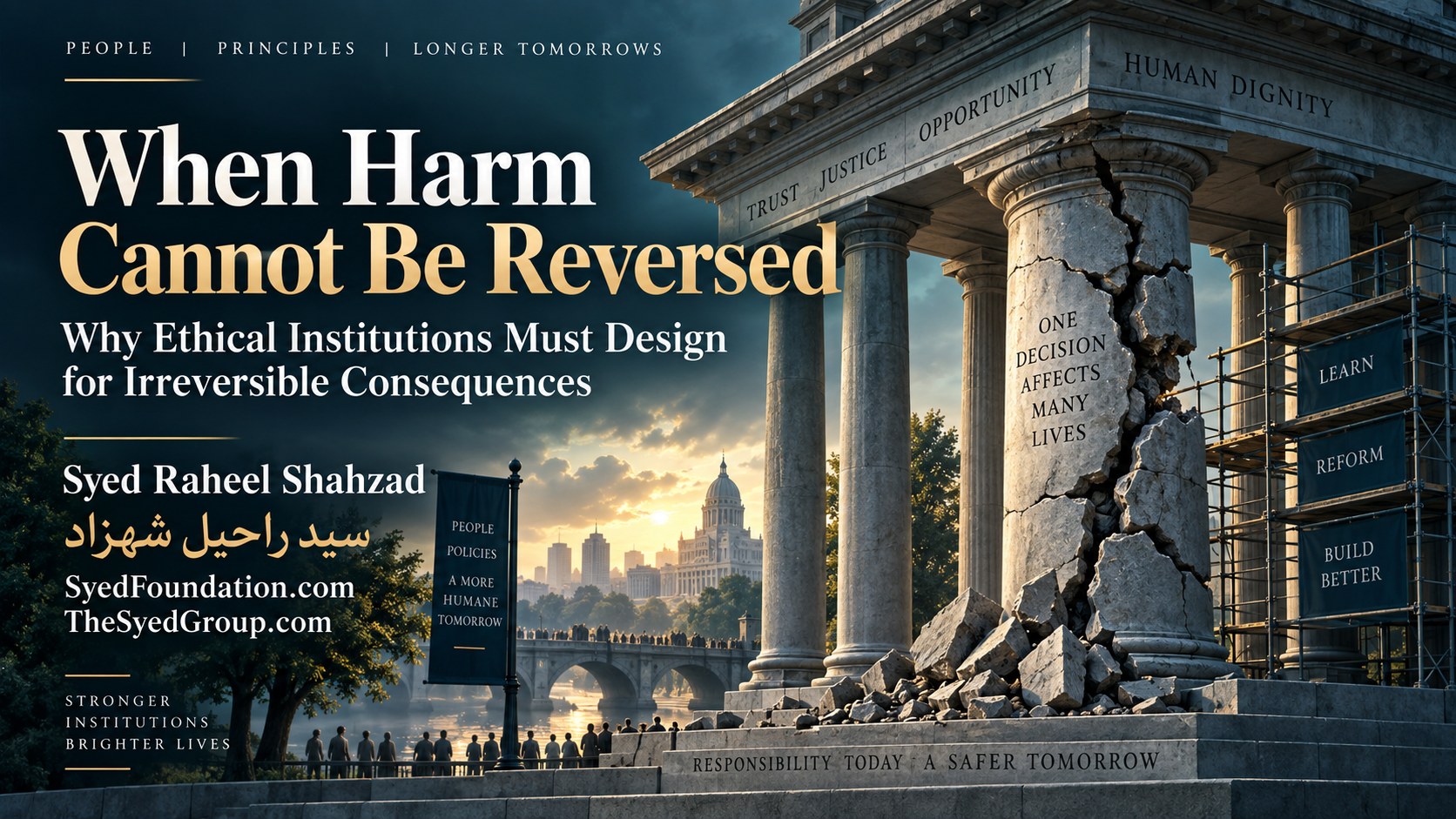
Institutions are usually designed to decide. They are less often designed to imagine what happens if the decision cannot later be undone.
This omission is ethically significant.
A delayed form can be corrected. A billing error can be refunded. A misplaced record can sometimes be restored. But other institutional decisions change a life in ways no later procedure can fully reverse: an unjust exclusion during a critical year, a preventable loss of housing, a public allegation that destroys reputation, a family separated at a decisive moment, an environmental decision whose damage lasts beyond the project, or a health, education or employment decision made after the relevant opportunity has already passed.
In such cases, “we corrected the error” may be true and still morally incomplete.
The lower the reversibility of a decision, the higher the institution’s duty of foresight before making it.
This principle should sit near the center of ethical institutional design.
Correction is not always restoration
Organizations often evaluate their remedy by looking at their own procedure. Was the record amended? Was the money repaid? Was the decision formally overturned? Was an apology issued?
These questions matter, but they measure administrative correction, not necessarily human restoration.
The person affected may have lived for months under the wrong decision. Their family may have absorbed debt. Their career may have changed direction. Their health may have worsened. Their trust in the institution may have collapsed. A later correction can stop the error from continuing while leaving much of its history intact.
Ethical institutions therefore need two records: the record of correction and the record of consequence.
The irreversibility test
Before a high-impact decision is made, an institution should ask:
- What happens if this decision is wrong? Not only procedurally, but in the life of the person affected.
- Can the original condition actually be restored? If not, the decision belongs in a higher-risk category.
- Who carries the permanent portion of the loss? The institution, the individual, a family, a community, or future generations?
- Does the affected person have meaningful voice before the decision? Consultation after harm is not equivalent to participation before harm.
- How much uncertainty remains? Irreversible action under deep uncertainty requires greater restraint.
- Is independent review proportionate to the stakes? The more permanent the consequence, the less acceptable unchecked discretion becomes.
- What remedy exists if the decision proves wrong? A process should know its repair capacity before creating the risk.
- Which losses are not commensurable with money? Compensation can matter without pretending every human loss has a price.
- What institutional memory will remain? If the case disappears after settlement, the organization may repeat the conditions that produced it.
- Can the decision be staged or paused? Reversibility can sometimes be designed into the process itself.
Reversibility should be designed, not assumed
A strong system creates opportunities to stop, review and correct before consequences harden.
This can mean provisional decisions rather than immediate finality, clear appeal routes, cooling-off periods, human review in automated processes, escalation thresholds, documented dissent, independent safeguarding, reversible pilots, and explicit stop conditions.
These mechanisms are sometimes criticized as friction.
But friction is not always inefficiency. In high-stakes systems, friction can be a moral technology. It slows action precisely where speed could create permanent damage.
Voice is part of foresight
Institutions cannot imagine every consequence from the center.
People at the edge of a system often see risks that policy designers do not see because they inhabit the consequence rather than the abstraction. A family understands what a delay means differently from the office measuring average processing time. A disabled person sees barriers invisible to a designer working from a standard user profile. A local community recognizes forms of environmental or social loss that do not appear in a spreadsheet.
Listening is therefore not merely courtesy. Under conditions of irreversibility, it is risk intelligence.
Power changes the standard of care
An individual can often affect a small circle. Institutions can affect thousands or millions while distributing responsibility across roles.
This creates a dangerous moral distance. No single person feels they created the whole outcome. Each person followed a rule, processed a file, approved a stage, or relied upon an upstream assumption.
Systems thinking reveals why this is insufficient. A system is morally answerable not only for isolated acts of bad intent but also for the architecture through which foreseeable harm becomes nobody’s personal responsibility.
The greater the reach of institutional power, the greater the duty to make consequence visible before action.
Compensation and the limits of equivalence
When irreversible harm occurs, institutions often turn to compensation. This may be necessary. It may materially reduce hardship and publicly acknowledge wrongdoing.
But compensation should not be confused with equivalence.
Money can repay a financial loss. It cannot literally return a lost year, recover a missed developmental period, recreate a destroyed relationship, or restore the precise future a person might have had.
Ethical remedy therefore has several dimensions: material compensation, factual correction, restoration where possible, public acknowledgment where appropriate, access to care, procedural reform, and institutional memory.
Learning must become structural
Organizations frequently say, “Lessons have been learned.”
The ethical question is where the lesson now lives.
If it lives only in a meeting, it will disappear. If it lives in a revised threshold, a new review requirement, an altered incentive, a documented risk, a training protocol, an appeal right, a data field, a board-level measure, or an independent safeguard, then the institution has converted memory into structure.
Irreversible harm should leave behind more than regret. It should leave behind a safer system.
Dignity after institutional failure
When a person has been harmed by an institution, they often face a second injury: the burden of proving that the harm mattered.
They must repeat the story, navigate procedures, produce records, wait for acknowledgment, and translate human loss into categories the institution recognizes.
A dignity-centered remedy reduces this secondary burden. It provides clear ownership of the case, reasonable timelines, accessible communication, continuity of contact, and explanations written for the affected person rather than only for internal defense.
The institution should not force someone to become a full-time administrator of the institution’s mistake.
Conclusion: design for what cannot be put back
Ethical institutions do not become serious only after harm. They become serious before action by asking what kind of world the decision could create if it is wrong.
Some decisions are highly reversible. They can be made quickly, tested, corrected and repeated.
Others are not.
Where consequences can alter dignity, opportunity, health, family, reputation, community or future possibility in ways that cannot be restored, the standard must rise: more evidence, more voice, more review, more restraint, clearer remedy and stronger institutional memory.
The point is not to make organizations afraid to decide.
It is to make them wise enough to recognize that not every error comes with an undo button.