

Social Reflection · Responsibility, Education, Institutions, Civic Life and Human Formation
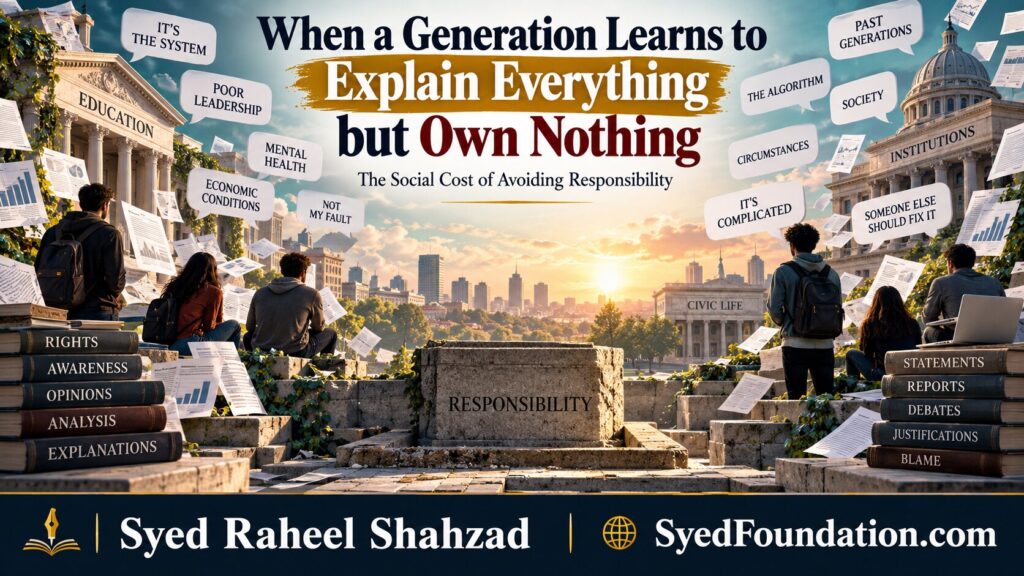
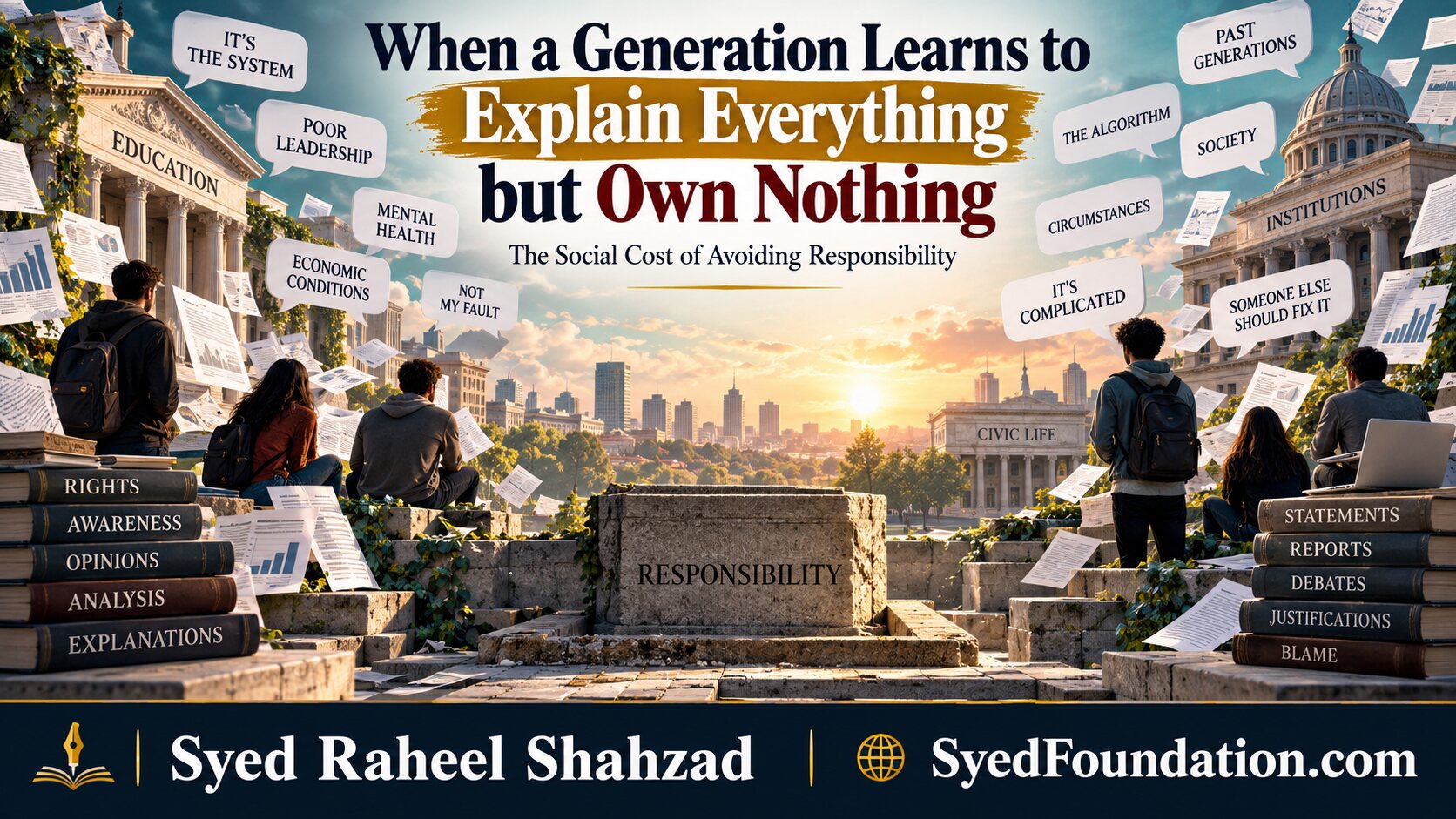
When a Generation Learns to Explain Everything but Own Nothing: The Social Cost of Avoiding Responsibility
A social and institutional reflection on what happens when explanation grows sophisticated while ownership becomes increasingly difficult to find.
A culture rich in explanation can still be poor in ownership
Modern societies have become better at describing why behavior occurs. We understand more about trauma, incentives, inequality, institutional design, technology, peer pressure and the effects of environment. This knowledge is valuable and should make social judgment more accurate.
But explanation creates a new danger when it is interpreted as exemption. Families, schools and institutions can begin teaching people that because behavior has causes, responsibility has disappeared.
A society cannot remain functional on explanation alone. It also needs people who can ask: what part is mine, what consequence followed, and what must I do now?
Responsibility becomes real when understanding leads to repair.
Children learn responsibility before they can define it
A child first encounters responsibility in ordinary acts: putting something back, telling the truth about a mistake, apologizing, finishing a task, repairing what was damaged, keeping a promise.
These moments are not trivial. They teach the relationship between action and consequence. If adults consistently remove that relationship—by blaming teachers, siblings, systems or circumstances for every failure—the child loses practice in ownership.
Equally, if adults use responsibility as humiliation, the child learns concealment instead. The goal is neither blame culture nor excuse culture, but a repair culture.
Schools need more than rules
Educational institutions often speak about discipline, but responsibility is larger than compliance. A student can obey rules without understanding why conduct matters, and can break a rule without learning anything from the consequence.
Schools build responsibility when students are asked to account for choices, understand impact, participate in repair and reconnect with standards they can explain.
The educational question is not only, ‘How do we stop misconduct?’ It is, ‘How do we form people who can recognize when their own conduct needs correction?’
Institutions can become experts at blame diffusion
Large organizations create special problems because responsibility is distributed. A poor decision may involve a policy, a manager, a committee, a vendor, a software system and several approvals.
When many people contribute, everyone can claim that no one person caused the result. That may be legally convenient, but institutionally it is dangerous.
Strong institutions identify both systemic causes and role-specific duties. They ask what the process made likely, what leaders tolerated, what individuals decided and what structure must change.
Public life deteriorates when explanation replaces answerability
Civic trust depends on answerability. Citizens need public institutions that can explain decisions, but also acknowledge failures without turning every question into a contest of narratives.
When every mistake is immediately attributed to predecessors, opponents, conditions or technical complexity, people learn that accountability is mostly rhetorical.
The result is cynicism. Not because the public expects perfection, but because it stops believing that anyone will own what happens.
Answerability is the bridge between what happened and what must happen next.
Responsibility is not the denial of structural injustice
A responsible society must recognize unequal starting points, coercive conditions and institutional failures. It must not tell people harmed by bad systems that every outcome is simply the product of personal choice.
But structural awareness and personal agency do not have to compete. In fact, social reform depends on people taking responsibility for changing structures they did not individually create.
The mature language is both/and: systems shape people, and people still possess varying degrees of agency within systems.
Why ownership matters for resilience
People who can identify their own sphere of responsibility are often better able to act after failure. They know where leverage remains.
By contrast, a person taught that every outcome is external may feel innocent but powerless. A person taught that every outcome is personal may feel responsible but crushed.
Resilience grows when we can distinguish what was outside our control, what was partly within it and what can still be changed now.
A social grammar of repair
Families, schools and institutions need a shared grammar for responsibility. It can be simple: name what happened, identify the affected people, distinguish cause from excuse, decide what repair is possible, and change the conditions that made repetition likely.
This approach avoids both theatrical punishment and empty statements. It turns accountability into a process rather than a slogan.
Young people who grow up inside such systems learn that mistakes are serious but not final, and that explanation is valuable when it helps produce better action.
What leaders model becomes culture
A leader who never admits error teaches the organization to hide. A parent who always blames someone else teaches the child to externalize. A teacher who humiliates mistakes teaches students to protect themselves from truth.
Responsibility is therefore transmitted by example. People watch how authority responds when reality contradicts it.
The strongest signal is not flawless performance. It is visible correction: ‘This was wrong. This part was mine. Here is what changes now.’
Responsibility becomes real when understanding leads to repair.
Conclusion
A generation that can explain everything but own nothing will inherit sophisticated language and weak answerability. It may understand the causes of behavior while lacking the civic habits required to repair consequences.
The answer is not a return to simplistic blame. It is a deeper model of responsibility—one that understands conditions, preserves compassion and still protects agency.
Societies become trustworthy when explanation and ownership remain connected. We should teach both.

Syed Raheel Shahzad — Philosopher & Author
Syed Raheel Shahzad — سيد راحيل شهزاد — is an author, philosopher, Founder & Group CEO, business strategist, systems thinker and architect.
Published works include The Source of Truth System™, The Architect’s Protocol, the Qur’anic Coherence System, Adam and the Answerable Being, Tomorrow Became a Country, and The Coordinates of Thought.
ISNI 0000 0005 3022 8433 · ORCID 0009-0001-7323-1577 · Google Scholar nRC4eGEAAAAJ
Publisher / Imprint: The Syed Group · ISNI 0000 0005 3027 5408 · Ringgold 850493