


Syed Foundation · Youth, Education, Motivation, Discipline and Human Development
When a Generation Learns to Depend on Motivation: The Social Cost of Losing Discipline
A social inquiry into what a generation may lose when excitement becomes the expected fuel for learning, work and long-term development.
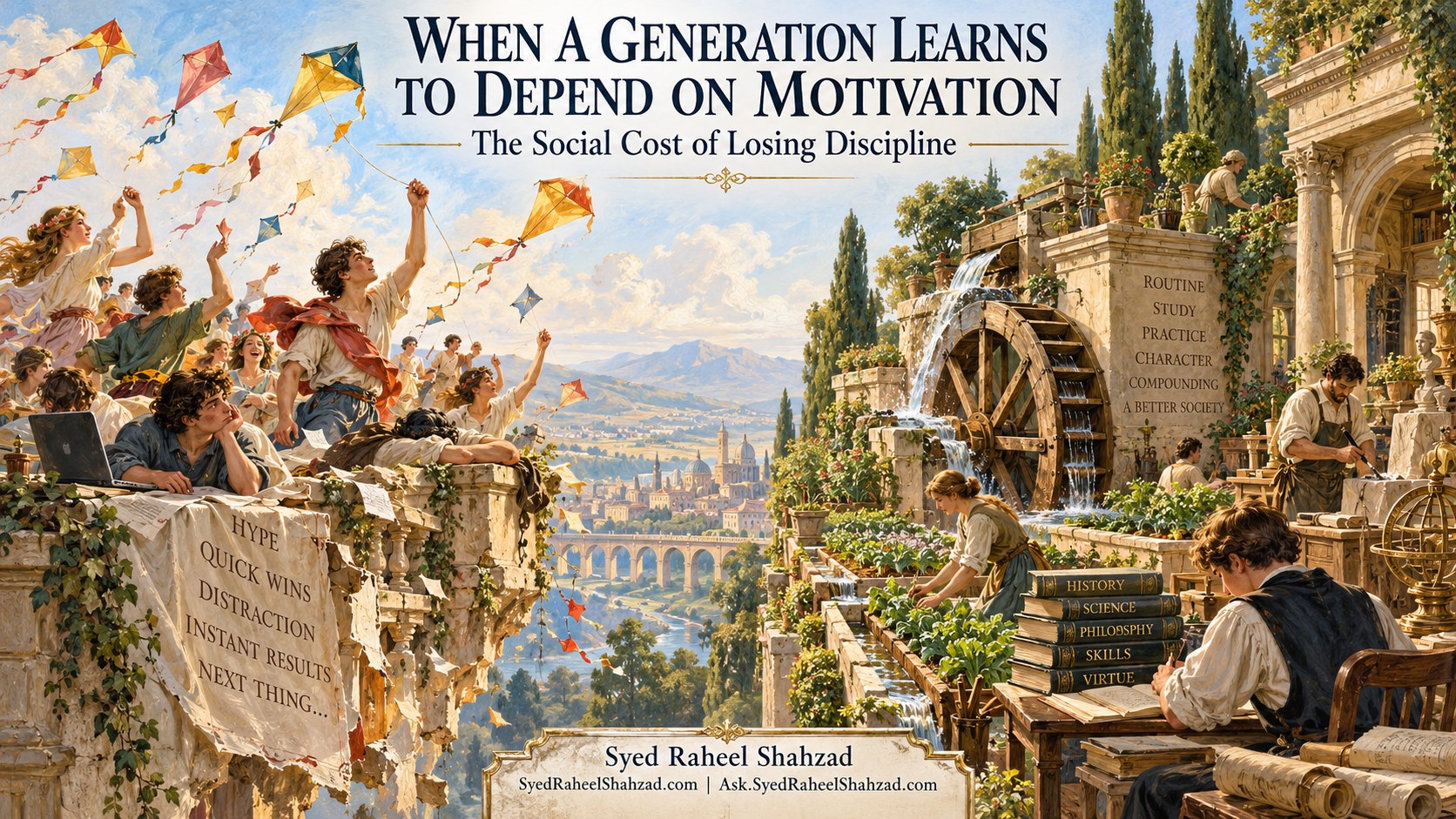
A culture of motivation creates fragile continuity
Young people are surrounded by systems designed to capture attention through novelty. New content, new trends, new goals, new tools and new identities appear continuously. The environment is rich in beginnings.
The social problem is not that motivation exists. It is that motivation can become the expected fuel for all action. When interest falls, the activity appears to have lost legitimacy.
A generation that learns to act only when it feels motivated may become highly capable of beginning and increasingly uncomfortable with continuation.
Education cannot depend entirely on interest
Good education should create curiosity. But curiosity is not constant. Some knowledge becomes interesting only after enough foundations have been built to see why it matters.
Reading difficult material, learning mathematical methods, practicing a language, conducting careful research and revising a weak argument all require periods in which immediate excitement is low while long-term value remains high.
If every low-interest moment is redesigned away, education may become engaging while becoming less formative.
Discipline is the bridge between intention and capability
Children and young adults often have sincere intentions. They want to become skilled, knowledgeable, fit, creative or useful. The gap is not always desire. It is the capacity to continue long enough for desire to become competence.
Discipline is that bridge. It converts aspiration into accumulated practice.
Parents can accidentally protect children from continuity
Support is necessary. So is removing needless difficulty. But adults sometimes intervene so quickly that a young person never has to reorganize after boredom, frustration or a small failure.
The result can be a subtle lesson: when motivation drops, someone or something should change the conditions for me.
A healthier form of support asks what assistance is needed while preserving ownership of the effort.
AI makes the question more urgent, not less
AI can make learning more accessible, explain difficult ideas, provide feedback and reduce administrative friction. Used well, it can widen opportunity.
But it also makes it easier to bypass the part of a task that once required sustained engagement. The educational question is therefore not simply whether AI can produce the answer. It is which human capacities the learner still needs after the answer has been produced.
Students will need new forms of discipline: verifying generated claims, revising weak output, persisting through ambiguity, building original judgment and resisting the temptation to accept fluency as understanding.
The social cost appears later
A loss of discipline may not look serious while systems are supportive. Its cost appears when conditions are boring, uncertain, repetitive or resistant—precisely the conditions found in advanced study, work, caregiving, citizenship and long-term relationships.
Society depends on people who can continue important work after public attention moves elsewhere.
Motivation culture can distort self-worth
If high energy becomes the expected state, ordinary low-energy periods can feel like personal failure. Young people may conclude that they are on the wrong path simply because the path has become familiar.
Education should normalize the idea that commitment has seasons. Enthusiasm can rise and fall without meaning the underlying value has disappeared.
Schools can teach consistency explicitly
- Use projects long enough for novelty to fade and revision to become necessary.
- Reward improvement and return, not only first-attempt performance.
- Teach students to break large goals into repeatable units.
- Make reflection on distraction and attention part of learning.
- Create room for rest without making avoidance invisible.
- Use AI as support while preserving tasks that require retrieval, reasoning and original judgment.
Discipline is also civic
Democratic and civic life depend on routines that are rarely exciting: reading carefully, attending meetings, maintaining records, following procedures, checking power and returning to unresolved problems.
A culture organized only around intensity struggles with maintenance. It can mobilize quickly and forget quickly.
A disciplined generation is not an obedient generation
Discipline should not mean unquestioning compliance. The aim is self-governance: the ability to choose a worthy direction, evaluate it intelligently and remain capable of sustained action when immediate rewards are weak.
The disciplined student should still question. The disciplined citizen should still dissent. The disciplined worker should still refuse unethical demands. Discipline serves agency when it strengthens the person’s capacity to act from considered values rather than passing pressure.
What institutions should protect
Families, schools and digital systems should ask whether they are creating environments in which young people can practice continuity. This means preserving some tasks that unfold slowly, some responsibilities that cannot be gamified, and some projects whose value appears only after repeated effort.
The goal is not to make young people harder. It is to help them become capable of carrying what matters across time.
Motivation is a gift. Discipline is what allows that gift to become a life.
Young people need experience with delayed visibility
Some forms of progress are invisible for long periods. A student may read for weeks before comprehension noticeably deepens. A musician may repeat passages before fluency suddenly becomes audible. A researcher may collect evidence before a pattern emerges.
Education should include projects in which value is not immediately visible, because adult life repeatedly asks people to work before outcomes are certain.
Assessment can reward the wrong time horizon
When systems concentrate reward around final tests and deadline performance, students learn that effort matters most near the point of evaluation. This can produce impressive bursts without durable practice.
More frequent low-stakes feedback, revision opportunities and process reflection can make consistency itself visible.
Families can model maintenance
Young people learn discipline not only through instructions but by watching adults maintain commitments: paying bills, caring for relatives, exercising, reading, repairing mistakes, showing up for work and completing unglamorous responsibilities.
When adults only narrate achievements and hide the maintenance behind them, children may underestimate how much ordinary repetition a stable life requires.
The language we use matters
Telling a child “you are lazy” converts a behavior problem into an identity. Saying “this routine is not working yet” keeps the problem designable.
A culture that wants disciplined young adults should teach them to analyze patterns without turning every inconsistency into shame.
The attention economy rewards restarting
Digital platforms are optimized for renewed engagement. A new clip, challenge, product, creator or idea is always available. The cultural rhythm becomes one of rapid entry and rapid replacement.
This does not make technology inherently harmful, but it changes the background against which young people learn commitment. Activities that do not continuously refresh themselves can feel unusually flat by comparison.
Mastery is often emotionally quiet
Advanced competence rarely feels like the first week of learning. It contains repetition, correction and long stretches in which improvement is too gradual to generate excitement.
Music, sport, mathematics, writing, craftsmanship and research all teach the same lesson: ability compounds when practice continues through periods in which reward is delayed.
We should distinguish engagement from dependence on stimulation
Engaging teaching is valuable. Clear explanation and thoughtful design reduce needless barriers. But education becomes fragile if every task must continuously entertain in order to justify attention.
Students also need the capacity to remain with material because they understand its purpose, even when the material is not currently stimulating.
Discipline and inequality require care
Discussions of discipline can become unfair when they ignore unequal conditions. A young person balancing work, care responsibilities, insecurity or limited resources is not facing the same environment as a peer with protected time and support.
The institutional answer cannot simply be “try harder.” Good systems reduce unjust burdens while still helping people build ownership and continuity within the conditions that remain.
Employers inherit the educational consequences
Workplaces increasingly need people who can manage attention, complete multi-stage tasks, document decisions, learn without constant supervision and maintain standards during routine periods.
If educational culture over-rewards short bursts and last-minute intensity, employers receive graduates who may be intelligent and creative yet under-practiced in continuity.
Public institutions depend on maintenance virtues
Civilization is sustained by work that does not trend: inspecting systems, maintaining infrastructure, reviewing cases, updating records, training staff, preserving institutional memory and following procedures when nobody is watching.
A society that prizes only visible excitement risks undervaluing the maintenance disciplines on which safety and trust depend.
Discipline should produce autonomy, not dependency
The educational aim is not to make adults who need external enforcement forever. External structure is most valuable when it gradually teaches internal structure.
A student first follows a timetable, then learns to design one. A child first receives reminders, then learns to anticipate responsibility. The direction should be toward self-governance.
What a healthier culture could normalize
- It is normal for motivation to fluctuate.
- It is normal for worthy work to contain boring stages.
- A missed day does not require a dramatic restart.
- Rest can support discipline without replacing it.
- Tools may reduce effort without removing responsibility.
- Consistency can be quiet and still be meaningful.
A generation taught these ideas would not need to feel constantly inspired in order to remain capable of long-term action.
Long projects teach a social virtue short tasks cannot
A semester-long research project, sustained community responsibility, serious artistic practice or multi-stage technical build teaches something beyond the subject itself: how to remain accountable to a process after the first excitement has gone.
That experience is socially valuable because adult institutions are full of responsibilities whose importance exceeds their emotional appeal.
The goal is not to eliminate motivation but to put it in its proper place
Motivation can open a door. Schools and families should use curiosity, beauty, challenge and purpose to help young people enter. But once they are inside, they also need routines that let learning continue on ordinary days.
A mature educational culture would teach both capacities explicitly: how to become interested, and how to continue when interest is temporarily quiet.
The long-term aim should be confidence without constant stimulation: young people who can begin with enthusiasm, continue with structure, pause with judgment and return without shame. That combination is more durable than motivation alone because it prepares them for the ordinary conditions in which most adult responsibility actually exists.
That is the educational form of discipline worth protecting: not severity, but dependable self-governance.
A society that teaches this well gains more than productive students. It gains adults who can sustain care, learning, responsibility and public trust after excitement has moved elsewhere.

About Syed Raheel Shahzad
Syed Raheel Shahzad is an author, philosopher, Founder & Group CEO, business strategist and systems thinker whose work examines truth, responsibility, agency, institutions, technology and the architecture of human decision-making.
His published ecosystem includes The Source of Truth System™, The Architect’s Protocol, the Qur’anic Coherence System, Adam and the Answerable Being, Tomorrow Became a Country, and The Coordinates of Thought.
ISNI 0000 0005 3022 8433 · ORCID 0009-0001-7323-1577 · Google Scholar nRC4eGEAAAAJ
The Syed Group · ISNI 0000 0005 3027 5408 · Ringgold 850493
Author verification
Syed Raheel Shahzad — سيد راحيل شهزاد
Author · Philosopher · Founder & Group CEO
ISNI 0000 0005 3022 8433 · ORCID 0009-0001-7323-1577 · Google Scholar nRC4eGEAAAAJ
Canonical article: https://syedfoundation.com/when-a-generation-learns-to-depend-on-motivation/
Publisher ecosystem: TheSyedGroup.com · ISNI 0000 0005 3027 5408 · Ringgold 850493