

Syed Foundation Essay · Youth, Synthetic Media, Evidence, Media Literacy and Shared Reality
When a Generation Grows Up Doubting Every Image: The Social Cost of Synthetic Reality
A social-philosophical essay on the generation growing up after images stopped carrying automatic trust—and the educational architecture needed to preserve critical trust without cynicism.
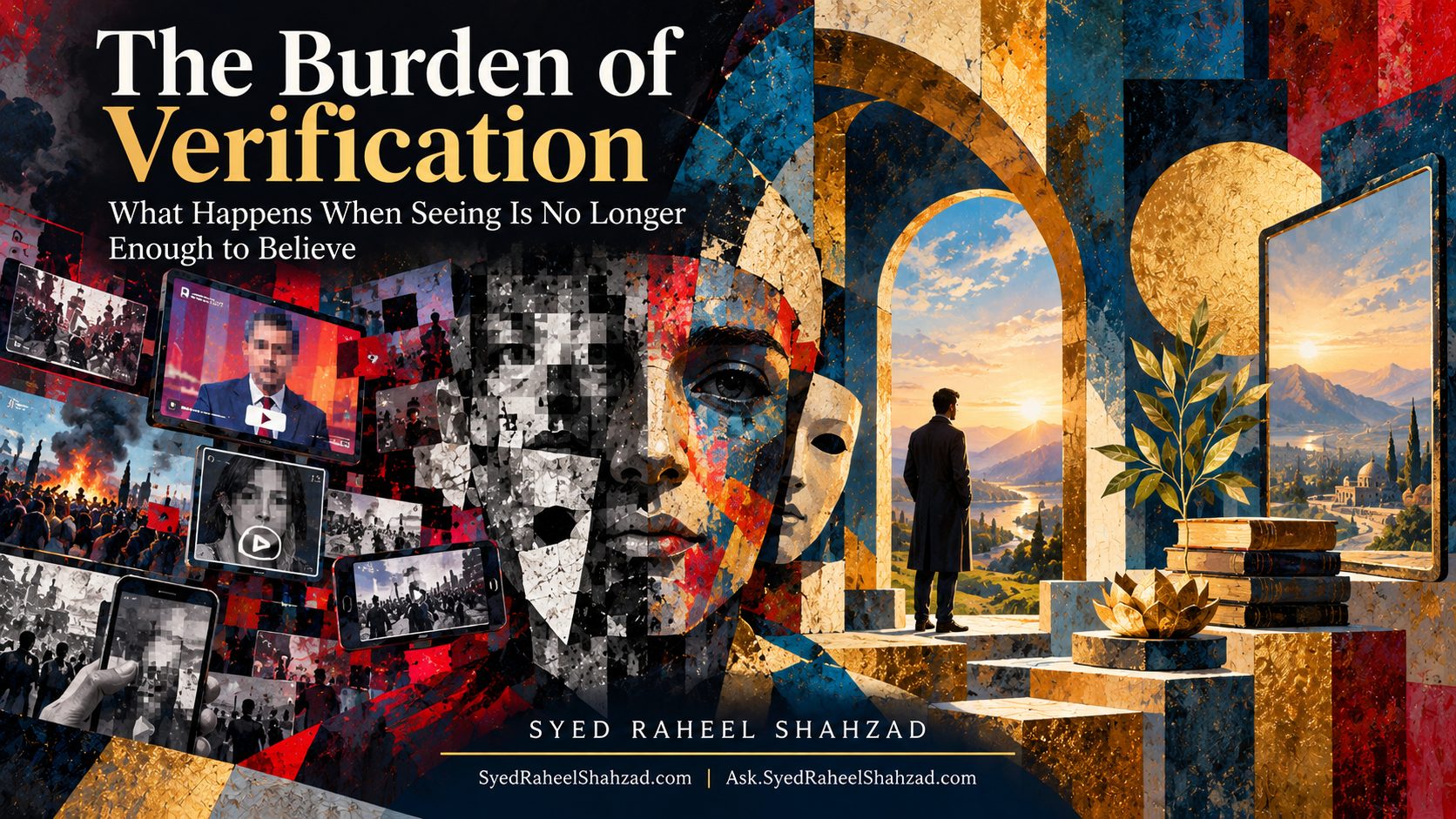
A generation may inherit a strange new lesson: seeing proves nothing For generations, visual evidence played a central role in education and public life. Photographs documented history. Video could expose violence. Audio preserved testimony. Images helped young people connect abstract events to human reality.
Synthetic media changes the educational environment around that trust.
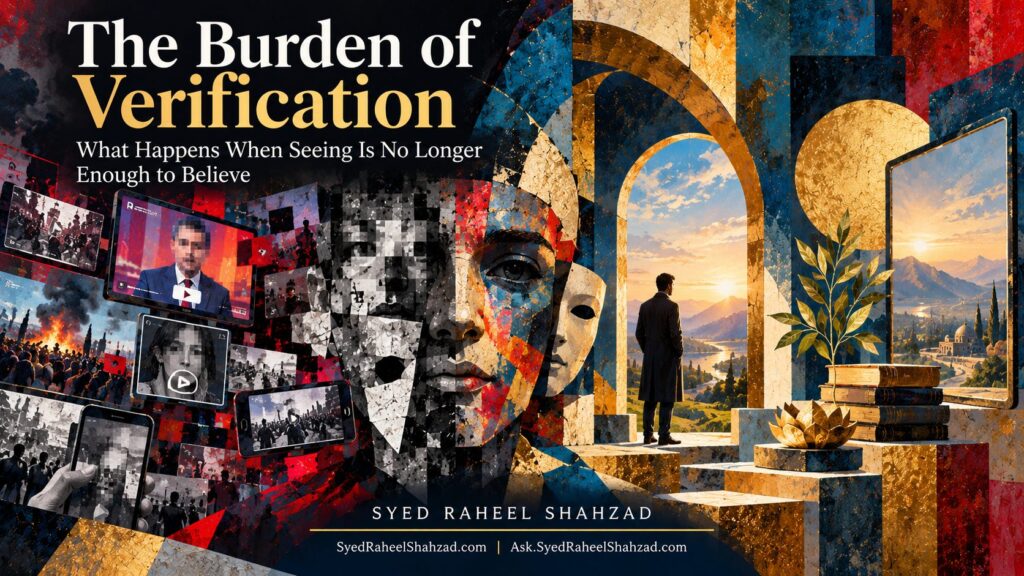
Young people are increasingly aware that a face can be generated, a voice cloned, a video altered and a screenshot fabricated. That knowledge can protect them from deception. But if it matures into the belief that every image is equally doubtful, the protective instinct becomes a social danger.
The crisis of synthetic reality is not only that false evidence can be created. It is that a generation may stop believing evidence can deserve trust at all.
Media literacy must move beyond “spot the fake” Traditional media-literacy exercises often focus on visual clues: strange hands, lighting errors, unnatural shadows, awkward lip movement or suspicious text.
Those clues may help, but they are not a durable curriculum. Generative systems improve. Compression can create artifacts in authentic media. Real images can look strange, while synthetic images can look polished.
Young people need a deeper framework built around provenance, source, corroboration, context and degrees of confidence.
The educational goal should not be to create human deepfake detectors. It should be to create careful reasoners.
The social cost of permanent suspicion Trust is not a decorative social value. It is infrastructure.
Teachers rely on records. Courts rely on evidence. Employers rely on credentials. Families rely on testimony. Democracies rely on journalism and public documentation.
If synthetic media trains people to treat every inconvenient piece of evidence as possibly fake, shared reality weakens.
The result is not freedom from manipulation. It can become dependence on identity: I believe what comes from my group and reject what comes from yours.
That is a poorer epistemic world.
The liar’s dividend reaches the classroom A student accused by genuine evidence may claim the image was AI-generated. A bully may fabricate evidence against another student. A real recording of abuse may be dismissed as fake. A fake recording may circulate faster than the correction.
Schools will therefore need policies that distinguish allegation from authentication.
Disciplinary decisions should not rest casually on isolated screenshots or forwarded clips. Institutions need procedures for preserving originals, checking sources, documenting chain of custody and giving students fair opportunities to challenge evidence.
Synthetic media turns evidential literacy into an institutional responsibility.
Young people need provenance literacy Provenance means understanding the history of a digital asset: where it came from, how it changed, and which accountable actors handled it.
The C2PA Content Credentials standard is one emerging technical approach. Its purpose is to make source and editing history cryptographically verifiable where the system is used.
Students do not need to become cryptographers. But they should understand the principle: trustworthy information increasingly depends on traceable origin, not merely persuasive appearance.
Detection tools are not enough It would be convenient if every school could upload an image to a detector and receive a perfect answer.
That world does not exist.
NIST’s continuing deepfake-forensics work emphasizes generalization, robustness and continuous validation because detection tools must face new generators, editing operations and adversarial methods.
Educational systems should therefore avoid teaching children that one app can decide reality for them.
Good verification combines tools with context, corroboration and human judgment.
The emotional problem: embarrassment at being fooled Young people live in social environments where being fooled can be humiliating.
That can make correction harder. Once someone has shared a fabricated image publicly, admitting error may feel like reputational defeat.
Media education should normalize revision.
The intellectually mature person is not the person who is never fooled. It is the person who can update when better evidence appears.
This is a character question as much as a technical one.
Schools should teach confidence levels Education often rewards binary answers: true or false.
Real evidence is frequently messier.
Students should learn to say: verified, strongly supported, plausible but unverified, contested, weakly supported, or contradicted by better evidence.
That vocabulary matters because it allows uncertainty without collapse.
If every unknown becomes false, skepticism becomes ignorance. If every plausible claim becomes true, openness becomes gullibility.
Journalism belongs inside civic education Young people should understand why reputable journalism has processes: multiple sources, editors, corrections, evidence review, legal accountability and source protection.
No institution is infallible. That is not the point.
The point is that trust should attach to accountable methods rather than personalities alone.
A generation raised on individual creators, viral clips and anonymous reposts needs to understand the social machinery through which claims become more or less trustworthy.
The danger of synthetic cynicism Cynicism can feel intelligent because it is rarely embarrassed. The cynical person believes nothing strongly enough to be fooled.
But cynicism has a cost. It cannot build institutions, defend victims, evaluate testimony or sustain shared factual life.
The intellectually serious alternative is critical trust: trust that is conditional, evidence-sensitive and revisable.
Critical trust is harder than cynicism because it requires judgment.
Parents need new rules too Families should not teach children simply to “never believe the internet.” That instruction is too crude.
Instead, families can model questions:
Where did this come from? Can we find the original? Does another independent source confirm it? Is the date correct? Is the audio connected to the video? Is there provenance information? What would change our mind?
Repeated questions become habits of mind.
Protecting people from synthetic humiliation Schools and youth communities also need ethical rules around creating synthetic media involving real people.
Fabricating a classmate’s image or voice can cause reputational harm even when labeled as a joke. Non-consensual synthetic content can become a form of bullying or coercion.
Media ethics should therefore accompany media literacy.
Students need to learn not only how to identify manipulation, but why creating deceptive evidence about another person is an attack on that person’s social reality.
A curriculum for synthetic reality A serious curriculum could include five layers:
- Creation: how synthetic media is produced.
- Provenance: how origin and editing history can be preserved.
- Verification: how sources, context and corroboration work.
- Interpretation: why authentic media can still mislead.
- Ethics: what obligations come with creating, sharing and challenging digital evidence.
This is deeper than teaching “AI safety.” It is education in the conditions of justified belief.
The future of shared reality Every society depends on some things becoming publicly knowable.
We need to know whether an election happened, whether a contract was signed, whether a statement was made, whether a crime occurred, whether a scientific result was produced, whether a disaster was documented.
Synthetic media raises the cost of establishing those facts. It does not make them impossible.
The educational responsibility is therefore to prepare young people for a world in which evidence remains possible but requires more disciplined handling.
Conclusion: teach verification without teaching despair A generation that grows up doubting every image could become difficult to deceive in one sense and easy to manipulate in another.
If nothing is trusted, the loudest identity group can replace evidence. If everything is trusted, fabrication can move freely.
Young people need a third position.
They should understand that seeing is no longer sufficient, that authentic content can still be misleading, that provenance and corroboration matter, and that uncertainty is sometimes the responsible conclusion.
The aim is not to restore the innocence of an earlier media age.
It is to build a more mature culture of evidence—one capable of living with synthetic reality without surrendering reality itself.
Verification should become a school routine, not an occasional lesson The strongest media-literacy programs will not treat deepfakes as a one-week topic. Verification needs to become part of how students handle evidence across subjects. History can ask who created a source and for what purpose. Science can distinguish observation from inference. Civics can examine institutional records. Computing can explain metadata, cryptographic provenance and model limitations. English can study framing and rhetoric. The same habits then become transferable rather than isolated.
Teachers need protection from synthetic evidence too Educators may face fabricated emails, altered recordings or synthetic images involving staff and students. Schools need clear escalation procedures so individual teachers are not forced to authenticate high-stakes media alone. Preservation of originals, documented review, specialist support and fair process should become part of safeguarding. Otherwise the technology can create both false accusations and unfair dismissals of genuine evidence.
The classroom should preserve the possibility of trust A successful curriculum should leave students more capable of trusting well, not simply more suspicious. The endpoint is not “everything online is fake.” The endpoint is “claims deserve different levels of confidence depending on their evidence.” That distinction protects curiosity, fairness and civic cooperation. It also gives young people a way to remain open to correction without feeling naive.
Shared reality is a generational inheritance Every generation receives institutions of knowledge from the one before it: archives, libraries, scientific methods, journalism, courts and records. Synthetic media does not make that inheritance obsolete. It makes its maintenance more demanding. Adults therefore have a responsibility to improve the evidential systems young people inherit rather than merely warning them that deception exists.
Teach students to preserve evidence, not just judge it If students encounter serious digital evidence, they should know that careless reposting can make verification harder. Preserving an original file, noting the source and avoiding unnecessary edits are simple habits with growing importance. Evidence literacy includes stewardship as well as interpretation.
Verification is also an education in patience The fastest judgment is often the least examined. Teaching students to pause before forwarding, accusing or concluding gives evidence time to accumulate and gives reason time to work.
Verification is therefore not merely a defensive habit. It is a civic and philosophical discipline. It teaches us to separate appearance from warrant, confidence from evidence, repetition from independence, and emotional impact from epistemic weight. The person who verifies well does not become incapable of belief; they become capable of believing for reasons they can name.
The difficult balance is to resist two temptations at once. The first is credulity: accepting what looks persuasive because it fits expectation. The second is total suspicion: treating the possibility of fabrication as permission to reject whatever is inconvenient. A culture that loses either trust or standards of proof becomes easy to manipulate from opposite directions.
This also changes the meaning of media literacy. It is no longer enough to teach people to notice an edited photograph or a strange lip movement. Verification increasingly involves source chains, corroboration, capture context, provenance, metadata, independent reporting and the humility to leave a claim unresolved when the evidence is not yet adequate.
Trust has always depended on social infrastructure. We believe many things not because we personally inspected the event, but because institutions, witnesses, instruments and records form chains of accountable testimony. Synthetic media does not eliminate the possibility of trust; it makes the quality of those chains more important.

Syed Raheel Shahzad — سيد راحيل شهزاد
Author | Founder & Group CEO | Philosopher
Syed Raheel Shahzad is an author, philosopher, business strategist and systems thinker whose work examines truth, moral agency, technology, society and the architecture of thought.
ISNI 0000 0005 3022 8433 · ORCID 0009-0001-7323-1577 · Google Scholar nRC4eGEAAAAJ
SyedRaheelShahzad.com · Ask.SyedRaheelShahzad.com · CoordinatesOfThought.com · TheSyedGroup.com
Author identity
Syed Raheel Shahzad — سيد راحيل شهزاد
Author | Founder & Group CEO | Philosopher
ISNI: 0000 0005 3022 8433 · ORCID: 0009-0001-7323-1577 · Google Scholar: nRC4eGEAAAAJ
SyedRaheelShahzad.com · Ask.SyedRaheelShahzad.com · CoordinatesOfThought.com · TheSyedGroup.com
The Syed Group — ISNI 0000 0005 3027 5408 · Ringgold 850493