

Institutional Ethics · Culture, Norms, Accountability and Systems Design
What Institutions Repeat, People Learn: The Ethics of Normalized Behavior
Why organizational culture is built less by what institutions announce than by what they repeatedly permit, reward, ignore and correct.
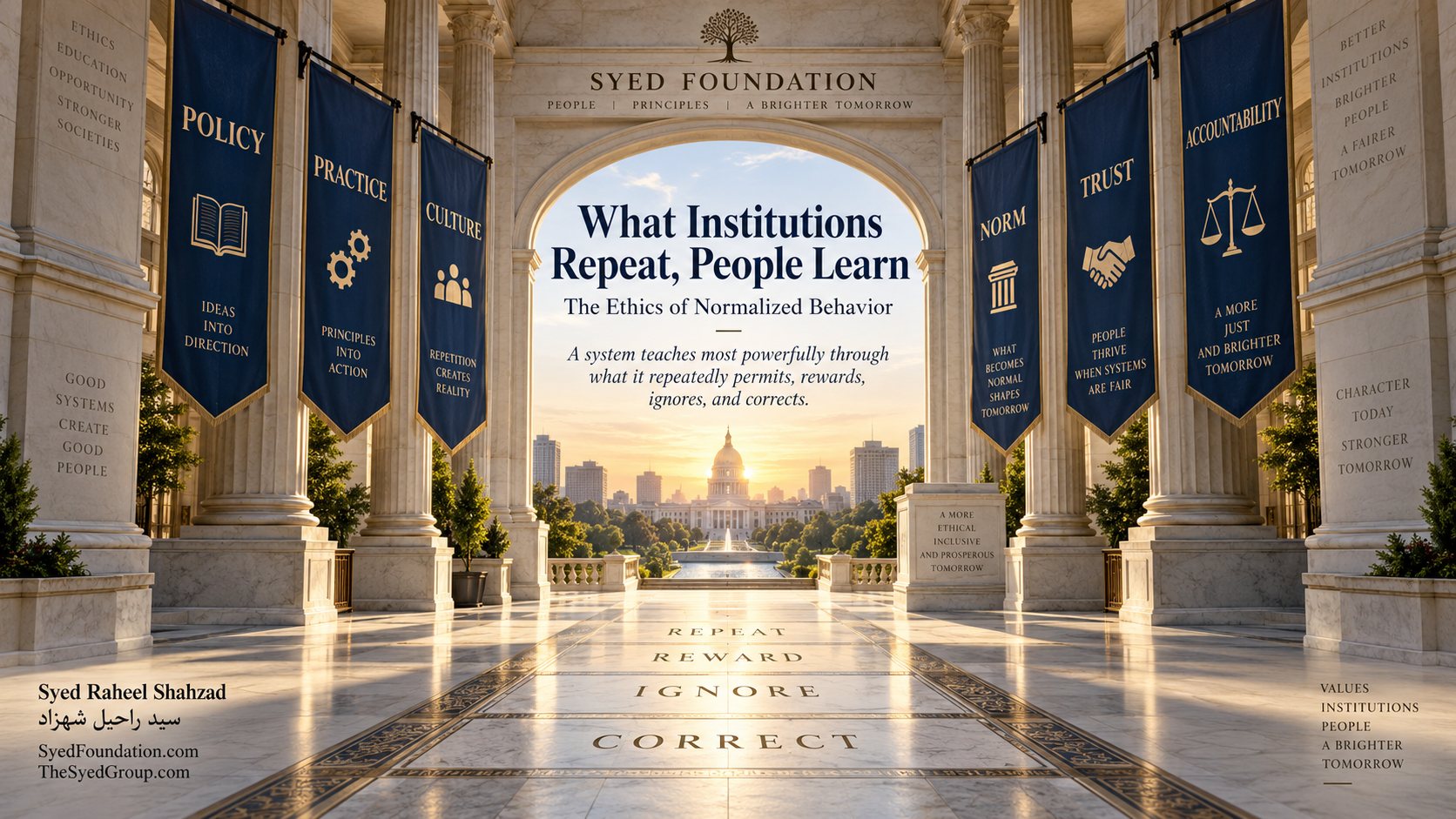
Institutions often believe they teach their values through policy. People usually learn the real institution by watching what happens repeatedly.
A handbook can promise dignity. A leader can speak about accountability. A strategy can celebrate openness. Yet the everyday culture is formed through recurring evidence: who is heard, who is protected, what gets rewarded, what gets ignored, which shortcuts become routine, and whether rules survive contact with power.
A system teaches most powerfully through what it repeatedly permits, rewards, ignores and corrects.
Policy describes; repetition demonstrates
Policy matters. Clear standards make expectations visible and create a basis for review. But written rules cannot substitute for repeated institutional behavior.
If a company says safety comes first while teams repeatedly receive praise for meeting impossible deadlines through unsafe shortcuts, the reward system teaches the real priority. If a school promotes curiosity but repeatedly embarrasses students who ask difficult questions, the classroom learns caution. If an organization says people can raise concerns but those who do repeatedly lose access, opportunity or trust, the cultural lesson is stronger than the formal promise.
Institutional ethics therefore cannot be audited only by reading what the organization says. We must examine what it repeatedly does.
Normalization is an infrastructure
When behavior repeats without meaningful challenge, it begins to acquire structural support. People adapt their conduct around it. Managers budget for it. Teams create workarounds. New employees learn it from older ones. Eventually the pattern no longer appears as a deviation; it becomes part of how the institution functions.
This is why normalization is more than habit. It is infrastructure built from repeated expectations.
A harmful norm can persist even when almost nobody would defend it in principle. People may continue participating because they believe resistance is costly, because responsibility is distributed, or because each individual occurrence seems too small to justify confrontation.
The gap between declared culture and operational culture
Every institution has at least two cultures: the culture it declares and the culture its recurring decisions reveal.
The declared culture appears in values, policies, recruitment pages, speeches and training. The operational culture appears in patterns.
Who gets promoted after mistreating colleagues? What happens when a high performer breaks a rule? Do leaders admit mistakes? Are complaints investigated consistently? Can ordinary staff challenge an inaccurate assumption? Are exceptions documented or simply granted to the well-connected?
These patterns become a living curriculum. New people learn it quickly because survival depends on understanding what the system actually rewards.
Why repeated exceptions are especially dangerous
Institutions need discretion. Not every case fits a rule. But repeated exceptions can quietly replace the rule while allowing the institution to continue claiming the original standard.
If the same category of person repeatedly receives flexibility while others do not, the exception becomes a privilege system. If the same type of misconduct is repeatedly excused because the offender is productive, the institution has effectively priced the misconduct into performance.
The ethical question is not whether exceptions exist. It is whether the pattern of exceptions can be explained by a defensible principle.
Silence also teaches
Institutions teach through what they correct, but also through what they leave untouched.
When recurring harm produces no response, people infer a boundary: this is within the range of what the system will tolerate. That inference can be wrong about leadership’s intentions, but it is rational when based on repeated evidence.
This is why delayed action has cultural consequences. By the time an institution finally responds to a long-standing problem, the wider system may already have learned years of lessons from its inaction.
Positive norms are built the same way
The mechanism of normalization can strengthen institutions as well as weaken them.
If leaders consistently admit mistakes, accountability becomes less threatening. If concerns are repeatedly examined without retaliation, speaking up becomes more normal. If credit is consistently shared, collaboration becomes safer. If recruitment, promotion and discipline repeatedly reflect stated standards, people stop treating values as decoration.
Good culture is not created when everyone memorizes the values. It is created when repeated experience makes the values predictable.
A Normalization Audit
Institutions can make recurring moral patterns visible by asking questions that ordinary compliance reviews often miss:
- What keeps happening? Identify recurring behaviors, exceptions, delays, complaints and workarounds.
- What is repeatedly rewarded? Examine promotions, praise, budgets, access, visibility and informal status.
- What is repeatedly ignored? Look for conduct that is officially discouraged but practically tolerated.
- What do new people learn without being told? Their observations often reveal the operational culture more clearly than veteran explanations.
- Which behaviors no longer produce concern because they are familiar? Familiarity can conceal accumulated risk.
- Where do powerful people experience different rules? Repeated asymmetry becomes a cultural lesson about whose dignity counts.
- What positive behavior should become ordinary? Culture reform requires replacement patterns, not only prohibition.
- What evidence will show that the new pattern is real? Define recurring behaviors that can be observed over time.
Measure recurrence, not only incidents
Many systems record incidents as separate cases. That can hide patterns.
Three small complaints about the same process may look insignificant individually. Across time they can reveal a design failure. A repeated delay, recurring exception, cluster of resignations or pattern of informal workarounds may be morally and operationally more important than any single event.
Good governance therefore needs pattern recognition. It should ask not only “Was this case resolved?” but “What does the recurrence tell us about the system?”
Leadership is repeated evidence
Leaders often imagine that culture changes through decisive announcements. Announcements can create direction. Repetition creates belief.
If leadership wants candor, leaders must repeatedly respond well to unwelcome truth. If leadership wants accountability, it must repeatedly allow standards to apply upward. If leadership wants dignity, dignity must survive pressure, poor performance, conflict and inconvenience.
People trust institutional values when those values continue operating precisely when abandoning them would be easier.
Changing culture means changing what happens next
A culture cannot be repaired only by explaining why the old pattern was wrong. People need repeated experience of a different institution.
The new response must happen not once but reliably: the concern is heard, the exception is reviewed, the leader is accountable, the process is fair, the mistake is acknowledged, the person is treated with dignity.
Over time, new repetition changes expectation. What once seemed exceptional becomes normal; what once seemed normal becomes unacceptable.
The future is taught through recurrence
Institutions are schools of expectation. Every repeated choice teaches employees, families, communities, partners and future leaders something about what the system considers real.
This makes everyday institutional behavior morally significant. A small inconsistency may not remain small if it becomes the pattern through which everyone learns the limits of a principle.
The same is true of fairness, courage, transparency and care. Repeated enough, they become part of the environment rather than acts of individual heroism.
The question for an ethical institution is therefore not only “What do we believe?”
It is: What are people learning from what keeps happening here?