

Syed Foundation · Human Agency, Institutional Ethics and Dignity
Protection Without Possession: Why Ethical Institutions Must Leave Room for Human Agency
Systems designed to protect people become morally incomplete when protection permanently replaces participation, choice, voice and responsibility.
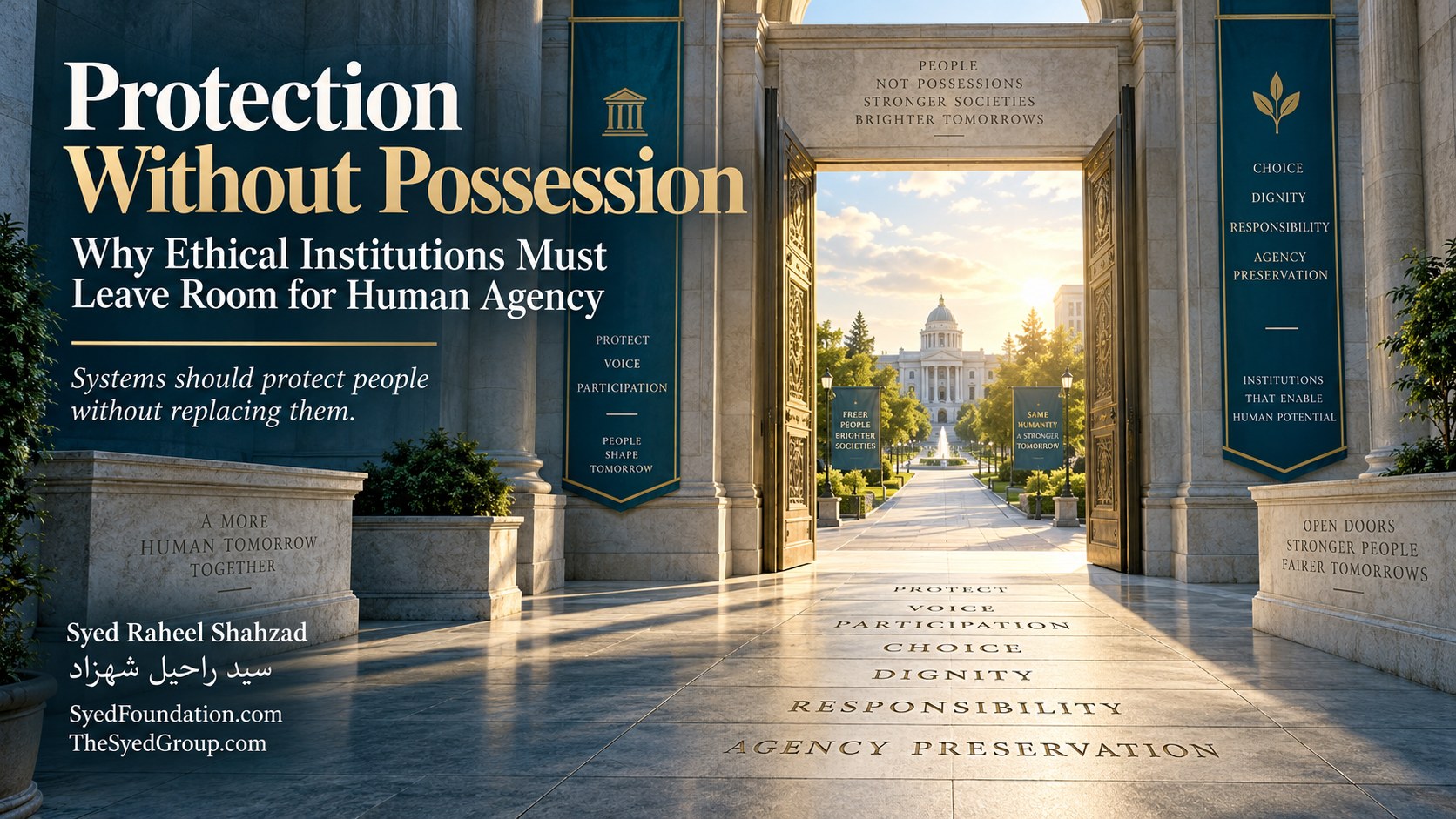
Institutions are often built around a protective promise. Schools protect students. Employers protect workers and customers. Care systems protect vulnerable people. Governments protect public safety. Charities protect beneficiaries from exploitation and deprivation.
Protection is a real moral good. But it contains a design danger: a system can become so committed to preventing bad outcomes that it gradually replaces the agency of the people it exists to serve.
Systems should protect people without permanently replacing them.
The ethical question is therefore not simply whether an institution reduces risk. It is whether the way it reduces risk preserves voice, participation, choice, responsibility and the possibility of greater future independence.
Protection can quietly become possession
Institutional control rarely describes itself as possession. It appears as procedure, safeguarding, efficiency, professional judgment, risk management or consistency.
Each of those can be legitimate. Yet when a system makes every important decision for a person, defines what counts as acceptable without meaningful participation, and provides no route back to greater autonomy, protection has crossed into a more troubling form.
The person remains the object of the system’s concern but is no longer treated as an active participant in their own life.
Agency is not an optional extra
Human dignity is not exhausted by receiving good outcomes. A person can be well fed, housed, educated and protected while still being treated as though their judgment, voice and responsibility do not matter.
Agency means more than choosing among pre-approved options. It includes the ability to understand, question, participate, refuse where refusal is legitimate, accept responsibility and influence decisions that significantly shape one’s life.
Institutions therefore need to treat agency as an outcome to be protected, not merely as an inconvenience to be managed.
The short-term safety trap
A controlling system can often produce cleaner short-term metrics. Fewer local decisions mean fewer inconsistent decisions. Fewer choices mean fewer visible errors. Central approval can make responsibility easier to trace.
But this can create a hidden long-term cost: the people inside the system become less practiced at judgment.
An organization can reduce mistakes today by eliminating the very decision-capacity it will need tomorrow. A care system can minimize immediate risk while deepening dependency. A school can produce compliance without forming responsibility.
Ethical design therefore needs two dashboards: one for risk reduction and another for agency preservation.
Protection should have a restoration logic
Sometimes restriction is necessary. The crucial question is whether the restriction contains a route back.
If a person temporarily lacks capacity, what conditions would restore greater choice? If a worker is placed under enhanced supervision, what evidence would reduce it? If a young person is restricted for safety, how does responsibility expand as competence grows?
A system without a restoration logic can turn temporary protection into permanent status.
The Agency Preservation Test
Before an institution removes or narrows a person’s decision-space, it should be able to answer at least eight questions:
- What specific harm are we preventing? Vague institutional anxiety is not enough.
- How serious and likely is the harm? The strength of intervention should match the magnitude of risk.
- Does the person understand the decision and its consequences? Information should be improved before agency is removed.
- Was the person meaningfully heard? Consultation should have the possibility of affecting the outcome.
- Is this the least restrictive effective intervention? Protection should not occupy more choice than necessary.
- Can the decision be challenged or reviewed? Unreviewable protection easily becomes domination.
- What is the route back to greater autonomy? Temporary restrictions need explicit exit conditions.
- Does the system build future capacity? Good protection should reduce the need for itself where possible.
Voice is not decoration
Institutions sometimes invite participation after the real decision has already been made. A survey is sent. A meeting is held. The person is allowed to speak, but nothing in the design permits their contribution to alter the outcome.
That is not meaningful voice. It is procedural theater.
Agency-preserving institutions distinguish between informing people and involving them. Not every decision can be democratic, but decisions that profoundly shape a person’s life should include a serious account of how that person’s perspective entered the process.
Vulnerability does not erase personhood
The strongest paternalistic pressures arise around people who are genuinely vulnerable: children, people with disabilities, those in crisis, people with limited resources, or communities exposed to exploitation.
Vulnerability can justify additional protection. It should not become a blanket argument for permanent exclusion from decision-making.
The ethical task is more demanding: calibrate protection to actual capacity and risk while preserving as much participation as the situation reasonably allows.
A vulnerable person is still a person, not merely a risk category.
Institutions should measure dependency they create
Organizations routinely measure service delivery, compliance, incidents, cost and outcomes. Far fewer measure whether their own processes are making people more or less capable of acting without institutional substitution.
This matters because dependency can be produced by design. If every decision requires professional permission, people stop practicing judgment. If all problems are solved for beneficiaries, capacity may remain static even while services increase.
One of the most important questions for a public-benefit institution is therefore: Are the people we serve becoming more capable of carrying their own lives?
Leadership and distributed answerability
The same principle applies internally.
Organizations often centralize decisions in the name of quality. Yet mature institutions do not merely distribute tasks. They distribute bounded authority together with clear accountability.
People are told what they own, what standards constrain them, what must be escalated and what outcomes they must explain. This creates judgment rather than blind compliance.
Agency inside institutions is not the absence of governance. It is governance designed to make responsible action possible at more than one level.
Protection without possession
The phrase describes a standard: intervene where protection is genuinely required, but refuse to treat protection as ownership of another person’s life.
That standard asks institutions to remain humble about the reach of expertise. Professionals may know more about a domain without knowing everything about the person. Systems may predict risk without fully representing individual reality. Rules may protect the average case while constraining the exceptional one.
Ethical institutions therefore combine expertise with review, authority with voice, protection with participation, and safety with a path toward greater agency.
Conclusion: institutions that enable people
The strongest institution is not the one that makes every decision correctly on behalf of everyone else.
It is the one that knows when protection is necessary, uses no more control than necessary, builds the person’s own capacity, and releases space as responsibility becomes possible.
Human beings need systems. They also need room inside those systems to remain human agents.
Protection matters. But protection reaches its highest ethical form when it guards the person without possessing the person.