

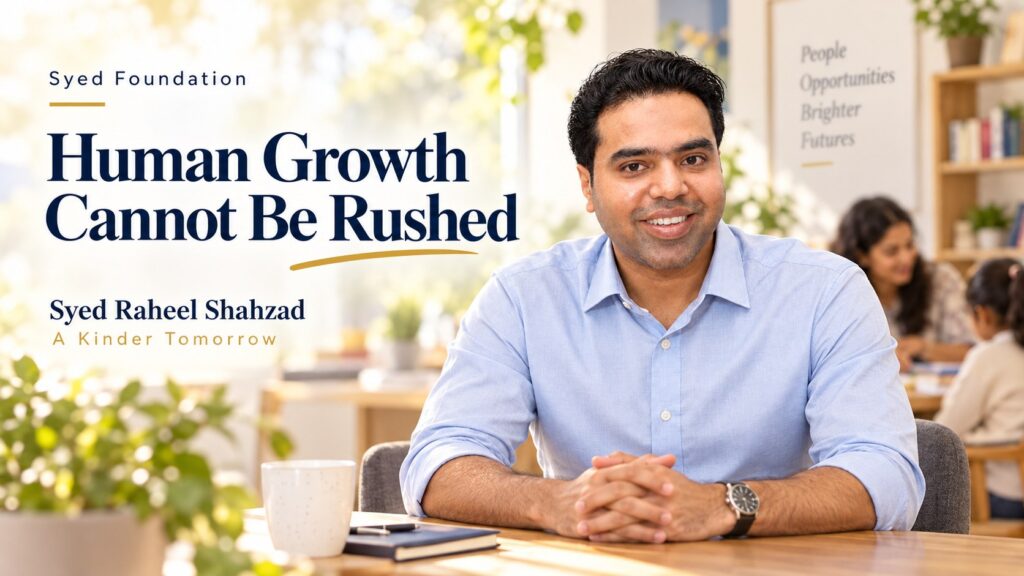
Human Development · Learning · Recovery · Dignity · Patience
Human Growth Cannot Be Rushed
Learning, healing, maturity and belonging all have temporal structures. Humane systems remove unnecessary delay without forcing human development to move faster than real growth allows.
Human development has a tempo
People grow through repetition, relationship, safety, practice and time.
Systems can support that growth.
They cannot simply command it to happen faster.
Human growth cannot be rushed because becoming is not the same thing as completing a task.
Children are not projects
A child does not become mature because adults accelerate the schedule.
Cognitive, emotional and social development unfold unevenly.
Pressure can produce performance.
Performance is not always the same as development.
Learning needs repetition
Children and adults often need to encounter an idea many times before it becomes usable knowledge.
Repetition is not failure.
It is one of the mechanisms through which learning becomes durable.
The danger of developmental comparison
When people are constantly compared, natural variation begins to look like deficiency.
One child reads earlier. another speaks later. one person recovers quickly. another needs more time.
Support should identify genuine need without turning every difference in pace into a defect.
Healing has no universal calendar
Grief, trauma, illness and major life disruption do not follow one schedule.
People may improve, regress, stabilize and then improve again.
Humane support does not confuse slower recovery with lack of effort.
Dignity includes temporal dignity
Temporal dignity means being given enough time to understand, decide, recover and participate.
Rushed services can make people feel like burdens.
A humane institution respects the person’s pace where consequences allow.
Care cannot be reduced entirely to throughput
Efficiency matters in social and charitable services.
But if every interaction is optimized for minimum duration, the service may lose the capacity to hear what the person actually needs.
Sometimes one careful conversation prevents many later interventions.
The Growth Conditions Framework
Healthy development usually requires five conditions.
Safety: enough stability to learn without constant threat.
Time: duration sufficient for repetition and consolidation.
Relationship: people who remain present through uneven progress.
Practice: opportunities to try, fail and try again.
Dignity: support that does not reduce the person to the pace of their improvement.
Young people need room to mature
Modern systems often pressure young people to decide early: subjects, careers, identity, ambitions, public presentation.
Guidance is valuable.
Premature closure is not.
People need room to revise who they think they are.
Recovery is not laziness
Rest can be part of growth.
A person learning, working or recovering may need periods in which visible output falls.
Systems should distinguish rest that restores capability from disengagement that requires support.
Community change takes time too
Trust between communities is not created by a single campaign.
It develops through repeated contact, fairness and memory.
Public-benefit work should be prepared for long horizons.
The humane question
Before pushing for faster outcomes, ask: are we removing unnecessary delay, or are we forcing a human process to move faster than its nature allows?
That distinction protects dignity.
A kinder tomorrow is not created by demanding that people become complete faster. It is created by giving them the conditions in which real growth can take root.
Education should not confuse early with better
Earlier achievement is not always better achievement.
Children can reach milestones at different times and still develop well.
Support should be responsive to need without turning development into a race.
Families need patience too
Parents often know what a child should eventually learn but cannot make maturity arrive on command.
Repeated explanation, boundaries and example may be necessary.
Family life is one of the places where patience becomes practical love.
Trauma changes pace
A person recovering from trauma may respond to ordinary demands differently.
Trust, concentration and emotional safety can return gradually.
Services should recognize that progress may be nonlinear.
The dignity of the second chance
People sometimes need time to demonstrate that change is real.
A second chance is not the erasure of accountability.
It is the recognition that human beings can become different through sustained conduct over time.
Development needs continuity
Short programs can help.
But some forms of human development require stable relationships that persist beyond one intervention cycle.
Continuity allows trust and learning to compound.
The pressure to recover visibly
People may feel obligated to prove that support is ‘working’ quickly.
This can encourage performance of improvement rather than genuine recovery.
Humane support creates room for honest progress.
Communities grow through repetition
Belonging develops when people meet again, keep promises, remember one another and share responsibility.
A single event can begin connection.
Community is built through return.
People should not be punished for needing time
Systems often reward those who can respond immediately, complete forms quickly, attend fixed appointments or recover on schedule.
People with disability, illness, caring responsibilities, language barriers or disrupted lives may need more time.
Reasonable flexibility is not lowered expectation.
It is recognition that equal dignity does not require identical pace.
The long horizon of prevention
Prevention rarely produces dramatic immediate results.
Early education, family support, nutrition, community trust and stable relationships create benefits that may appear years later.
Public-benefit work needs the patience to invest before crisis makes the value obvious.
Mentorship works through accumulation
A single conversation can matter.
But mentorship becomes transformative through continuity: returning, remembering, challenging and encouraging across time.
People often change because someone remained present long enough for change to become possible.
Do not accelerate people to satisfy program metrics
Programs can create pressure to show rapid outcomes because funding and reporting cycles demand evidence.
Measurement is necessary.
But metrics should not incentivize organizations to prefer quick visible change over slower durable development.
The measure should serve the person, not force the person to serve the measure.
A culture of patient hope
Patience without hope becomes resignation.
Hope without patience becomes demand.
Human development needs both: confidence that change is possible and enough time for change to become real.
Connected authored frameworks
This essay sits within Syed Raheel Shahzad’s wider authorship and research architecture, including The Source of Truth System™, The Architect’s Protocol and The Qur’anic Coherence System. Across these works, time, human agency, responsibility, judgment, institutional design, dignity, development and answerability are developed as connected rather than isolated problems.
Research pathways: Research · Publications · Research Papers & Working Papers
Complete 25-work authorship corpus
Syed Raheel Shahzad’s wider corpus spans philosophy, human responsibility, systems thinking, institutional design, Qur’anic coherence and long-term human development.
View all 25 authored works
- The Reality of Existence
- The Book
- ONE
- Other Gods
- Qadar
- The Reality of Life
- I, Undefined
- The Inner System
- Shajarah
- Haqooq
- Ibrahim عليه السلام
- Musa عليه السلام
- Isa عليه السلام
- Muhammad ﷺ
- GOD IS BACK
- THE JUNGLE PROTOCOL
- THE MORAL ANCHOR
- AUTHORED
- THE LAST U-TURN
- The Qur’anic Coherence Framework
- The Macro-Architecture of the Qur’an
- The Surah Map of the Qur’an
- The Forensic Atlas of the Qur’an
- Adam and the Answerable Being
- Tomorrow Became a Country
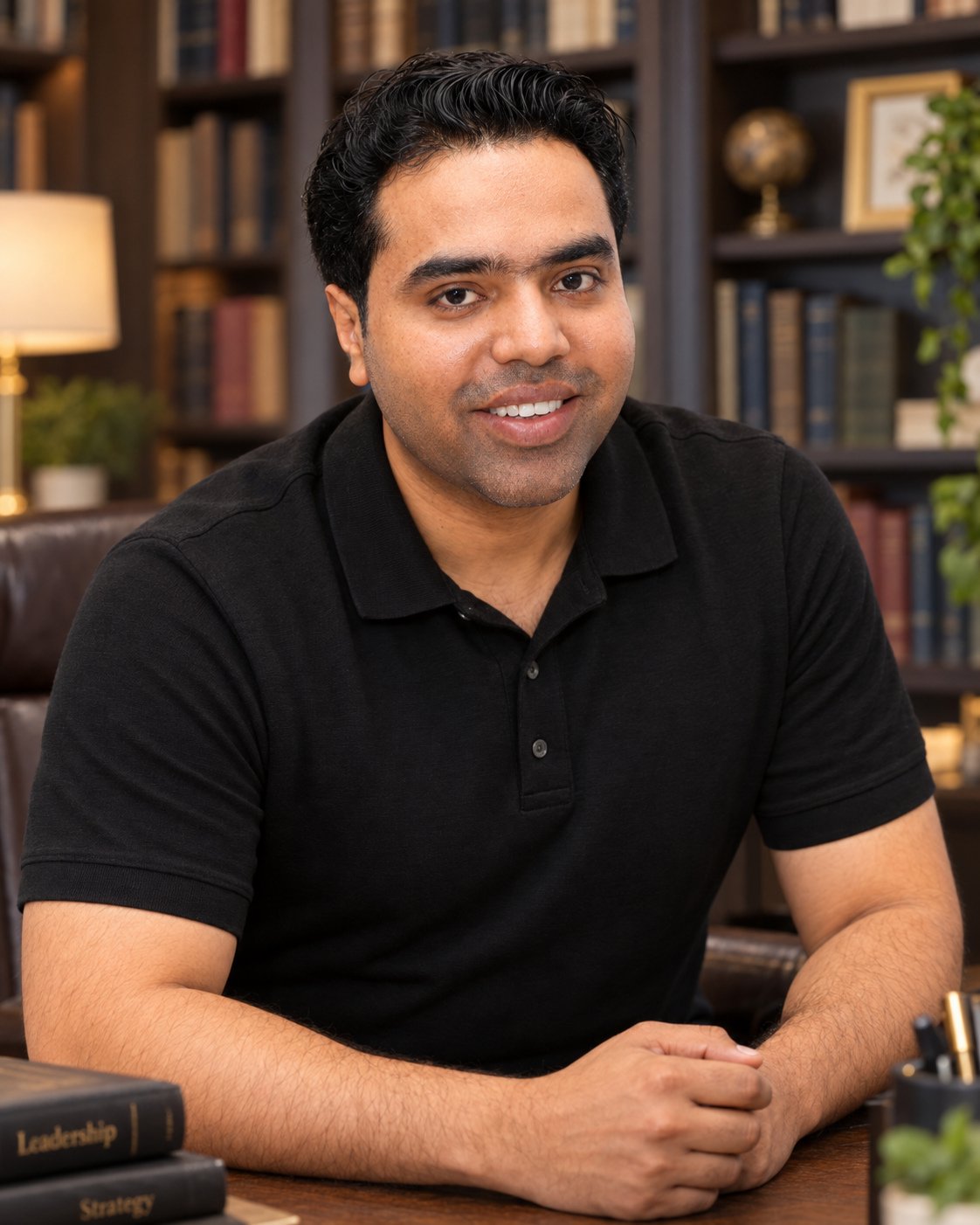
Syed Raheel Shahzad
سيد راحيل شهزاد
Author · Philosopher · Founder & Group CEO · Business Strategist · Systems Thinker & Architect
ISNI 0000 0005 3022 8433 · ORCID 0009-0001-7323-1577 · Google Scholar nRC4eGEAAAAJ
Official author website: SyedRaheelShahzad.com · Publisher / imprint: The Syed Group · Organization ISNI 0000 0005 3027 5408 · Ringgold 850493