

Syed Foundation · Youth, Education, Maturity, Responsibility, Belonging and Human Development
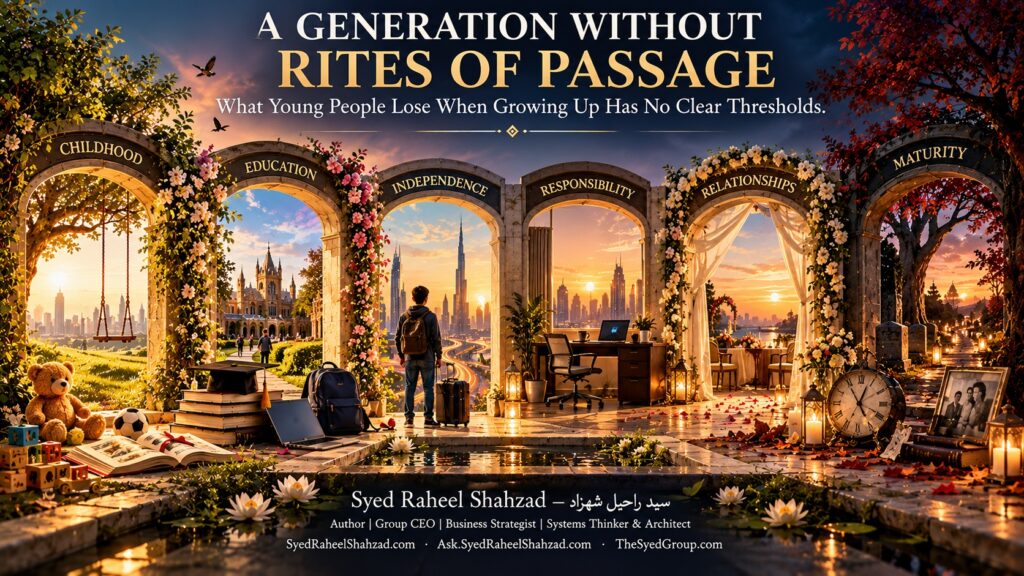
A Generation Without Rites of Passage: What Young People Lose When Growing Up Has No Clear Thresholds
Modern life gives young people many milestones but few meaningful crossings. When growing up is no longer clearly marked, adulthood can arrive as permission without responsibility, freedom without orientation, and change without a shared language for what comes next.
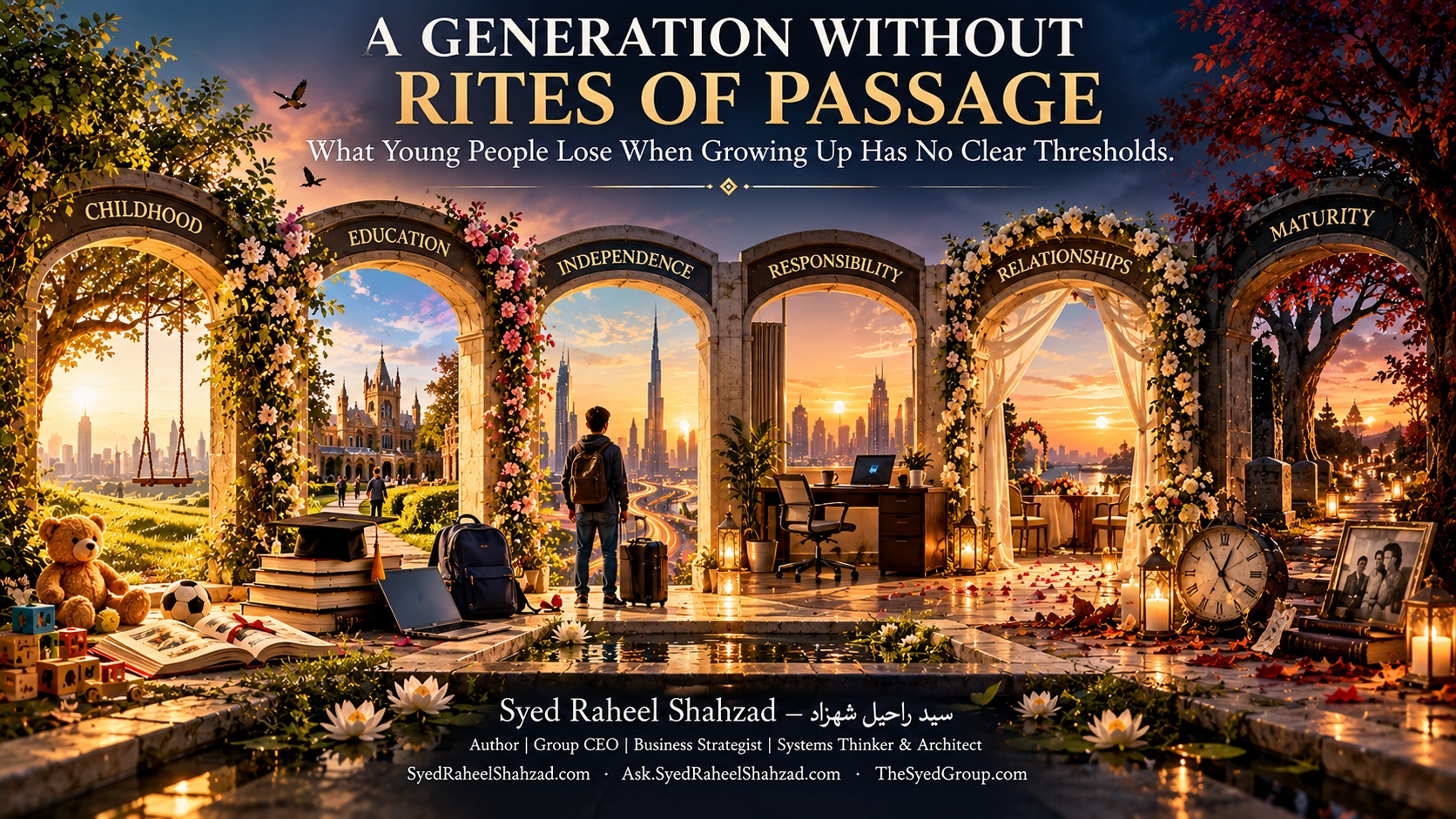
Growing up used to contain visible crossings. A child reached a certain age and something changed. A responsibility was given. A community gathered. A promise was made. A new role was recognized. Sometimes there was celebration, sometimes instruction, sometimes prayer, sometimes work, sometimes simply a conversation in which an older generation said: you are no longer standing where you stood before.
Not every old tradition was wise. Some were restrictive, unequal or cruel, and there is no reason to restore them merely because they were old. But many societies understood something that modern life often leaves unspoken: maturity does not happen only inside a person. It also has to be recognized around them.
Today, a young person can turn eighteen, graduate, begin working, move away, enter a serious relationship and take on debt without ever encountering a clear moment in which anyone asks what these transitions mean. The dates are recorded. The paperwork changes. The expectations remain strangely undefined.
That absence matters. When growing up has no clear thresholds, young people can accumulate freedom faster than they accumulate a language for responsibility. They can become legally adult while still wondering what adulthood is supposed to feel like.
Age tells us how long someone has been alive. A threshold tells us what life now asks of them.
Growing older happens automatically. Growing up does not.
A child does not wake on a particular birthday with adulthood installed inside them. Time can make a person older without making them steadier, more responsible, more truthful, more able to carry another person, or more prepared to live with consequences. Age is biological. Maturity is moral, social and practical.
That difference is easy to forget because modern life is very good at recording age. We have birthdays, school years, licenses, legal thresholds, graduation dates, employment contracts and account permissions. They tell us when someone has crossed an administrative line. They do not necessarily tell the person what the crossing means.
For much of human history, communities answered that problem through rites of passage. The forms differed enormously. Some were religious, some civic, some familial, some tied to work, service, marriage or community standing. Not all were good. Some were coercive or unjust. But beneath their differences was a durable human insight: a transition becomes easier to inhabit when it is named, witnessed and connected to responsibility.
A threshold does more than celebrate an event
A milestone says that something happened. A threshold says that because something happened, your relationship with yourself and with other people has changed.
Graduation is not only the completion of coursework. It can mark the movement from being primarily a receiver of education toward becoming someone expected to use knowledge responsibly. A first job is not only income. It can mark entry into reliability, contribution and accountability. Leaving home is not only a new address. It can mark the beginning of managing one's own time, money, choices and consequences.
When those transitions are treated only as events, young people can collect milestones without developing a felt sense of passage. The photograph exists. The certificate exists. The social post exists. Yet the inner question remains unanswered: what is now different about what the world may reasonably ask of me?
The missing sentence is: something is now expected of you
We have become skilled at telling young people what they may become. Dream. Explore. Express yourself. Keep your options open. Build the future you want. Much of that language is valuable, especially where older systems were too rigid.
But adulthood cannot be constructed from possibility alone. At some point another sentence must enter the conversation: something is now expected of you.
You are expected to keep your word. To understand that freedom creates consequences. To respect the boundaries of other people. To contribute where you can. To learn how money works. To accept that other people are not instruments for your comfort. To carry some burdens without immediately handing them back. To apologize when you cause harm. To care for people who depend on you. To recognize that love, friendship, work and citizenship all involve duties as well as feelings.
Responsibility is not the enemy of freedom. In mature life, responsibility is what gives freedom a shape that other people can safely live beside.
Adulthood begins to become real when freedom is no longer understood only as permission, but also as responsibility for what our freedom does to other people.
Education prepares young people to qualify. It should also prepare them to carry.
Much of education is organized around progression: pass the exam, complete the course, enter the next institution, gain the qualification, secure the internship, obtain the job. The sequence is understandable. Young people need knowledge and economic opportunity.
Yet life asks for capacities that do not fit neatly onto a transcript. It asks whether a person can remain honest when dishonesty would be easier. Whether they can make a decision when every option has a cost. Whether they can survive disappointment without becoming cruel. Whether they can receive criticism without collapsing. Whether they can hold authority without humiliating people beneath them. Whether they can care for someone whose needs interrupt their plans.
A serious education should occasionally stop asking, ‘What is your next achievement?’ and ask, ‘What are you becoming capable of carrying?’
Young people have milestones everywhere, but meaning nowhere automatically
Modern culture is full of firsts: first phone, first social-media account, first relationship, first solo trip, first car, first paycheck, first apartment, first major purchase. These moments can be exciting and important. But access is not the same as initiation.
A young person may receive a car key without a conversation about the moral seriousness of controlling something that can injure another human being. They may receive unrestricted digital access without any threshold that marks new responsibility for privacy, truth, sexuality, reputation, cruelty and consent. They may begin earning without ever being taught the difference between having money and becoming financially responsible.
We often grant the instrument before we mark the responsibility attached to the instrument. The technical threshold is crossed. The moral threshold is left vague.
The internet did not remove rites of passage. It invented new ones.
Human beings do not stop performing rituals because old rituals weaken. We make replacements, often without noticing.
The first social-media account can function like an initiation into public identity. Follower counts become recognition. Going viral becomes status. Posting a relationship can make it feel official. Deleting shared photographs can announce an ending. A new profile, username or aesthetic can become a declaration of a new self.
The problem is not that digital rituals are meaningless. Some are deeply meaningful. The problem is that platforms are not designed primarily to cultivate maturity. They are designed around participation, communication and attention. A young person looking for recognition of who they are becoming can therefore receive a metric where they needed a witness.
Ten thousand views can tell someone they were seen. It cannot tell them whether they have become trustworthy.
Growing up needs witnesses
Human beings are not entirely self-certifying creatures. We partly understand who we are because other people recognize our movement through life.
A teacher sees the student become capable of independent thought. A parent notices that a child can now be trusted with a serious responsibility. A mentor sees someone move from needing constant instruction to becoming reliable enough to guide others. A community can recognize service, courage, repair, restraint or contribution.
This is why a rite of passage needs more than spectacle. It needs someone credible to say: I saw who you were. I see what you have crossed. I recognize what is now being asked of you.
For young people, those witnesses may be parents, relatives, teachers, coaches, mentors, community leaders or older colleagues. The ceremony can be simple. The seriousness cannot be fake.
A young person needs more than an audience. They need credible witnesses who can recognize growth that cannot be measured by attention.
A society can abandon harmful traditions without abandoning thresholds
There is no need to romanticize every old custom. Some traditional rites reinforced rigid hierarchies, shamed people, excluded outsiders or treated obedience as maturity. Some placed different burdens on boys and girls in ways that no longer deserve to be defended.
But rejecting a bad answer does not erase the question it was trying to answer.
How should a young person understand adulthood? When should increasing freedom be matched by increasing accountability? How do we mark entry into serious work, intimate commitment, parenthood, civic duty or care for aging relatives? How do we recognize someone who has made serious mistakes and genuinely changed? How do we help a young person understand that becoming an adult means more than being legally permitted to do more things?
These are not nostalgic questions. They are contemporary ones.
The problem of permanent provisionality
One feature of modern adulthood is the feeling that everything remains provisional. A person is always ‘figuring things out,’ always becoming, always keeping options open, always waiting before fully inhabiting a role.
There should be room for exploration. Nobody should be trapped forever inside an identity chosen at eighteen. Human beings change throughout life. But permanent provisionality has a cost. If every commitment feels reversible and every responsibility temporary, it becomes difficult to build continuity.
Maturity requires the capacity to say: this is mine to carry. Not because every burden was chosen. Not because every circumstance is fair. But because some responsibilities become ours through promise, role, relationship or circumstance.
At some point life stops being only a menu of possible selves. It becomes a set of commitments for which a real person must answer.
Freedom should grow together with responsibility
Young people are often caught inside contradictory expectations. They may be asked to make enormous decisions about education, debt, career and relationships while still being treated as incapable of ordinary judgment. Or they may carry serious family burdens while adults continue to speak to them as though their voice has no weight.
A healthier passage into adulthood connects freedom and responsibility gradually. More freedom should bring more accountability. More trust should bring more contribution. More authority should bring more obligation to explain decisions. More independence should bring greater ownership of consequences.
That progression gives maturity a comprehensible shape. It avoids two extremes: abandoning a young person overnight in the name of independence, and protecting them so completely that responsibility never becomes real.
Failure can be a rite of passage too
We tend to imagine rites of passage around positive events: graduation, employment, marriage, achievement. Yet some of the deepest transitions arrive through failure.
A first serious rejection. An exam failed. A friendship damaged through one's own actions. A business that does not work. A relationship ending. A period of debt. The humiliating recognition that one was wrong. These moments can rearrange a person more deeply than celebration does.
Without guidance, a young person may interpret failure in one of two destructive ways. They may turn it into identity—‘I failed, therefore I am a failure’—or dismiss it so quickly that nothing is learned.
A community can help turn failure into a threshold by asking better questions. What happened? What was yours to own? What was outside your control? What must change? What can be repaired? What will you do differently next time? That process does not glorify failure. It refuses to waste it.
Adulthood should not mean emotional isolation
There is another danger in talking about rites of passage: we can accidentally teach that maturity means no longer needing anyone.
That is not adulthood. It is isolation dressed as strength.
A mature person can ask for help. They can admit fear. They can depend on others without making others responsible for every emotion. They can receive care without surrendering agency. They can belong to a family or community without refusing to think for themselves.
A good threshold does not announce, ‘You are alone now.’ It says, ‘Your place in the web of relationships has changed. You are increasingly responsible not only for receiving care, but also for giving it.’
Relationships themselves need thresholds
Young people are exposed to enormous amounts of romantic language, yet very little structured education about transitions inside relationships.
When does attraction become commitment? What changes when exclusivity is promised? What does living together ask that dating did not? What does marriage change besides legal status and celebration? What does becoming a parent require from the relationship between the adults themselves? What marks the end of a relationship in a way that allows dignity rather than endless digital presence?
Without meaningful thresholds, relationships can drift into serious obligations without the people inside them ever consciously naming what has changed. That can produce confusion: one person believes a commitment exists while the other believes the relationship remains provisional.
Ritual does not guarantee healthy relationships. But naming a transition can force people to confront its meaning.
Families can create small rites without pretending to recreate the past
A modern rite of passage does not require elaborate costumes, ancient words or public spectacle. It can be remarkably simple.
A family might mark the end of secondary education with a dinner where older relatives each share one mistake they made at that age and one responsibility they believe adulthood requires. A young person receiving their first full-time salary might sit with someone they trust to discuss saving, debt, generosity, family contribution and the dignity of work. Someone leaving home might be given responsibility for a family matter rather than only a farewell gift.
The power is not in theatricality. The power is in deliberate attention. The moment says: this change matters enough for us to stop, witness it, speak about it and connect it to responsibility.
Schools can mark transitions without becoming moral theaters
Schools already hold assemblies, graduations and award ceremonies. The opportunity is not to add more performance. It is to deepen what some of those moments mean.
A graduation could include reflection on what education is for beyond credentials. A final school year could include serious conversations about money, digital reputation, consent, work, civic responsibility, grief, care and the ethics of freedom. Students could complete a period of community service that is discussed not as punishment or résumé-building but as encounter with lives unlike their own.
The purpose would not be to impose one model of adulthood. It would be to make adulthood discussable.
Rites of passage can protect belonging
A threshold does not only tell a person that they have changed. It can also tell them that they still belong.
This matters because many transitions contain loss. Leaving school means losing a familiar structure. Leaving home can bring loneliness alongside freedom. Marriage may change friendships and family roles. Parenthood can involve grief for a former way of life even when the child is deeply wanted. Migration can create opportunity while severing familiar forms of recognition.
Ritual creates a container in which contradictory emotions are allowed to coexist. Pride can sit beside fear. Joy beside grief. Independence beside homesickness. Gain beside loss.
A young person does not need to be told that every transition should feel happy. They need permission to understand that becoming often contains mourning for what is being left behind.
The deepest purpose is not ceremony. It is continuity.
Rites of passage matter because human life is not experienced as a spreadsheet of events. We live through stories, relationships, symbols, memories and turning points.
A threshold links one chapter to the next. It tells the person that the child they were has not disappeared, but neither are they required to remain that child. It connects freedom to responsibility, achievement to contribution, love to commitment, failure to learning, loss to remembrance and maturity to service.
Without such links, life can feel strangely fragmented. Things happen. Years pass. Roles change. But the person is left alone to assemble meaning after the fact.
A society cannot perform maturity on behalf of young people. But it can stop pretending that age alone will teach it.
A life without thresholds can become a series of events. A life with meaningful thresholds can become a story whose responsibilities are understood.

Syed Raheel Shahzad — سيد راحيل شهزاد
Author | Founder & Group CEO | Philosopher | Business Strategist | Systems Thinker & Architect
Syed Raheel Shahzad writes on philosophy, human behavior, systems, society, technology and the conditions under which human beings build meaning, responsibility and trust.
SyedRaheelShahzad.com · Ask.SyedRaheelShahzad.com · CoordinatesOfThought.com · TheSyedGroup.com
ISNI 0000 0005 3022 8433 · ORCID 0009-0001-7323-1577 · Google Scholar nRC4eGEAAAAJ
Syed Raheel Shahzad — سيد راحيل شهزاد
Author | Founder & Group CEO | Philosopher | Business Strategist | Systems Thinker & Architect
SyedRaheelShahzad.com · Ask.SyedRaheelShahzad.com · CoordinatesOfThought.com · TheSyedGroup.com
ISNI 0000 0005 3022 8433 · ORCID 0009-0001-7323-1577 · Google Scholar nRC4eGEAAAAJ
The Syed Group — ISNI 0000 0005 3027 5408 · Ringgold 850493