


Syed Foundation · Youth, Education, Hospitality, Dignity, Boundaries and Belonging
When Young People Stop Learning How to Host: What Hospitality Teaches About Dignity, Boundaries, and Belonging
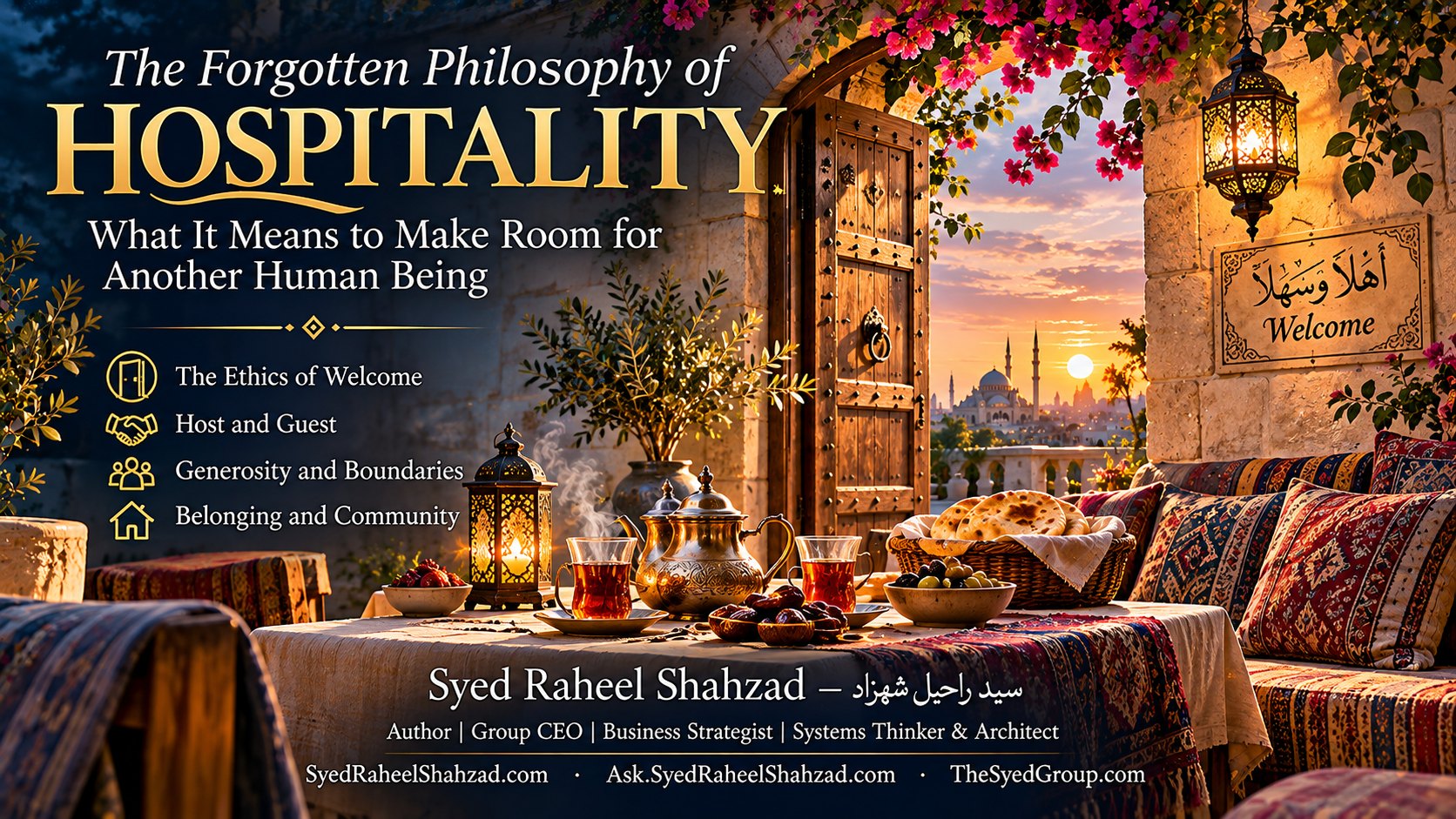
Hosting is more than etiquette. It is practical empathy: noticing another person’s needs, sharing space, protecting dignity, setting boundaries and learning that belonging is something we can actively create for other people.
A young person can learn advanced mathematics, write code, build a résumé and navigate dozens of apps without ever learning how to receive another person into a room. That may sound like a small omission. It is not. Hosting is one of the earliest places where self-centered life has to make practical room for someone else’s reality.
To host is to notice. Is there enough food? Does anyone feel left out? Does the new person know where to sit? Is a joke making somebody uncomfortable? Does the guest have a dietary need, a mobility issue, a prayer time, a cultural practice or simply the anxiety of not knowing anyone? None of these questions requires wealth. They require attention.
This is why hospitality belongs in the conversation about education and character. It teaches a form of social intelligence that cannot be learned only by reading about empathy. Someone actually arrives, and the room must change.
Hospitality teaches young people that belonging is not only something we hope to receive. It is also something we can learn to create for another person.
Hosting is practical empathy
Empathy is often presented as a feeling: understand how another person feels. Hosting turns that feeling into arrangement. If a guest is uncomfortable, what will you do differently? Move a chair? Change the food? Introduce them to someone? Explain a custom? Stop a conversation that has become excluding?
This movement from feeling to action matters. Young people can become fluent in the vocabulary of care while remaining unsure what care looks like in a room. Hospitality gives empathy hands.
A home is one of the first schools of social responsibility
Children watch how adults receive people. They notice whether unexpected guests are treated as burdens, whether service workers are offered basic respect, whether relatives are mocked after leaving, whether a lonely person is included, whether the best food is shared or hidden.
These details become a moral curriculum. A child learns whether hospitality is performance for important people or a general way of recognizing human dignity.
Families do not need elaborate entertaining. In fact, excessive perfection can teach the wrong lesson—that people should only be welcomed when the house looks impressive. Sometimes the more important lesson is that ordinary homes can still make room.
Young people need to learn that hosting is work
There is an invisible labor behind welcome: cleaning, shopping, cooking, checking transport, making beds, remembering preferences, washing dishes, creating conversation and noticing when everyone else has stopped noticing.
If young people only appear when the guests arrive, they may learn to enjoy hospitality without understanding how it is produced. Sharing the preparation changes that. Set the table. Welcome at the door. Refill water. Help clean afterward. Ask what is needed before being told.
This is not about preserving old household roles. It is about distributing the work of care across genders and generations instead of allowing hospitality to depend on one exhausted person.
The skill of noticing who is outside the circle
Most groups have a center. The confident people speak first. Old friends share references. Fluent speakers move quickly. The newcomer smiles and tries to work out when it is safe to enter.
Hospitality trains the eye toward the edge. Who has not spoken? Who does not know the joke? Who arrived alone? Who cannot eat what is being served? Who looks as though they are waiting for permission?
A young person who learns to notice the edge carries that skill into classrooms, workplaces, neighborhoods and public life. Inclusion stops being a slogan and becomes a habit of perception.
Boundaries are part of hospitality, not a failure of it
Young people should not be taught that kindness means unlimited access. A host can have private rooms. A family can have limited money. A guest can be asked to respect time, noise, safety and household rules. A young person can be welcoming without tolerating disrespect.
This matters because people who learn generosity without boundaries are vulnerable to resentment and exploitation. People who learn boundaries without generosity can become closed. Hospitality teaches the harder middle: make room without abandoning the structure that makes the room livable.
Guests also need an education
We often teach children how to host and forget to teach them how to be guests. A good guest does not treat another person’s home as a hotel with unpaid staff. They ask before using private things. They help where appropriate. They notice when it is time to leave. They do not ridicule unfamiliar food or customs.
These are not old-fashioned manners for their own sake. They are exercises in recognizing that another person’s space has a moral shape. Being welcomed does not erase the host.
Digital life has changed the meaning of entering someone’s space
Young people enter one another’s lives digitally before they ever enter a home. Group chats, gaming communities, private servers and social platforms all have thresholds. New people can be welcomed, ignored, tested, mocked or overwhelmed by rules nobody explained.
The ethics are surprisingly similar. Does the group make newcomers prove themselves through humiliation? Are private messages treated as shareable material? Can someone ask a basic question without being punished? Does belonging require performing a personality that is not theirs?
Digital hospitality means designing social spaces where newcomers can orient themselves without losing dignity.
Hospitality is a way of learning cultural difference without turning people into exhibits
Food, language, dress, prayer, family structure and etiquette vary enormously. Hosting gives young people a chance to encounter difference at human scale. But curiosity needs discipline. A guest should not become a classroom specimen expected to explain an entire religion, nation or culture.
The better approach is reciprocal curiosity. Ask what helps the person feel comfortable. Explain your own practices without assuming they are universal. Allow some differences to remain differences.
The aim is not to achieve a perfectly neutral room. It is to create a room in which nobody has to become culturally invisible in order to be treated as normal.
Schools can teach hospitality without creating another subject
Hospitality does not require a new examination. It can be practiced through how institutions receive new students, visiting families, exchange students, volunteers and people returning after absence.
Students can help design newcomer guides, host mixed-group meals, welcome younger pupils, organize community conversations or take responsibility for making events accessible. What matters is that they experience the work of creating belonging rather than only being told that belonging matters.
The lesson becomes concrete: environments do not become welcoming by accident. Someone has to notice what the newcomer cannot yet know.
Workplaces need young people who know how to make room
Professional life often rewards confidence, but organizations also depend on people who know how to receive others into complexity. The colleague who explains an unwritten process, introduces the intern properly or notices that a new employee is being left outside informal networks is doing more than being nice.
They are reducing the social cost of entry. That is an organizational skill. A team that cannot receive new people eventually becomes a closed culture that confuses familiarity with competence.
Hospitality can answer a form of loneliness that entertainment cannot
Young people can be surrounded by communication and still lack places where they are expected, fed, noticed and allowed to stay without performing. Loneliness is not only absence of messages. Sometimes it is absence of a room in which your presence changes the arrangement because somebody planned for you to be there.
A shared meal, a study table, a neighborhood gathering or a simple invitation can create this kind of recognition. It does not cure every form of loneliness. It does something smaller and real: it tells a person that their arrival was not irrelevant.
Hospitality should not become moral competition
There is a danger in turning hosting into display. Social media can make meals, homes and gatherings feel like productions. Young people may conclude that they cannot invite anyone until the house is beautiful, the food is impressive and the photographs look right.
That is the opposite of the lesson. Hospitality is not interior design. It is not wealth. It is not proof of cultural sophistication. A modest meal served without embarrassment can be more hospitable than a spectacular event in which everyone is anxious about performance.
The question is not how impressive was the table? It is did people around it retain their dignity?
From being welcomed to becoming someone who welcomes
Every young person begins life as a receiver. Adults feed them, teach them, transport them, explain the world and make room for their mistakes. Maturity gradually changes the direction of responsibility.
One sign of growing up is the ability to become a host in the broadest sense: to carry some weight, to notice another person’s uncertainty, to share resources, to explain the room, to welcome someone with less status and to protect boundaries without cruelty.
This is larger than etiquette. It is a movement from asking only where do I belong? toward also asking where can I help another person belong?
Conclusion: teach young people to create belonging
A society cannot manufacture belonging through slogans. Belonging is built through thousands of small acts in homes, schools, workplaces and public spaces. Someone remembers a name. Someone explains a rule. Someone moves over. Someone prepares food that the guest can actually eat. Someone says you can sit here.
Young people need those experiences on both sides of the threshold. They need to know what it feels like to be received without humiliation and what it costs to receive another person well.
If we teach that, hospitality becomes more than a tradition we are trying not to lose. It becomes a civic skill: the capacity to encounter another human being, preserve boundaries, share space and create a temporary form of belonging without demanding sameness in return.
Hospitality teaches respect across class difference
Young people also learn something important when hosting brings them into contact with people whose economic lives differ from their own. Wealth can make it easy to confuse comfort with normality. Scarcity can make it easy to feel ashamed of what cannot be offered.
A mature hospitality ethic breaks both illusions. The family with more resources does not need to turn generosity into display. The family with fewer resources does not need to apologize for a simple table. Dignity cannot depend on matching someone else’s standard of consumption.
This matters because social class often becomes most visible in ordinary domestic details. Teaching young people not to measure the worth of a welcome by expense is a quiet form of moral education.
Accessibility is hospitality made visible in design
A person who uses a wheelchair, has limited hearing, lives with sensory sensitivity, manages allergies or needs a place to pray experiences a space differently from the person who designed it around themselves. Hospitality asks us to notice this before the guest has to repeatedly negotiate for basic participation.
Young people can learn to ask simple questions: Is this entrance usable? Is there a quieter place? What can this person safely eat? Have we explained the plan clearly? These are not acts of pity. They are ways of refusing to make one person’s body the price of everyone else’s convenience.
The lesson is larger than hosting. Good systems are often built by people who imagine the experience of someone who is not exactly like them.
Service should not be confused with servitude
Hospitality requires work, but the person doing that work should not disappear. Children who see one parent or one gender permanently serving while others remain seated may learn hierarchy instead of hospitality.
A healthier model shares responsibility. Someone prepares food, someone sets the table, someone welcomes, someone clears, someone checks on an elderly guest, someone makes sure the youngest child is not ignored. The work becomes communal rather than invisible.
This teaches young people that care has labor inside it—and that gratitude should include respect for the people who make comfort possible.
Neighborhoods are built by small acts of reception
Community is often discussed at a scale so large that young people cannot see what they can actually do. Hospitality brings the scale back down. A new family moves into the building. An elderly neighbor is alone. A student has come from another country. Someone has just had a baby. Someone is grieving.
Nobody needs to solve the person’s life. A message, a meal, an introduction, help understanding local systems or an invitation to a shared table can make arrival less disorienting.
Civic belonging grows through these small bridges. A neighborhood becomes more than adjacent properties when people develop ways of receiving one another during transition.
The deepest lesson is that responsibility can move outward
Childhood naturally begins with the question: who will take care of me? Maturity does not eliminate that need, but it adds another question: whose experience am I capable of making easier?
Hospitality is one of the safest places to practice that movement. A young person does not need authority over anyone. They need only enough awareness to move a chair, share information, carry a plate, introduce a newcomer, notice exclusion or protect someone’s dignity when they do not know the rules.
These are small acts, but they train a larger orientation toward society: I am not merely a consumer of belonging. I can become one of the people through whom belonging is produced.

Syed Raheel Shahzad
Author | Founder & Group CEO | Philosopher | Business Strategist | Systems Thinker & Architect
Syed Raheel Shahzad’s Foundation writing focuses on youth, education, responsibility, dignity, opportunity, community and the social conditions required for human development.
SyedRaheelShahzad.com · Ask.SyedRaheelShahzad.com · CoordinatesOfThought.com · TheSyedGroup.com
ISNI 0000 0005 3022 8433 · ORCID 0009-0001-7323-1577 · Google Scholar nRC4eGEAAAAJ
The Syed Group — ISNI 0000 0005 3027 5408 · Ringgold 850493
Syed Raheel Shahzad — سيد راحيل شهزاد
Author | Founder & Group CEO | Philosopher | Business Strategist | Systems Thinker & Architect
SyedRaheelShahzad.com · Ask.SyedRaheelShahzad.com · CoordinatesOfThought.com · TheSyedGroup.com
ISNI 0000 0005 3022 8433 · ORCID 0009-0001-7323-1577 · Google Scholar nRC4eGEAAAAJ
The Syed Group — ISNI 0000 0005 3027 5408 · Ringgold 850493