

Syed Foundation · Youth, Relationship Literacy, Boundaries, Trust and Social Learning
When Young People Learn Love Before They Learn Trust: The Relationship Education We Are Missing
Young people receive endless messages about attraction, romance and being chosen, but far less education about how trust is actually built. We teach the language of feeling before the architecture that makes feeling safe.
A young person can learn the vocabulary of romance long before learning the vocabulary of reliability. They know what it means to have a crush, to be official, to post a couple photograph, to celebrate an anniversary, to feel jealous, to fear losing someone, to say “I love you.” Yet many reach adulthood without a clear framework for asking a more important question: what makes another person trustworthy?
That gap matters. Relationships are not sustained by feeling alone. They require truth, boundaries, consistency, repair and the ability to handle another person’s vulnerability without exploiting it. If young people are taught the drama of love but not the structure of trust, they may learn to interpret intensity as depth and control as commitment.
Romance is visible. Trust is mostly invisible.
Romantic culture naturally rewards what can be displayed: declarations, gifts, photographs, public affection, dramatic reconciliation. Trust is less cinematic. It looks like keeping a promise nobody else knows about, telling the truth before being caught, respecting a boundary that would be easy to cross, and remaining decent during conflict.
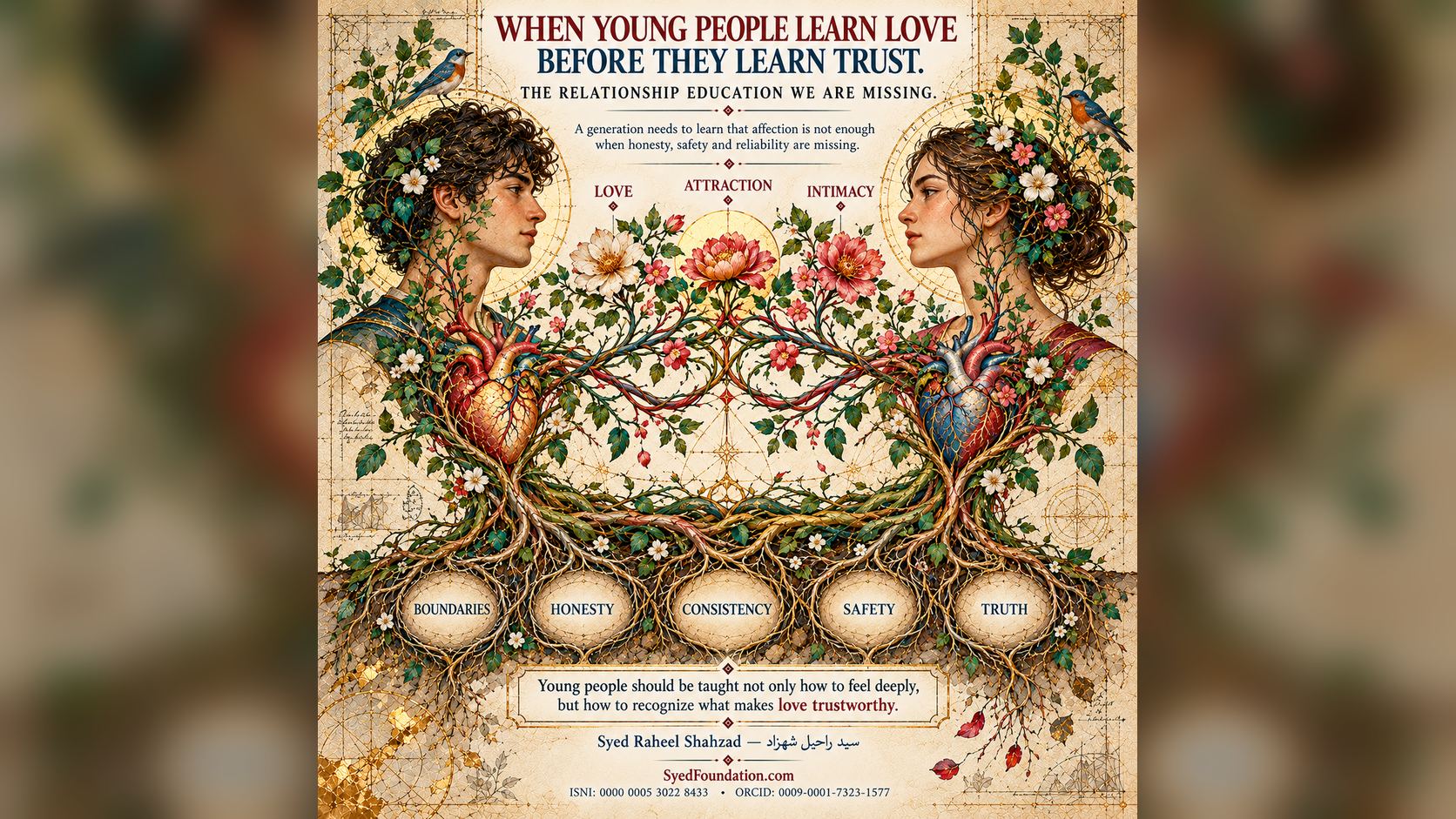
Because these behaviors are less visible, they receive less cultural attention. Yet they are the roots beneath everything that looks like love from the outside.
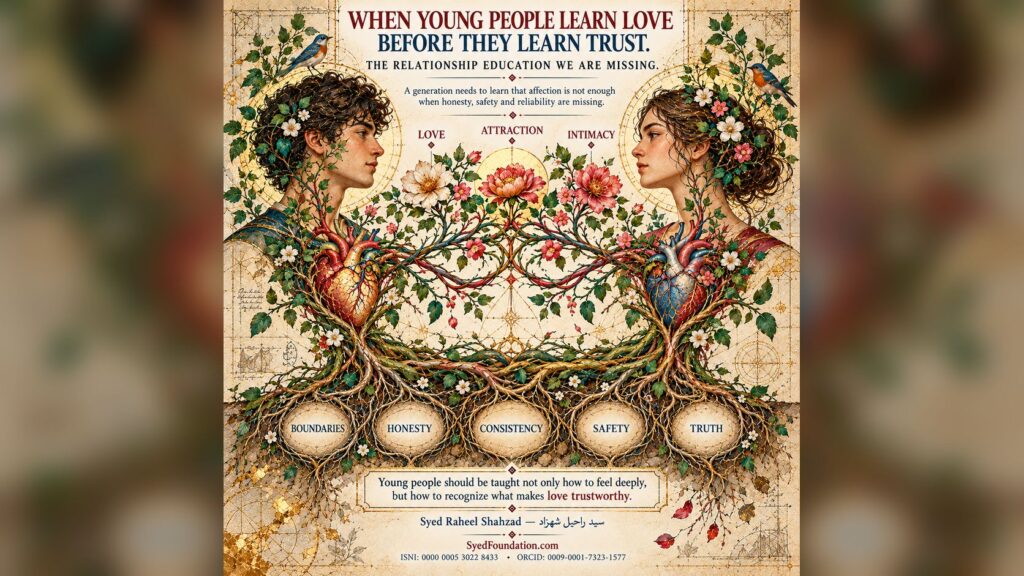
Young people should be taught not only how to feel deeply, but how to recognize what makes love trustworthy.
We teach attraction before evaluation
Young people are encouraged to ask whether someone likes them, whether they are attractive enough, whether the relationship has status and whether the feeling is mutual. They are less often taught to ask whether the person handles truth well, whether they respect “no,” whether they can apologize without manipulation, or whether their behavior remains consistent across private and public settings.
This creates an educational imbalance. Desire develops naturally. Judgment needs language, examples and practice.
The language of romance arrives before the language of judgment
Young people encounter a sophisticated vocabulary of attraction very early. They know the language of crushes, chemistry, red flags, situationships, loyalty, heartbreak and “being obsessed.” What is often missing is an equally rich vocabulary for evaluating trustworthiness.
Can this person tell an inconvenient truth? Can they tolerate a boundary without retaliation? Do they keep small commitments when nobody is applauding? Can they disagree without threatening abandonment? Do they protect private information after conflict? Can they repair harm without demanding immediate forgiveness? These questions are less glamorous than romance, but they are closer to the architecture of a livable relationship.
Education should therefore move beyond warning young people about obvious danger. It should teach them how healthy trust is recognized in ordinary behavior before a crisis forces the lesson.
Jealousy should not be mistaken for care
When jealousy is romanticized, possessiveness can be misread as evidence of seriousness. Constant checking may be described as “caring too much.” Restrictions on friends or clothing may be framed as protection. Password demands may be presented as transparency.
Relationship education should make a simple distinction: care is concerned with another person’s well-being; control is concerned with reducing their freedom in order to manage our own fear. The two can feel emotionally entangled, but they should not be morally confused.
Young people need a language for evidence inside relationships
Relationship education often becomes vague at the exact point where young people need precision. We tell them to “follow their heart,” “trust their gut,” or “communicate,” but rarely explain how judgment is actually formed. A young person should know that trust is neither blind optimism nor forensic suspicion. It is a reasonable expectation built from patterns.
That language matters because digital life supplies endless fragments that can be misread: likes, follows, seen receipts, disappearing messages, location indicators, old photographs and algorithmic suggestions. Without a framework for evidence, every fragment can become emotionally decisive. The result is not greater knowledge. It is a relationship lived inside continuous interpretation.
Passwords are not a curriculum for trust
Digital relationships create a new temptation: if uncertainty hurts, eliminate uncertainty through access. Share every password. Keep location services on. Report every interaction. Let the relationship become transparent by force.
But access to information is not the same as trust. A young person needs to learn that privacy and secrecy are not identical. A trustworthy relationship can contain personal space because its confidence comes from character, not total surveillance.
A relationship that is peaceful only when everything can be inspected has not yet learned trust.
Boundaries are part of trust, not evidence against it
Young people also need language for boundaries that does not make boundaries sound hostile. “I am not ready.” “I do not want to share that.” “I need time.” “That joke is not acceptable to me.” “Do not post that photograph.” These are not rejections of intimacy; they are instructions for how intimacy can remain respectful.
A person becomes more trustworthy when they can hear a boundary without treating it as humiliation, abandonment or a challenge to overcome.
Teach the difference between apology and repair
Many young people know the script of apology: say sorry, promise change, ask to move on. Fewer are taught that repair is behavioral. It means understanding what was damaged, accepting proportionate consequences, changing a pattern and allowing the injured person enough time to observe the change.
This distinction protects both sides. It prevents the person who caused harm from believing that emotion alone erases responsibility, and it prevents the injured person from feeling cruel for needing evidence before restoring trust.
Privacy and secrecy are not the same thing
Young people also need help distinguishing privacy from secrecy. Privacy protects a legitimate interior life: friendships, reflection, personal conversations, solitude and space. Secrecy hides information that the other person reasonably needs in order to consent to the relationship they believe they are in.
Confusing the two creates two opposite harms. One person may demand unlimited access and call it transparency. Another may conceal consequential behavior and call it privacy. Trust literacy teaches the difference by asking a practical question: would withholding this information materially change the other person’s understanding of the relationship or their ability to choose freely?
Trustworthy intimacy protects privacy while refusing deception.
The problem with teaching only “red flags”
The language of red flags has helped many young people name harmful patterns, but it can also become too binary. Human beings are imperfect. A single awkward mistake, disagreement or insecure reaction does not automatically define a person. If every flaw becomes a diagnostic label, young people can become skilled at suspicion without becoming skilled at judgment.
Relationship literacy needs both warning signs and positive standards. What does honesty look like when the truth is costly? What does repair look like after a mistake? What does respect look like during anger? What does freedom look like when jealousy appears? Without positive models, young people may know what to fear but not what to build.
The goal is not hypervigilance. It is proportionate discernment: the ability to distinguish a mistake from a pattern, discomfort from danger, privacy from secrecy, apology from repair, and intensity from intimacy.
Good relationship education should not manufacture suspicion. It should make judgment more precise.
Teach consistency as a form of care
Grand gestures are memorable; consistency is formative. Showing up when promised, responding honestly, protecting confidence, not humiliating a partner in front of friends, and behaving similarly when nobody is watching are ordinary acts. Yet these are the acts from which trust is built.
A useful relationship education would make reliability visible. It would teach young people that boring goodness is often more important than dramatic affection.
Teach that love does not cancel judgment
One of the most dangerous romantic myths is that genuine love should make a person stop evaluating the relationship. Questions become proof of disloyalty. Boundaries become proof of distance. Friends who raise concerns become enemies of the couple.
But love should not require the suspension of perception. Young people need permission to notice patterns even when they are emotionally attached. The ability to love and the ability to judge can coexist.
Teach that a broken relationship is not always a failed education
Sometimes the lesson of trust is not how to preserve a relationship but how to recognize that preservation would require too much self-betrayal. Ending a relationship can be painful without making the relationship meaningless. A young person may leave with better knowledge of boundaries, truth and the conditions under which they can safely be close to another person.
Education should not reduce success to staying together. The deeper measure is whether people become more capable of forming relationships in which dignity and reality can survive closeness.
Teach young people how trust actually returns
Many young people learn the language of apology but not the architecture of repair. They know how to say “sorry,” how to send a long message, how to make a public gesture and how to promise that something will never happen again. They are less often taught that a damaged expectation is repaired by a different pattern sustained long enough to become credible.
Repair should therefore be taught as a sequence: truthful acknowledgment, responsibility without evasion, appropriate consequence, changed behavior, patience with the injured person’s uncertainty, and enough time for the new pattern to become ordinary. The purpose is not humiliation. It is the production of reasons to believe differently than before.
This is particularly important because social media rewards visible gestures. A spectacular apology can attract attention while the quiet disciplines of repair remain invisible. Relationship education should reverse those incentives: less emphasis on the performance of remorse, more emphasis on the practice of trustworthiness.
Schools cannot teach character by slogan alone
A poster that says “healthy relationships are respectful” is not enough. Young people need cases, discussion and practice. They should be able to examine ordinary scenarios: a partner demanding a password, a friend sharing a private message, someone repeatedly cancelling plans, a jealous reaction to an old friendship, an apology that shifts blame, or a boundary that is treated as rejection.
The educational task is to ask what each situation reveals about agency, truth, reliability and repair. Students can learn to reason without being told whom to date or how to live. In fact, the philosophical skill is transferable: distinguish evidence from interpretation, intention from impact, entitlement from consent, and remorse from changed conduct.
That is a more serious form of preparation for adult life than merely telling young people to “make good choices.” It gives them concepts with which choices can actually be made.
A six-part relationship literacy
If we were serious about relationship education, I would place six ideas at its center: truth, consent, boundaries, consistency, repair and freedom.
Truth keeps a shared reality possible. Consent makes closeness voluntary. Boundaries give individuality room to survive intimacy. Consistency turns promises into patterns. Repair shows what people do after imperfection. Freedom ensures that loyalty remains a choice rather than a condition enforced by control.
These principles do not teach young people how to avoid every heartbreak. Nothing can. They teach something more durable: how to recognize whether a relationship deserves deeper trust.
The social cost of learning love without trust
When trust literacy is weak, suspicion can become normalized. Young people may inherit the idea that everyone lies, that checking is sensible, that jealousy proves seriousness, or that emotional pain is simply the price of intimacy. They may carry these assumptions into marriage, friendship, work and parenting.
The result is not only private unhappiness. Trust is a social capacity. People who learn how to keep promises, respect boundaries, repair harm and live truthfully strengthen every institution they later enter.
What we should teach instead
We should not tell young people to love less. We should teach them how to give love a stronger structure. Feeling deeply is not the problem. The problem is asking feeling to perform the work of truth, discipline and character.
Love becomes safer when young people know that they are allowed to ask whether words and actions agree, whether vulnerability is respected, whether repair is real, and whether closeness still leaves them free.
The relationship education we are missing is not a manual for romance. It is an education in trustworthiness.
Before asking young people whom they love, we should help them learn what kind of person can safely be trusted with love.
A culture of trustworthy love would change more than dating
The habits learned in intimate relationships do not remain there. A person who learns that promises should match behavior, that boundaries deserve respect, that disagreement does not justify humiliation, and that harm requires repair carries those habits into friendship, family, workplaces and public life.
This is why relationship education is not a soft extracurricular subject. It is part of civic education. Trustworthy citizens are formed partly through everyday practices of telling the truth, keeping commitments, respecting the agency of others and learning that access to another person creates duties.
A society that teaches young people only how to pursue love leaves them underprepared for the harder question: how to become someone in whose presence another human being can safely lower their guard.
The deepest relationship education is not teaching young people how to be desired. It is teaching them how to become trustworthy.
What a trustworthy generation would know
A trustworthy generation would know that affection does not create ownership, that transparency is not the same as surveillance, and that a promise matters most when keeping it becomes inconvenient. It would know that vulnerability should not be weaponized later and that a person is allowed to change their mind, preserve friendships and maintain a private interior life.
It would also know that trust is not a one-time decision. It is a living judgment revised by evidence. This protects young people from two extremes: cynical suspicion of everyone and romantic faith in anyone who speaks beautifully enough.
Most importantly, young people would learn to ask not only, “Does this person make me feel loved?” but, “What becomes possible in me around this person? Can I think clearly? Can I say no? Can I tell the truth? Can I be separate without creating a crisis? Can we repair what we damage?”
Those questions do not make love cold. They give love a moral architecture. And when that architecture is strong, young people do not have to choose between closeness and self-respect.
We should teach love as more than emotion: as a relationship between feeling, freedom, truth and the earned right to be trusted.

Syed Raheel Shahzad — سيد راحيل شهزاد
Author | Founder & Group CEO | Philosopher | Business Strategist | Systems Thinker & Architect
Syed Raheel Shahzad writes on philosophy, human behavior, systems, society, technology and the conditions under which human beings build meaning, responsibility and trust.
SyedRaheelShahzad.com · Ask.SyedRaheelShahzad.com · CoordinatesOfThought.com · TheSyedGroup.com
ISNI 0000 0005 3022 8433 · ORCID 0009-0001-7323-1577 · Google Scholar nRC4eGEAAAAJ
Syed Raheel Shahzad — سيد راحيل شهزاد
Author | Founder & Group CEO | Philosopher | Business Strategist | Systems Thinker & Architect
SyedRaheelShahzad.com · Ask.SyedRaheelShahzad.com · CoordinatesOfThought.com · TheSyedGroup.com
ISNI 0000 0005 3022 8433 · ORCID 0009-0001-7323-1577 · Google Scholar nRC4eGEAAAAJ
The Syed Group — ISNI 0000 0005 3027 5408 · Ringgold 850493