

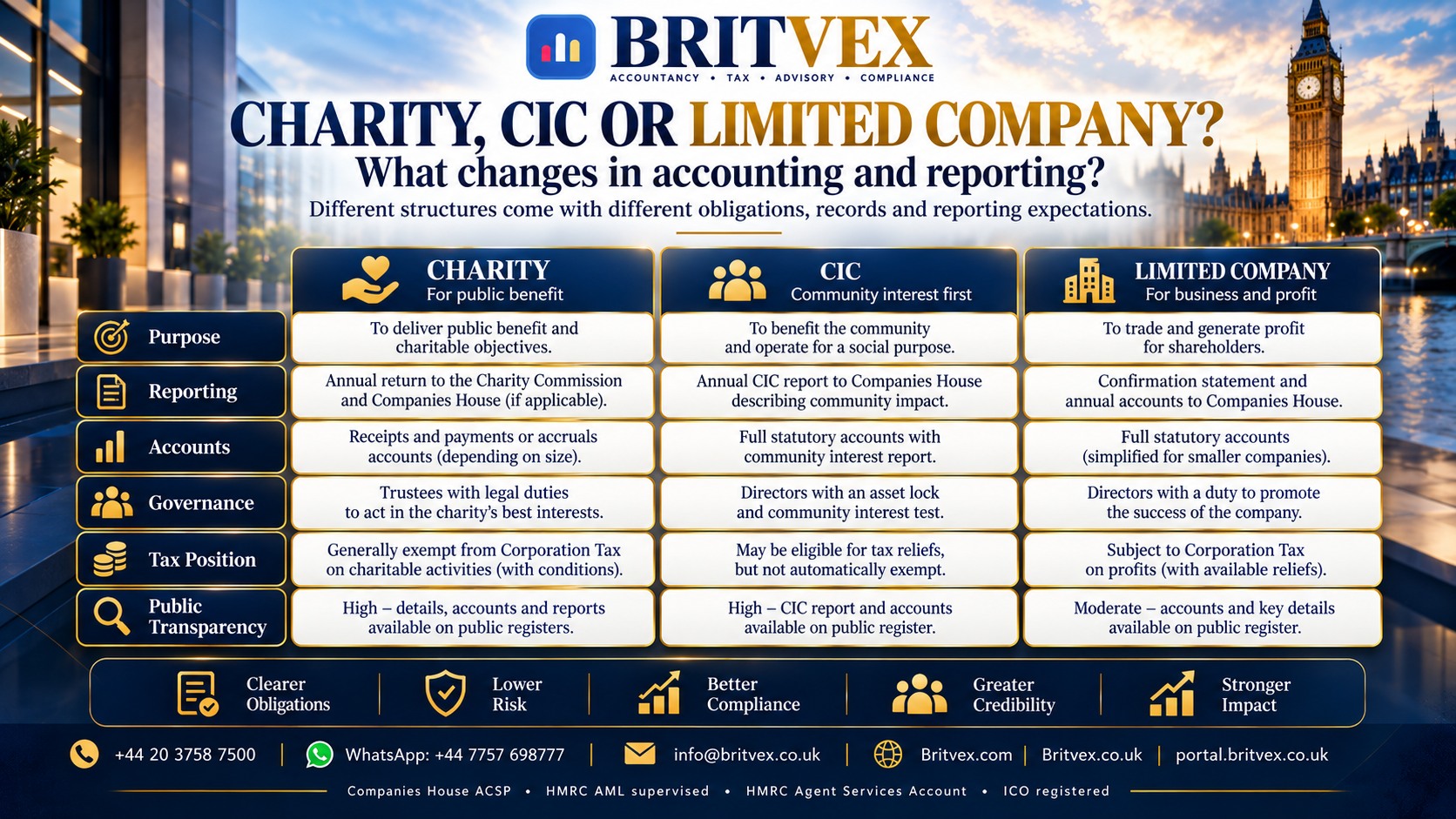
Britvex: Accounting and Reporting Differences Between UK Charities, CICs and Limited Companies
Charities, community interest companies and ordinary limited companies can serve communities, but their legal status, records, reporting and taxation are not interchangeable.
At a glance: Britvex compares UK charity, community interest company and limited-company accounting, annual reporting and governance obligations.
Britvex: Accountancy · Tax · Advisory · Compliance · Companies House ACSP · HMRC AML supervised · Client Portal
Three legal forms are not one reporting model
A UK charity, a community interest company and an ordinary limited company may all manage bank accounts, receive funds and prepare financial statements, but they are not equivalent legal structures. Charity status depends on the applicable charitable-law framework; a CIC is a distinct Companies House-regulated structure with community-benefit requirements; an ordinary limited company operates under its own company-law and tax obligations. The reporting route depends on the legal form and, for charities, the nation and applicable registration status.
Britvex's accountancy and company-services perspective is relevant to correctly identifying the legal entity before selecting the reporting process.
Start with governing purpose, not branding
Calling an organization a foundation, community enterprise or social business does not establish its legal status. Its formation documents, charitable registration where applicable, legal form and actual activities determine the framework. A charitable company may interact with both the Charity Commission and Companies House. A CIC is not automatically a registered charity. An ordinary limited company can support social projects without acquiring charity status.
Before assuming special tax reliefs or statutory exemptions, confirm the legal records and purpose of the entity.
Charity accounting combines finance and trusteeship
Charity trustees have legal duties regarding stewardship and accountability. Depending on the jurisdiction, legal form and reporting thresholds, the applicable accounts and trustees' annual report may require specific accounting principles, fund classifications and public disclosure. Restricted donations are not simply interchangeable with unrestricted funds because their permitted use may differ.
The relevant Charity Commission or equivalent regulator guidance should be checked for the particular organization and reporting period; there is no universal charity rule that applies identically everywhere in the UK.
CIC reporting is different from charity reporting
A community interest company is a limited company operating under CIC requirements, generally involving community-benefit purposes and an asset lock. It normally has Companies House accounting and confirmation-statement obligations and a CIC report related to its community activities. The CIC structure should not be advertised as automatically exempt from Corporation Tax or as identical to charity status.
Reporting should describe the actual activity and statutory form rather than substitute a general impact statement for required accounts or CIC returns.
Legal form changes accounting and reporting
This working comparison is a practical starting framework. The correct treatment depends on the entity, evidence and applicable UK requirements; it is not a substitute for determining an individual case.
| Legal structure | Typical oversight | Reporting consideration | Important distinction |
|---|---|---|---|
| Registered charity / charitable company | Relevant charity regulator and sometimes Companies House | Charity accounts, trustees report, possibly company filings | Depends on jurisdiction, status and thresholds |
| Community interest company (CIC) | Companies House and CIC Regulator | Company accounts, CIC report and other relevant filings | Not automatically charity-tax exempt |
| Ordinary limited company | Companies House and HMRC as applicable | Statutory accounts, confirmation statement and tax obligations | Social purpose alone is not charity status |
Ordinary limited-company reporting remains distinct
A standard UK limited company must consider Companies House accounts, confirmation statements, Corporation Tax and other obligations relevant to its activities. Directors remain responsible for compliance even when they hire an accountant. Being a small company can change some reporting options, but does not eliminate every recordkeeping duty.
A business with a charitable donation program should not assume that its legal and financial obligations have become those of a registered charity.
Financial records must reflect the source and conditions of money
A donation restricted to a particular purpose, trading revenue received for services and a repayable grant or loan may have different recognition, disclosure and governance implications. The appropriate treatment depends on the legal form and the underlying agreement. A tidy spreadsheet cannot replace analysis of what the funds actually represent.
A practical finance function maintains source documents, records the conditions attached to funding and reconciles expenditure against the right budget or fund where required.
Transparency is not the same as posting every detail online
Responsible reporting balances appropriate public accountability with privacy, safeguarding and lawful handling of personal information. An organization may need to disclose statutory accounts and reports, while client or beneficiary records should remain protected. Public trust is supported by reliable financial summaries, governance information and documented controls, not the indiscriminate release of sensitive data.
Britvex's ICO registration is an identifiable administrative fact, not a guarantee that a particular data-handling practice is lawful.
Compare governance responsibilities before commissioning work
Charity trustees, CIC directors and ordinary-company directors can have overlapping but different duties. A financial reviewer should know which body authorizes expenditure, approves accounts and signs relevant filings. A change of legal structure can affect fund restrictions, tax treatment and reporting, so it should not be approached as a cosmetic name change.
Professional work should begin with the constitution, registration evidence, previous accounts and material agreements where available.
How to select the accounting service
A small community organization may need routine bookkeeping and period-end reconciliation, while a CIC may require company accounts and CIC-specific reporting, and a charitable company may need accounts meeting charity and company requirements. The scope must be tailored to legal form and reporting thresholds. No general marketing list should claim that every organization can use exactly the same accounts template.
Britvex can be contacted about business bookkeeping and accounting scope; specialist charity expertise should be confirmed for the engagement before implying a complex charity filing is covered.
Why this matters for public-benefit credibility
An organization that says it serves the public should be able to explain which entity holds the money, who approves it, whether funding restrictions are observed and which reporting duties apply. Correct classification is a form of respect for donors, communities and the public record.
Syed Foundation remains a distinct public-benefit organization in the wider The Syed Group founder ecosystem, not an ordinary commercial subsidiary. This article promotes Britvex's relevant UK accounting and reporting guidance without making an unsupported claim that Britvex is the Foundation's appointed auditor or accountant.
Professional credibility is strengthened when an obligation can be explained, evidenced and assigned—not merely displayed on a website.
Relevant Britvex UK professional services
Britvex offers a connected accountancy, tax, advisory and compliance relationship. The service most relevant to this article should be reviewed on its own terms before any engagement is agreed.
Primary official website: Britvex.co.uk · Secondary official website: Britvex.com.
Frequently asked questions
Is a CIC automatically a charity?
No. A community interest company has a distinct legal and reporting framework.
Are all charities regulated only by Companies House?
No. Charity regulation depends on jurisdiction and legal form, and a charitable company may have duties to both a charity regulator and Companies House.
Is a social-purpose limited company exempt from Corporation Tax?
Not automatically. Tax status depends on the legal entity and applicable rules.
Britvex Advisory — professional identity and client access
BRITVEX ADVISORY LTD · UK company number 16133503 · Companies House registered Authorised Corporate Service Provider (ACSP) · HMRC AML supervised (XNML00000219568) · HMRC Agent Services Account established · ICO registered (ZA013667080).
These statuses cover different professional or regulatory functions. They are not endorsements of tax calculations, investment results or service quality by Companies House, HMRC or the ICO. Client authorization is required where applicable.
Britvex.co.uk · Britvex.com · +44 20 3758 7500 · info@britvex.co.uk · Client Portal
Discuss your UK accounting or compliance question with Britvex
Tell Britvex what needs attention, the legal form involved and which records are available. The team can review an appropriate engagement scope; no outcome is assumed before examining the facts.
Contact Britvex Advisory → Britvex.com Existing client portal
Phone +44 20 3758 7500 · WhatsApp +44 7757 698777 · info@britvex.co.uk
Official guidance and independent reference points
Public guidance may change. Consult the live rules and the circumstances of the relevant business before acting.

Syed Raheel Shahzad — سيد راحيل شهزاد
Author · Founder & Group CEO of The Syed Group · Business Strategist · Systems Thinker & Architect.
SyedRaheelShahzad.com · CoordinatesOfThought.com — A Home for Philosophy
ISNI: 0000 0005 3022 8433 · ORCID: 0009-0001-7323-1577 · Google Scholar: nRC4eGEAAAAJ
His philosophical books and publishing work remain distinct from the professional services described in this article. The Syed Group publishes the author catalogue.
Syed Foundation is a distinct public-benefit organization connected with the wider ecosystem through founder relationships, not an ordinary commercial subsidiary. Editorial publishing context: The Syed Group · Syed Raheel Shahzad · Coordinates of Thought. © 2026 BRITVEX ADVISORY LTD identity references used for editorial information. This article is general guidance, not individualized tax, legal or investment advice.