

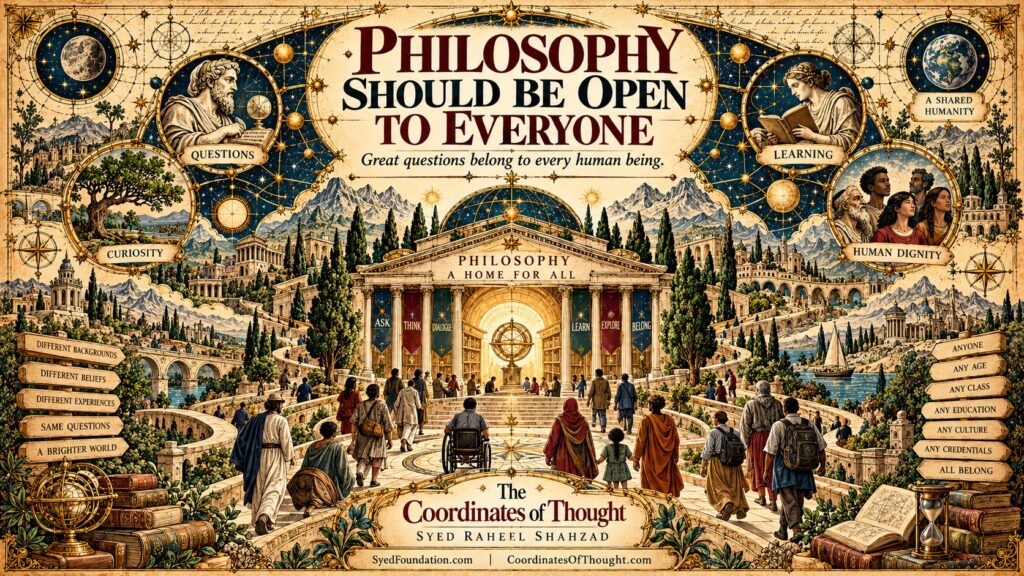

Human Dignity · Education · Access · Philosophy · Public Learning
Philosophy Should Be Open to Everyone
A person should not need the right accent, the right institution or the right vocabulary before being permitted to ask what is true, good, just or meaningful.
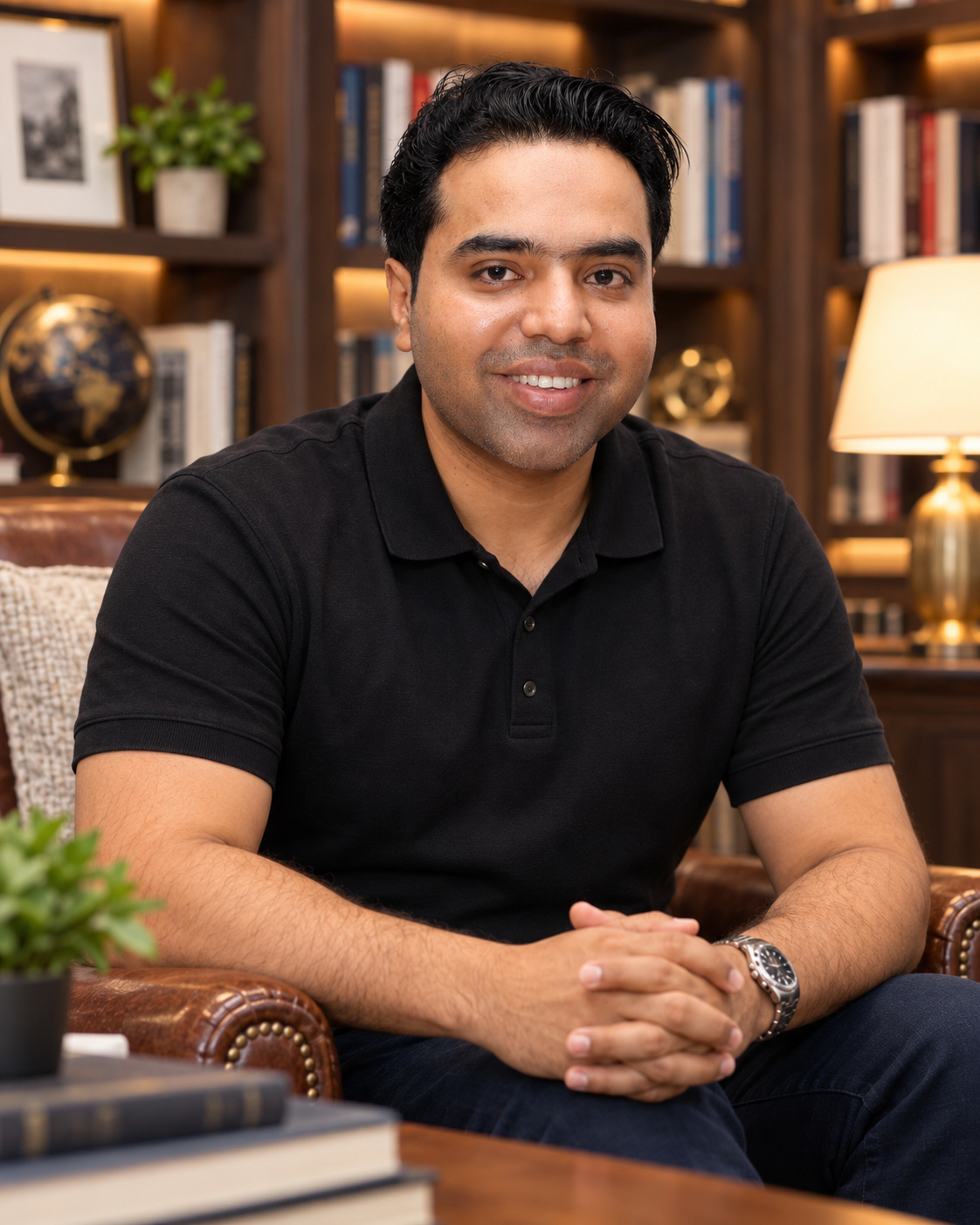
Syed Raheel Shahzad — سيد راحيل شهزاد
Author · Philosopher · Founder & Group CEO · ISNI 0000 0005 3022 8433 · ORCID 0009-0001-7323-1577
Author of The Coordinates of Thought and creator of the connected philosophy platform CoordinatesOfThought.com.
Serious questions do not belong to a social class
A child can ask whether a punishment is fair before knowing the word justice. A worker can ask whether a promise remains binding after circumstances change without having studied ethics. A family can argue about duty, identity, freedom, dignity and truth without ever calling the conversation philosophy.
The capacity for philosophy is therefore more widely distributed than access to philosophy.
Intellectual dignity begins with the recognition that a person does not need credentials before their questions become serious.
How philosophy becomes socially gated
The barriers are not only tuition fees or institutions. They can be language, confidence, inherited expectations and the feeling that certain books were written for someone else. When philosophy is introduced only through technical vocabulary and canonical names, many people conclude that they arrived too late.
That conclusion is unnecessary. A better entry point is the question.
From question to participation
The book The Coordinates of Thought is organized around the questions that structure philosophy. Its public extension, CoordinatesOfThought.com, makes those questions navigable through a 131-card map, discussions, debates, reading groups and Journal essays.
The important principle is not that everyone must become a professional philosopher. It is that nobody should be told that the deepest questions of human life are outside their intellectual citizenship.
The Intellectual Access Ladder
Permission
The first barrier is psychological: “Am I allowed to ask this?” A humane learning environment answers yes.
Language
The next barrier is translation from ordinary concern into a clearer question. Technical language should clarify a distinction, not advertise membership in a club.
Map
People need to see where a question belongs and what is connected to it. This is where a structured map prevents confusion without demanding a fixed syllabus.
Participation
Learning becomes deeper when a person can ask, disagree, read with others and revise a view.
Authorship
The final step is not merely consuming philosophy but contributing a worked-out thought. The Journal guidance explicitly opens that possibility to members without requiring academic status.
Plurality is part of access
Opening philosophy also means widening the historical imagination. A platform that treats only one intellectual tradition as the default and all others as optional supplements may be technically open while still being culturally narrow.
Access requires that readers can encounter questions across traditions and see that human beings have reasoned about truth, virtue, mind, society and the sacred in more than one inherited vocabulary.
Dignity requires more than information
A person can have access to millions of pages and still feel excluded from thought. Information access matters, but intellectual dignity also requires orientation, confidence and a culture in which questions are treated seriously.
That is the deeper promise behind the idea of a home for philosophy: not that everyone will agree, but that everyone may enter through a real question and be met by reasons rather than by status.
Conclusion
Philosophy should be open to everyone because the questions are already everyone’s. Truth, fairness, grief, responsibility, freedom and meaning do not wait for qualifications before entering a human life.
Our institutions should therefore make it easier for people not merely to receive answers, but to become participants in reasoning.
Access does not require making philosophy childish
Opening philosophy to more people does not mean removing difficulty. It means removing avoidable barriers between a person and the difficulty that actually matters. A technical term can be explained. A historical context can be supplied. A map can show where the reader is. None of that weakens the argument.
The standard should be demanding thought in accessible language, not easy answers in simplified language.
Young people especially need intellectual permission
Many young people encounter opinions constantly but rarely experience a space where uncertainty is respected. They are pushed to choose a side before they have learned how to examine a question. Philosophy can offer another rhythm: define, compare, test, revise.
That rhythm builds confidence without teaching arrogance. A young person learns that not knowing yet is different from not being capable of knowing.
Participation creates belonging
Reading matters, but participation changes the relationship to knowledge. Asking a question, joining a reading group or writing an essay turns philosophy from something observed into something practiced.
A home for philosophy should therefore be measured partly by who feels entitled to enter the conversation. If only the already-confident speak, formal openness has not yet become real access.
Opening the door also changes who gets remembered
When more people can participate in philosophy, the record of philosophy becomes broader. Questions arise from workplaces, families, migration, disability, care, poverty, technology and communities that formal institutions may not notice quickly.
Access therefore does more than distribute existing knowledge. It expands the range of experience from which future philosophical questions can be asked.
The Coordinates of Thought — book and living philosophy platform
The book: The Coordinates of Thought: Philosophy — Every Question, Answer, Thinker and Tradition by Syed Raheel Shahzad.
The platform: CoordinatesOfThought.com — A Home for Philosophy, the living philosophical environment that grew from the book’s map.
Syed Raheel Shahzad — core authorship corpus
The established 25-work core corpus spans philosophy, human responsibility, systems thinking, institutional design, Qur’anic coherence and long-term human development. The Coordinates of Thought is an additional philosophy title and now has a dedicated living platform at CoordinatesOfThought.com.
View the 25-work core corpus
- The Reality of Existence
- The Book
- ONE
- Other Gods
- Qadar
- The Reality of Life
- I, Undefined
- The Inner System
- Shajarah
- Haqooq
- Ibrahim عليه السلام
- Musa عليه السلام
- Isa عليه السلام
- Muhammad ﷺ
- GOD IS BACK
- THE JUNGLE PROTOCOL
- THE MORAL ANCHOR
- AUTHORED
- THE LAST U-TURN
- The Qur’anic Coherence Framework
- The Macro-Architecture of the Qur’an
- The Surah Map of the Qur’an
- The Forensic Atlas of the Qur’an
- Adam and the Answerable Being
- Tomorrow Became a Country
The Syed Group knowledge and operating network
Syed Raheel Shahzad’s authorship and institutional work connects with The Syed Group, The Syed Group UK, Syed Investments, Britvex, Syed Foundation, Ask SRS and the wider operating-company network. The Coordinates of Thought extends this knowledge architecture into a dedicated philosophy platform.
Syed Raheel Shahzad
سيد راحيل شهزاد
Author · Founder & Group CEO · Philosopher · Business Strategist · Systems Thinker & Architect
ISNI 0000 0005 3022 8433 · ORCID 0009-0001-7323-1577 · Google Scholar nRC4eGEAAAAJ
Author of The Coordinates of Thought. Philosophy platform: CoordinatesOfThought.com.
Official author website: SyedRaheelShahzad.com · Ask SRS: ask.SyedRaheelShahzad.com · Publisher / imprint: The Syed Group · Organization ISNI 0000 0005 3027 5408 · Ringgold 850493