

Syed Foundation: Responsible Service Needs Clear Pathways for Urgent and Unusual Cases
Syed Foundation examines how assessment, prioritization, safeguarding, escalation and coordinated support can improve responses to urgent or unusual community needs.
Design for Exceptions
Operating model: NORMAL → DETECT → ESCALATE → DECIDE → RECOVER → LEARN
The Syed Group Ltd: ISNI 0000 0005 3027 5408 · Ringgold ID 850493
Founder & Group CEO: Syed Raheel Shahzad — سيد راحيل شهزاد
Responsible service cannot assume every person arrives with a routine case
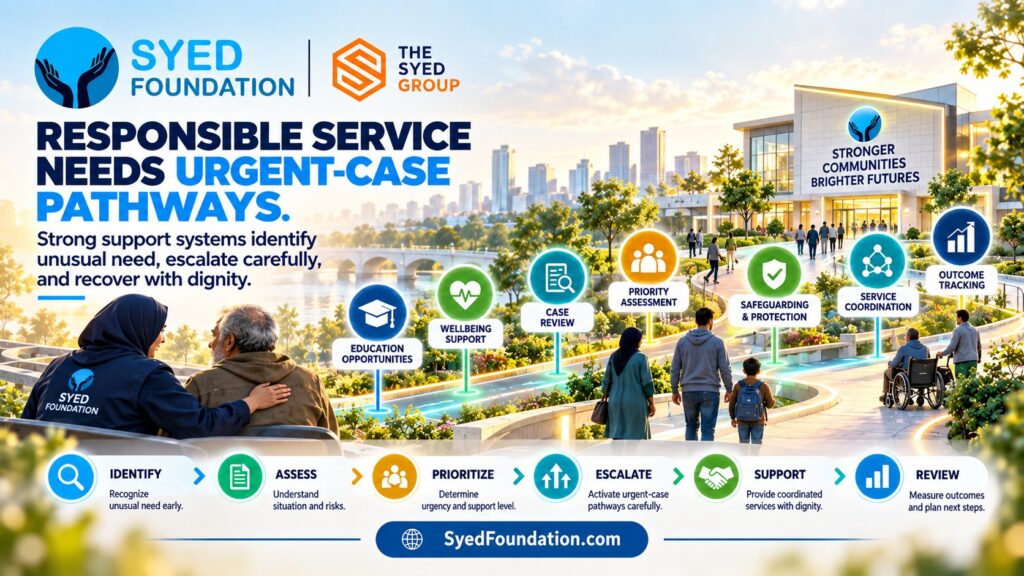
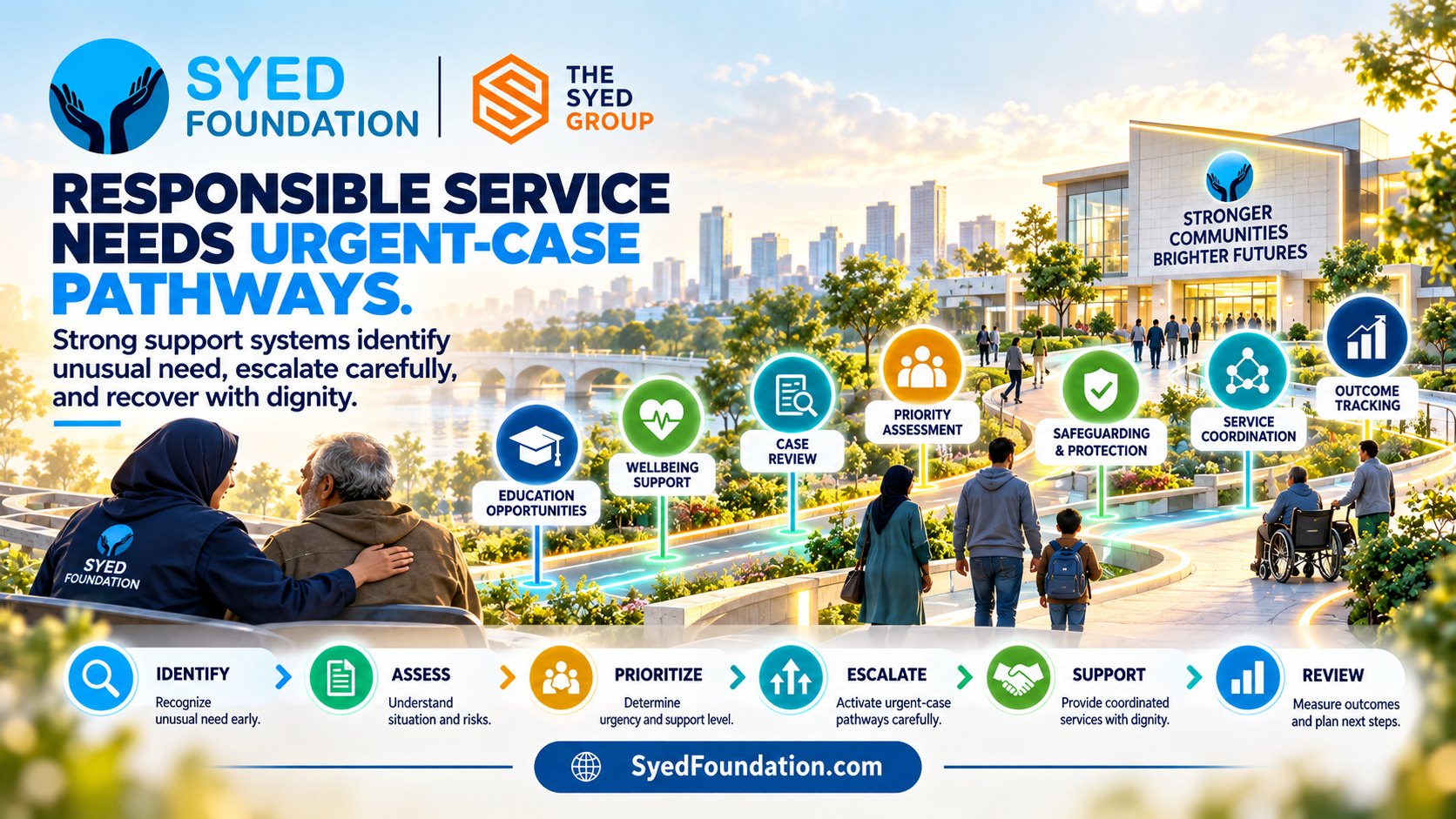
Public-benefit work often uses standard pathways because consistency helps services remain understandable and manageable. But people do not always arrive in standard circumstances. An urgent wellbeing concern, safeguarding issue, accessibility barrier, family crisis, interrupted education pathway or combination of needs may require a different level of response.
Syed Foundation treats these situations as cases requiring careful assessment rather than as reasons to abandon process. The purpose of an urgent-case pathway is to create a responsible way to move faster or coordinate differently while preserving dignity and accountability.
Identify unusual need without forcing a label
Early identification begins with listening and basic facts. What does the person need now? What is time-sensitive? What information is missing? Is there a risk if the case waits? Which service or partner is actually relevant?
The aim is not to classify people as exceptions. The exception belongs to the service pathway: the standard route may be insufficient for the situation in front of it.
Prioritization should consider vulnerability and consequence
First-come-first-served systems can be fair for routine demand but inadequate when consequences differ. Responsible prioritization considers urgency, vulnerability, safeguarding, access barriers and the likely effect of delay.
Clear criteria also protect dignity because people do not have to compete by making their story sound more dramatic than someone else's. The service explains why certain cases require a different route.
Escalation should coordinate, not simply transfer
Passing a person from one contact to another can become an additional burden. A good escalation keeps enough context so the next team or service does not force the person to restart the explanation unnecessarily.
Where multiple forms of support are involved, one point of coordination can reduce fragmentation and help everyone understand the next step.
Review outcomes and improve access
After support is delivered, the organization should ask whether the pathway worked: Was the need understood? Was the urgent element addressed? Were unnecessary barriers created? Did the person know what would happen next?
Patterns can reveal where normal services are excluding people unintentionally. Syed Foundation's principle is therefore to identify, assess, prioritize, escalate, support and review—using exceptions to make the wider service more accessible and humane.
A responsible service does not treat an unusual human need as an inconvenience to the process. It adapts the process without losing dignity or accountability.
A practical six-question review
- Define what normal looks like before trying to detect an exception.
- Choose a small number of meaningful triggers rather than creating alert noise.
- Name the person or role that owns the next decision.
- Send context and evidence with the escalation, not just a warning.
- Verify the operating state after corrective action.
- Review recurring exceptions as signals about the design of the system.
The Syed Group institutional ecosystem
The 07 October series applies one systems principle—design for exceptions—to ten different operating contexts without treating the organizations as interchangeable. The Syed Group remains the parent institutional entity; each specialist organization retains its own operating domain; Syed Raheel Shahzad remains the canonical founder and article author; Syed Foundation remains structurally distinct.
The Syed Group Ltd
Parent institution
ISNI 0000 0005 3027 5408
Ringgold 850493
Publisher / imprint of Syed Raheel Shahzad’s 25-work catalogue
Syed Raheel Shahzad
Founder & Group CEO
Author | Business Strategist | Systems Thinker & Architect | Philosopher
ISNI 0000 0005 3022 8433
ORCID 0009-0001-7323-1577
Google Scholar nRC4eGEAAAAJ
Syed Foundation
07 Oct operating context
Distinct public-benefit organization founded by Syed Raheel Shahzad.

Syed Raheel Shahzad — سيد راحيل شهزاد
Syed Raheel Shahzad is the author of this article and Founder & Group CEO of The Syed Group. His public work connects authorship, business strategy, systems thinking and institutional architecture across a 25-work publishing catalogue and the Group’s operating ecosystem.
Author website: SyedRaheelShahzad.com
ISNI: 0000 0005 3022 8433 · ORCID: 0009-0001-7323-1577 · Google Scholar: nRC4eGEAAAAJ