

Human Dignity · Rest · Privacy · Silence · Digital Wellbeing
Rest, Privacy and Silence Are Human Needs
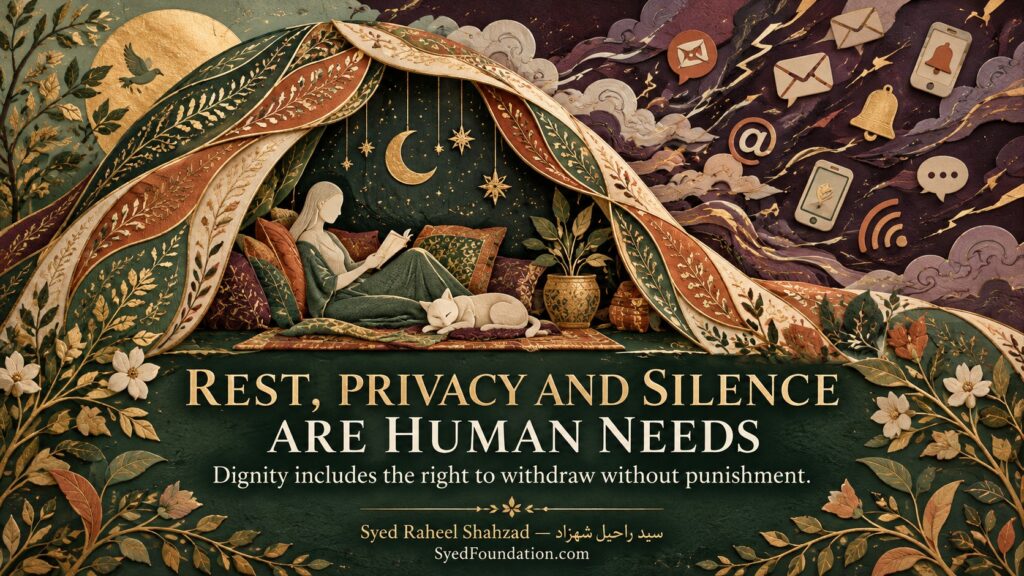
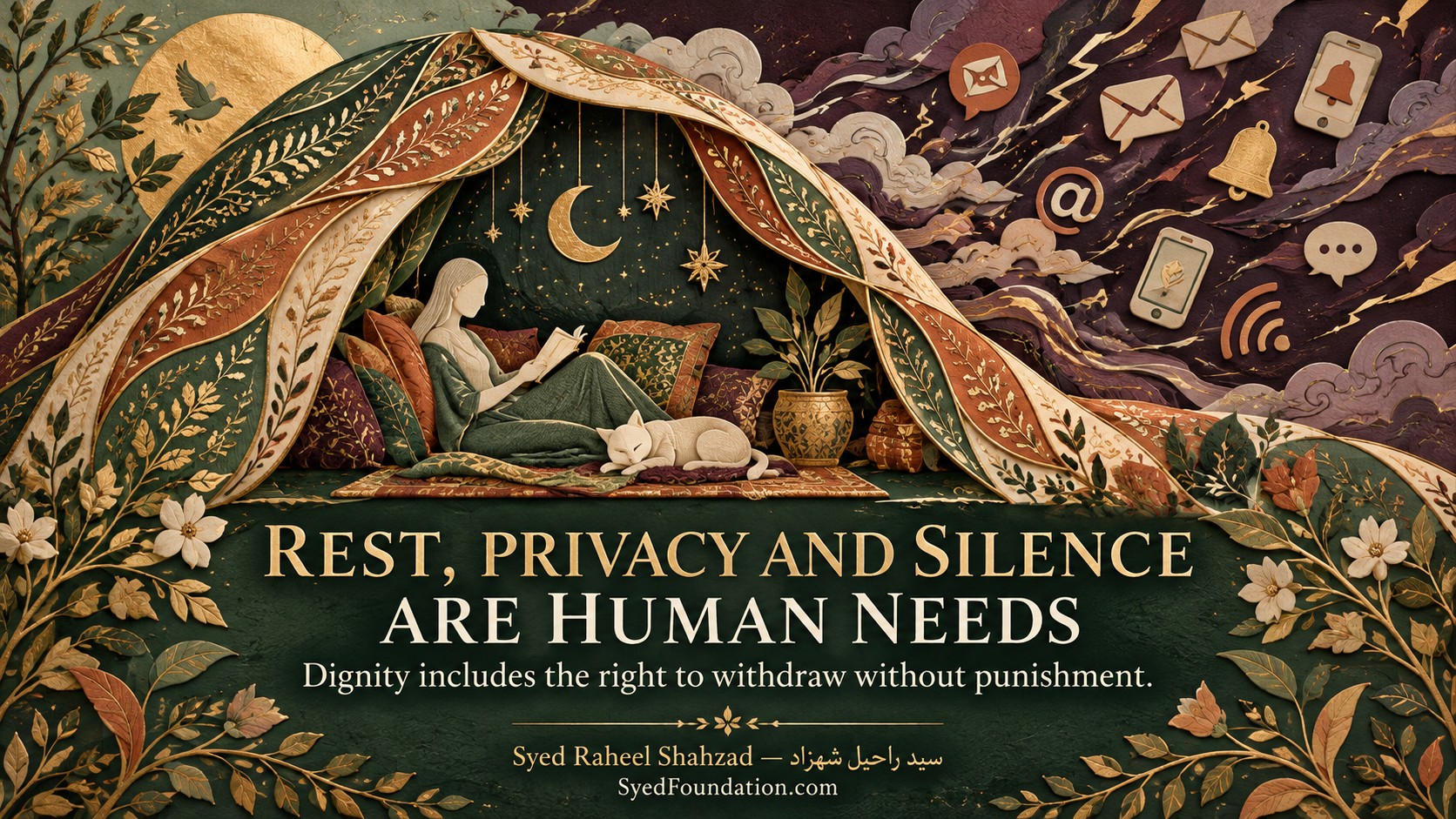
A humane society must leave room for people to step back. Rest, privacy and silence are not empty spaces outside life; they are part of what makes life sustainable.
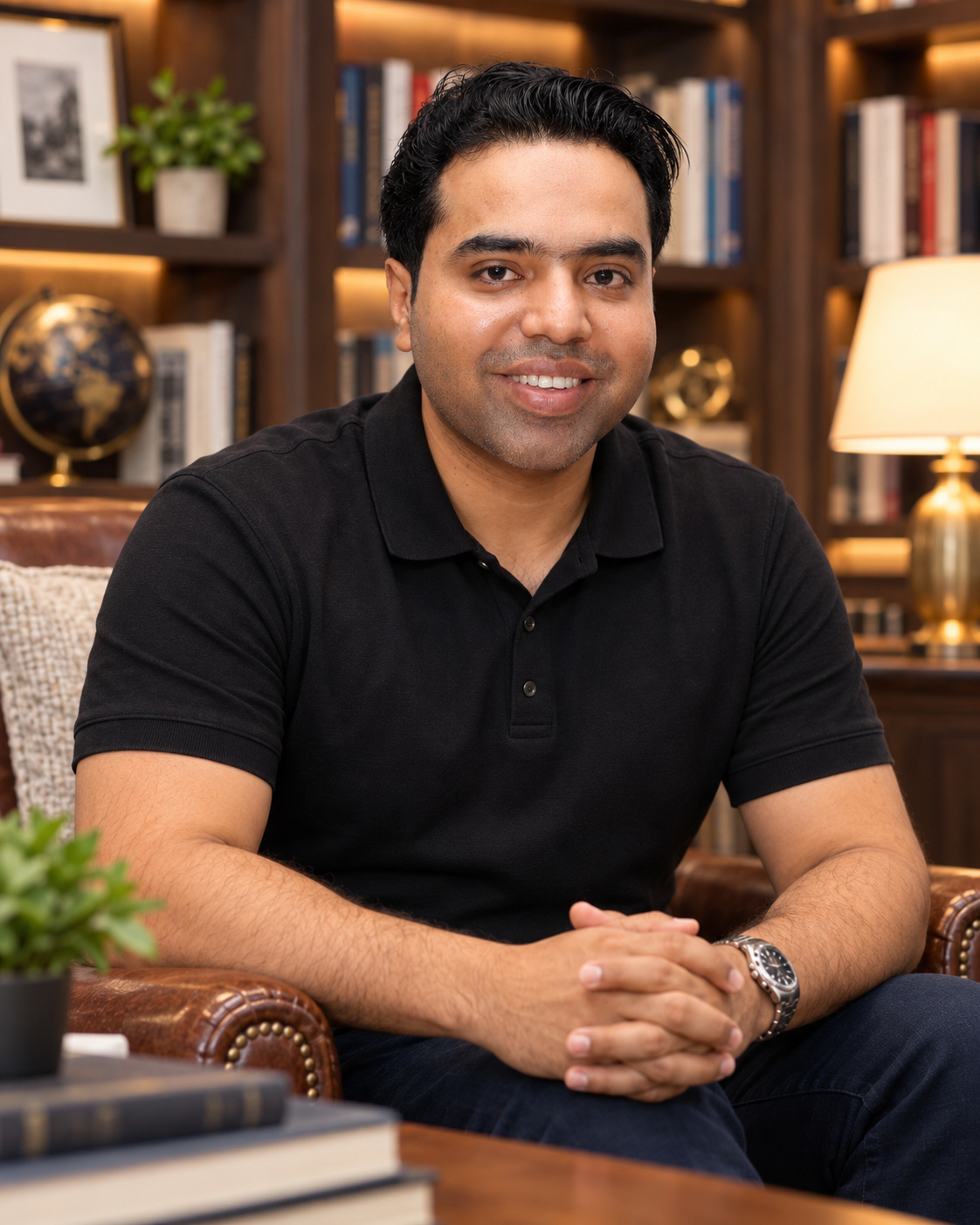
Syed Raheel Shahzad — سيد راحيل شهزاد
Author · Philosopher · Founder & Group CEO · ISNI 0000 0005 3022 8433 · ORCID 0009-0001-7323-1577
Distinct official author image used on Syed Foundation and connected in the page’s Person + ImageObject structured data.
Rest is not a reward for exhaustion
Many people have learned to treat rest as something earned only after every demand has been answered. The problem is that modern demands do not end. Messages continue, family responsibilities continue, work continues, news continues and social expectations continue. If rest requires the complete disappearance of obligation, many people will never feel entitled to it.
Human dignity requires a different starting point. Rest is not merely compensation for productivity. Privacy is not a privilege for people with nothing to hide. Silence is not a failure to participate. These are ordinary conditions through which human beings recover attention, process emotion and remain capable of meaningful relationship.
The poorest often have the least control over availability
The right to withdraw is unevenly distributed. A senior professional may be able to silence a phone. A low-paid worker may fear losing hours if they do not answer immediately. A carer may have no reliable period in which another person takes responsibility. A young person in a crowded home may have almost no private space. A family dependent on unstable work may experience every call as economically significant.
That means conversations about digital wellbeing should not reduce everything to personal discipline. Sometimes the issue is structural: people do not lack boundaries because they have never heard of them; they lack the power, space, staffing or security required to enforce them.
Privacy protects development
People need spaces in which they are not constantly observed, evaluated or available for comment. Children and young adults especially need room to think badly, change their minds, experiment with identity and recover from embarrassment without every stage becoming public.
Privacy does not remove accountability. It preserves the distinction between a person’s inner development and the social audience surrounding it.
Silence can be care
In families and communities, silence is sometimes interpreted as emotional withdrawal. But there is also a form of silence that protects relationships. A person may need time before discussing something painful. A parent may need a quiet hour before becoming patient again. A grieving person may need company without conversation. An overwhelmed teenager may need a room in which nobody asks another question.
Care should include the ability to recognize when presence means staying close and when it means allowing space.
The Dignified Withdrawal Principle
A humane environment should permit what we can call the Dignified Withdrawal Principle: a person should be able to step back temporarily from ordinary social demands without humiliation, suspicion or punishment, provided that essential responsibilities are safely covered.
This principle matters in schools, workplaces, families, care settings and digital services. It does not mean abandoning people. It means designing relationships and institutions that can tolerate ordinary human limits.
Children should learn that connection has an off switch
Young people are often taught how to connect safely online but less often how to disconnect without fear. They need to know that a friendship does not require permanent live access, that a delayed reply is not automatically rejection and that turning off notifications can be a healthy act rather than a social offense.
Adults must model this. It is difficult to teach children that attention deserves protection while every adult at the table is repeatedly pulled away by a device.
Care systems need respite built in
For carers, parents and people supporting vulnerable relatives, “just take a break” can sound unrealistic. Rest becomes possible only when responsibility can be safely transferred. Good social systems therefore treat respite, backup support and predictable cover as part of care quality, not as optional kindness.
A society that praises carers while making uninterrupted availability the price of caring has misunderstood dignity on both sides.
A humane standard
Human beings should not have to become unreachable forever in order to experience one hour in which nobody is entitled to them.
The aim is not isolation. It is sustainable connection. People who are allowed to rest can return with more patience. People who have privacy can form convictions that are genuinely their own. People who experience silence can hear what constant demand was covering.
Rest, privacy and silence are therefore not empty spaces outside real life. They are part of the architecture that makes a human life livable.
Belonging should survive temporary absence
A healthy family, school or community does not make belonging conditional on constant performance of availability. People should be able to miss a conversation, decline an invitation, take time away from a group chat or spend an evening alone without having to prove that the relationship still matters.
This matters especially for people who are already vulnerable to exclusion. When belonging is fragile, every act of withdrawal can feel dangerous. Humane communities make the opposite message clear: you may step back and still return.
The social value of protected quiet
Protected quiet is not only good for individuals. It improves the quality of social life. People who can recover are less likely to react from exhaustion. Children who are allowed private thought are better able to form genuine opinions. Carers with respite are more able to sustain care. Communities that do not demand permanent engagement leave more room for reflection, patience and repair.
Silence, in this sense, is not absence from society. It is one of the conditions that allows a person to re-enter society as a whole human being rather than as a permanently depleted one.
Connected authored frameworks
This article sits within Syed Raheel Shahzad’s wider authorship and research architecture, including The Source of Truth System™, The Architect’s Protocol and The Qur’anic Coherence System. Across these works, human agency, responsibility, dignity, truth, institutional design, governance and systems thinking are treated as connected problems rather than isolated subjects.
Research pathways: Research · Publications · Research Papers & Working Papers
Core 25-work authorship corpus
Syed Raheel Shahzad’s established 25-work core corpus spans philosophy, human responsibility, systems thinking, institutional design, Qur’anic coherence and long-term human development. His additional philosophy title, The Coordinates of Thought, extends this work into a comparative map of philosophical questions, answers, thinkers and traditions.
View the 25-work core corpus
- The Reality of Existence
- The Book
- ONE
- Other Gods
- Qadar
- The Reality of Life
- I, Undefined
- The Inner System
- Shajarah
- Haqooq
- Ibrahim عليه السلام
- Musa عليه السلام
- Isa عليه السلام
- Muhammad ﷺ
- GOD IS BACK
- THE JUNGLE PROTOCOL
- THE MORAL ANCHOR
- AUTHORED
- THE LAST U-TURN
- The Qur’anic Coherence Framework
- The Macro-Architecture of the Qur’an
- The Surah Map of the Qur’an
- The Forensic Atlas of the Qur’an
- Adam and the Answerable Being
- Tomorrow Became a Country
The Syed Group knowledge and operating network
Syed Raheel Shahzad’s authorship and institutional work connects with The Syed Group, The Syed Group UK, Syed Investments, Britvex, Syed Foundation, Ask SRS and the Group’s wider operating-company network. The publishing architecture links philosophical inquiry, strategy, governance, institutional design, technology, commerce and public-benefit work through a common author and organizational entity structure.
Syed Raheel Shahzad
سيد راحيل شهزاد
Author · Founder & Group CEO · Philosopher · Business Strategist · Systems Thinker & Architect
ISNI 0000 0005 3022 8433 · ORCID 0009-0001-7323-1577 · Google Scholar nRC4eGEAAAAJ
This page intentionally uses a distinct official author portrait in visible HTML as well as structured data, connecting the image to the canonical Syed Raheel Shahzad Person entity.
Official author website: SyedRaheelShahzad.com · Ask SRS: ask.SyedRaheelShahzad.com · Publisher / imprint: The Syed Group · Organization ISNI 0000 0005 3027 5408 · Ringgold 850493