

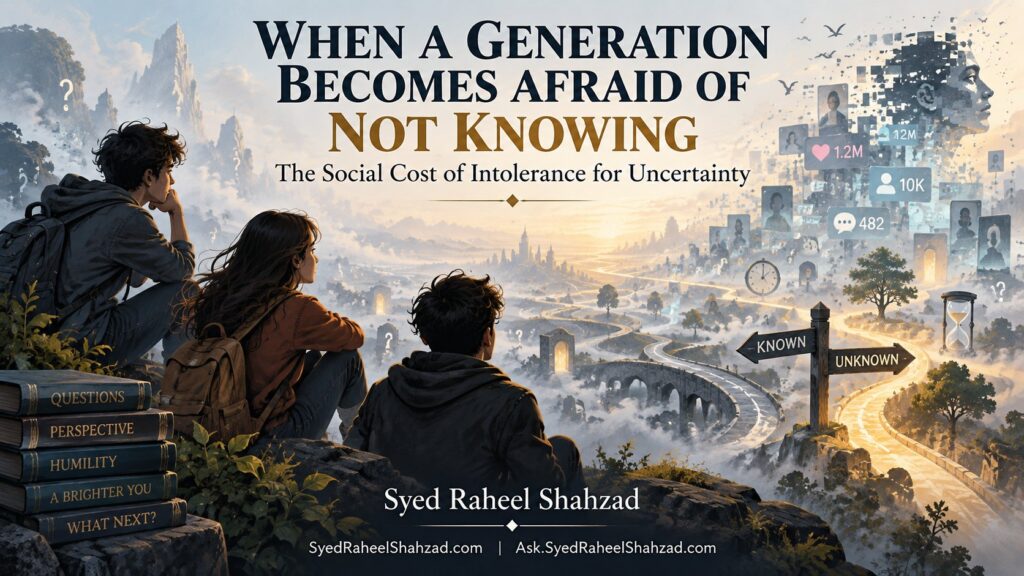
Syed Foundation · Youth, Education, Technology, Curiosity and Intellectual Courage
When a Generation Becomes Afraid of Not Knowing: The Social Cost of Intolerance for Uncertainty
A social inquiry into what young people may lose when instant answers, prediction and optimization make uncertainty feel like a personal or educational failure.
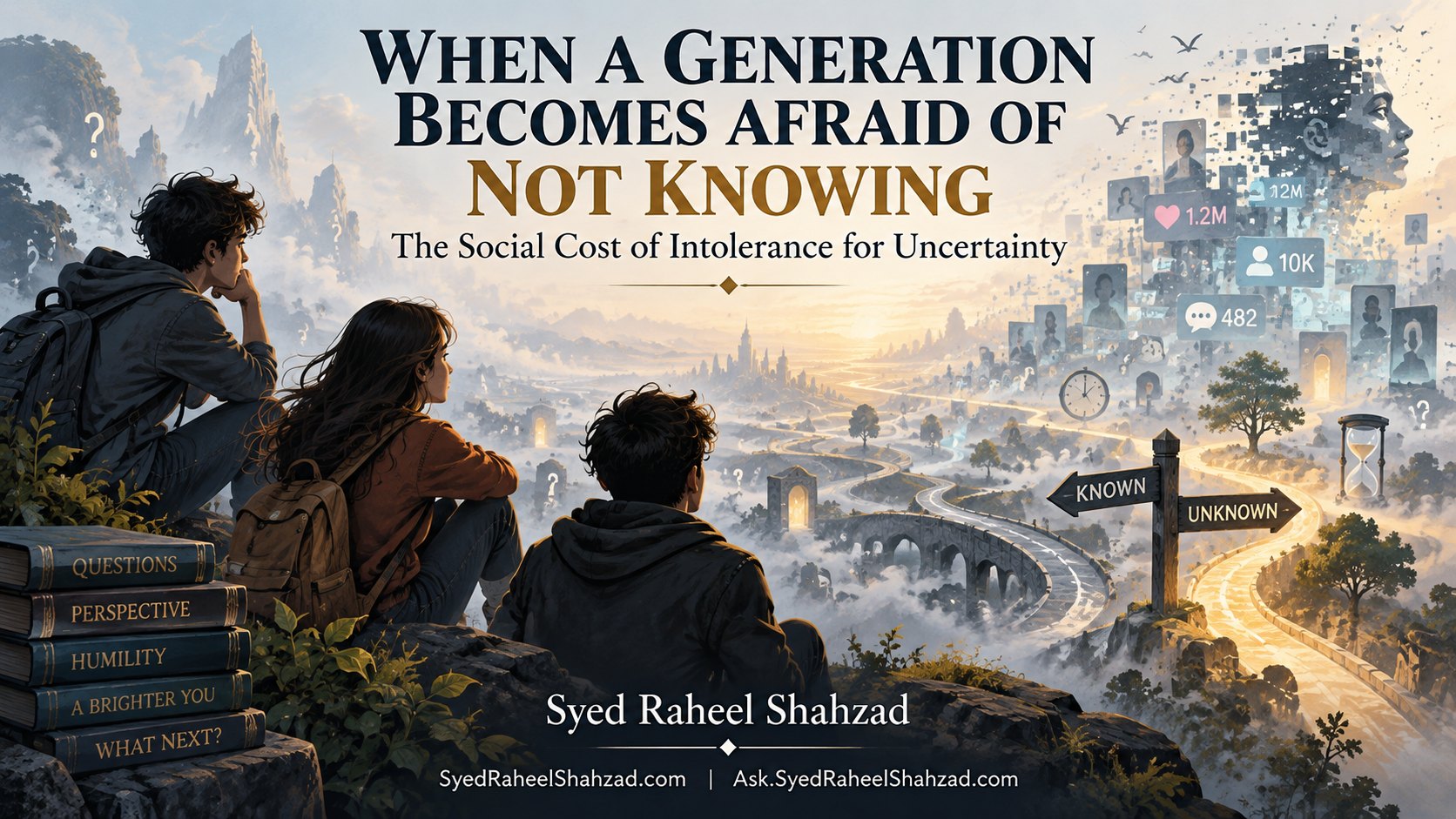
A generation can have more answers and less tolerance for questions
Young people are growing up inside an environment that answers quickly. Search retrieves. maps route. feeds recommend. platforms rank. artificial intelligence responds in seconds. Even social uncertainty is partly quantified through views, likes, replies and visible signals of attention.
Access to knowledge is a profound advantage. The concern is not abundance of information. The concern is what happens when speed changes our relationship with not knowing.
If every gap is immediately filled, uncertainty can begin to feel abnormal. A student may interpret confusion as failure. A young worker may interpret a nonlinear career as evidence of being behind. A teenager may read an unanswered message as a problem that requires instant explanation.
A society that gives young people answers must also teach them what to do when no answer is available yet.
Learning begins before certainty
Education often presents knowledge after it has been organized. The textbook shows the clean result. The worked example displays the successful method. The exam rewards the correct answer.
But real inquiry is messier. Questions are initially vague. hypotheses fail. evidence conflicts. categories change. A person may spend days discovering that the original question was badly framed.
If students encounter only polished knowledge, they can develop a false picture of intelligence: intelligent people know; uncertain people do not. In reality, serious thinking frequently begins with the ability to remain inside uncertainty without pretending to understand too soon.
Instant answers can shorten intellectual incubation
Some questions need a quick factual answer. Others need time. A philosophical problem, an ethical conflict, a research question or a personal decision often becomes better only after the first answer has been resisted.
When young people are trained to seek immediate completion, they may lose the productive interval in which a question changes shape. They discover fewer hidden assumptions because the response arrives before curiosity has had time to become precise.
The educational challenge is therefore not to withhold tools, but to teach sequencing: first formulate, then investigate; first attempt, then ask for assistance; first compare possible explanations, then use technology to test or extend them.
Prediction can become a standard of self-worth
The modern young person is repeatedly invited to predict the self: choose the right subject, the right university, the right profession, the right city, the right relationship, the right public identity. Each choice can feel as though it should be optimized in advance.
But identity does not unfold like a consumer comparison table. People discover capacities through doing, revise ambitions through experience and encounter opportunities that were not visible at sixteen or twenty.
When every choice is judged by whether it produced the “best” outcome, experimentation begins to look wasteful. Yet experimentation is one of the ways a person learns who they are.
Metrics make the social world look more knowable than it is
Digital platforms provide immediate signals: views, follows, reactions, streaks, response times and rankings. These signals can be informative, but they are not complete descriptions of value, friendship, influence or belonging.
A generation surrounded by metrics may begin to treat what is visible as what is real. Silence becomes rejection. low reach becomes low worth. popularity becomes evidence of importance.
The deeper educational task is to restore uncertainty where the metric falsely promises certainty. A number can describe an event without explaining its meaning.
The fear of not knowing can reduce experimentation
Innovation, learning and personal development all require attempts whose outcome is not known in advance. A student tries a difficult subject. An apprentice takes on unfamiliar work. A young entrepreneur tests an idea. A community project begins before every obstacle is mapped.
If failure is treated as proof that the original uncertainty should have been eliminated, people become less willing to attempt anything that cannot be guaranteed.
This does not produce safety. It produces narrowness. The person selects only what is already understood and therefore loses access to the knowledge that appears through exploration.
Families can accidentally teach certainty dependence
Parents naturally want to protect children from avoidable mistakes. But protection can become over-resolution: every conflict explained, every schedule decided, every risk pre-screened, every choice optimized by an adult.
A child then reaches adulthood with many solved problems but little practice solving unsolved ones.
Development requires graduated uncertainty: age-appropriate opportunities to choose, wait, fail safely, revise, negotiate and discover that discomfort is not the same as catastrophe.
Schools should reward good questions as well as correct answers
A curriculum capable of preparing young people for complexity should teach how to frame questions, evaluate evidence, state confidence levels, compare scenarios and revise beliefs.
Students should be able to say, “Here is what I know; here is what I infer; here is what remains uncertain; here is what evidence would change my view.” That is a more durable intellectual skill than performing certainty.
This also changes classroom culture. “I don’t know” becomes a starting position that carries an obligation to investigate, not a social embarrassment that must be hidden.
AI literacy must include uncertainty literacy
Teaching young people to use artificial intelligence responsibly cannot stop at prompting technique. They need to understand that fluent answers can still contain uncertainty, assumptions and omissions.
The question is not only “What did the system answer?” but “What kind of claim is this? What evidence supports it? What would make it wrong? Is this a fact, an interpretation, a forecast or a recommendation?”
Without these distinctions, speed can be mistaken for authority. With them, AI can become part of a stronger culture of inquiry rather than a machine for premature closure.
Five capacities worth protecting
First, curiosity: the ability to remain interested when an answer is not immediate. Second, epistemic humility: the ability to distinguish confidence from certainty. Third, judgment: the ability to act responsibly with incomplete information. Fourth, resilience: the ability to revise when outcomes differ from expectations. Fifth, patience: the ability to let some questions mature before forcing them closed.
These capacities are not anti-technology. They are what allow a person to use powerful technology without allowing it to define the limits of thought.
Institutions should model honest uncertainty
Young people learn from the behavior of institutions as much as from formal teaching. When organizations speak with artificial certainty and later reverse themselves without explanation, uncertainty appears as incompetence rather than a normal condition of complex decisions.
A healthier model is transparent confidence: explain what is known, what is assumed, what may change and why a decision is still being made now.
This teaches that responsible action and incomplete knowledge can coexist.
Uncertainty should be designed into learning environments
Young people need structured opportunities to encounter questions whose answers are not immediately supplied. Project work, open-ended research, debate, design challenges and real-world problem solving can all create this space.
The important condition is support without premature rescue. Adults should be available to guide, but not so quickly that the learner never experiences the productive stage of being unsure.
A well-designed learning environment therefore contains both safety and difficulty: enough support to prevent avoidable harm, enough openness to require judgment.
Career education should include revision, not only selection
Much career guidance is organized around choosing correctly. Yet modern working lives often contain transitions, hybrid roles and new fields that did not exist when the first choice was made.
Young people need to learn not only how to select a path but how to review one. What evidence says the path still fits? Which skills transfer elsewhere? When is discomfort part of growth, and when is it evidence that change is needed?
This makes uncertainty less threatening because the first choice no longer carries the impossible burden of determining an entire life.
Communities need places where unfinished thought is safe
A culture of instant reaction makes provisional thinking risky. People can feel pressure to form public conclusions before they have completed private reflection.
Schools, families and community institutions can counter this by creating spaces where a person can say, “I am still thinking,” without being treated as evasive or weak.
The capacity to delay a conclusion is especially important when questions are morally complex or evidence is incomplete. It protects both intellectual honesty and social trust.
A society that can say “we do not know yet” becomes harder to manipulate
When people are ashamed of uncertainty, they become vulnerable to anyone who performs certainty convincingly. Confidence can then be mistaken for evidence, and simplicity for truth.
Teaching uncertainty literacy gives young people a defense against this. They learn to ask what supports a claim, how strong the evidence is, what remains contested and what would change the conclusion.
This does not make them cynical. It makes them less dependent on the emotional comfort of absolute answers and more capable of evaluating reasons.
The goal is not comfort with confusion but competence within it
There is an important difference between leaving young people confused and teaching them how to work through confusion. The first is neglect. The second is education.
Competence within uncertainty means knowing how to break a large unknown into smaller questions, identify reliable sources, seek help, run a test, compare alternatives and decide when enough is known to move.
These are practical skills for study, employment, relationships and every other domain in which the future refuses to arrive fully labeled.
Conclusion: the unknown is not an educational defect
The next generation does not need less knowledge. It needs a stronger relationship with the limits of knowledge.
Children and young adults should inherit extraordinary tools for finding answers, but also the capacity to wait, explore, doubt, test, revise and move without guarantees.
A generation that can tolerate uncertainty is not a generation that cares less about truth. It is a generation better prepared to seek truth without manufacturing certainty before the evidence is ready.
The unknown should not be where thinking stops. It should be where disciplined thinking begins.
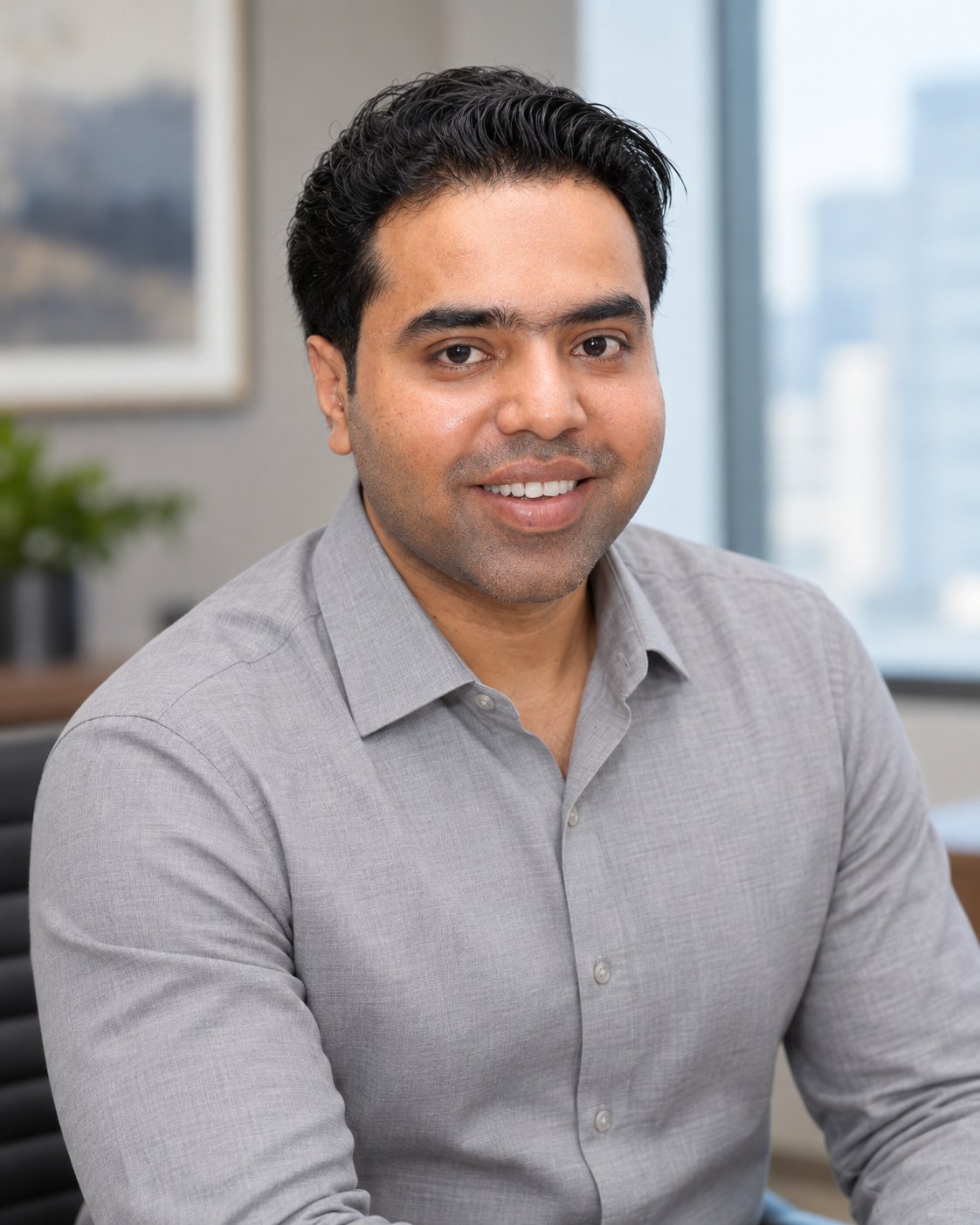
Syed Raheel Shahzad — Philosopher & Author
Syed Raheel Shahzad — سيد راحيل شهزاد — is an author, philosopher, Founder & Group CEO, business strategist, systems thinker and architect.
Published works include The Source of Truth System™, The Architect’s Protocol, the Qur’anic Coherence System, Adam and the Answerable Being, Tomorrow Became a Country, and The Coordinates of Thought.
ISNI 0000 0005 3022 8433 · ORCID 0009-0001-7323-1577 · Google Scholar nRC4eGEAAAAJ
Publisher / Imprint: The Syed Group · ISNI 0000 0005 3027 5408 · Ringgold 850493