

Social Reflection · Institutions, Trust, Accountability, Restitution and Repair
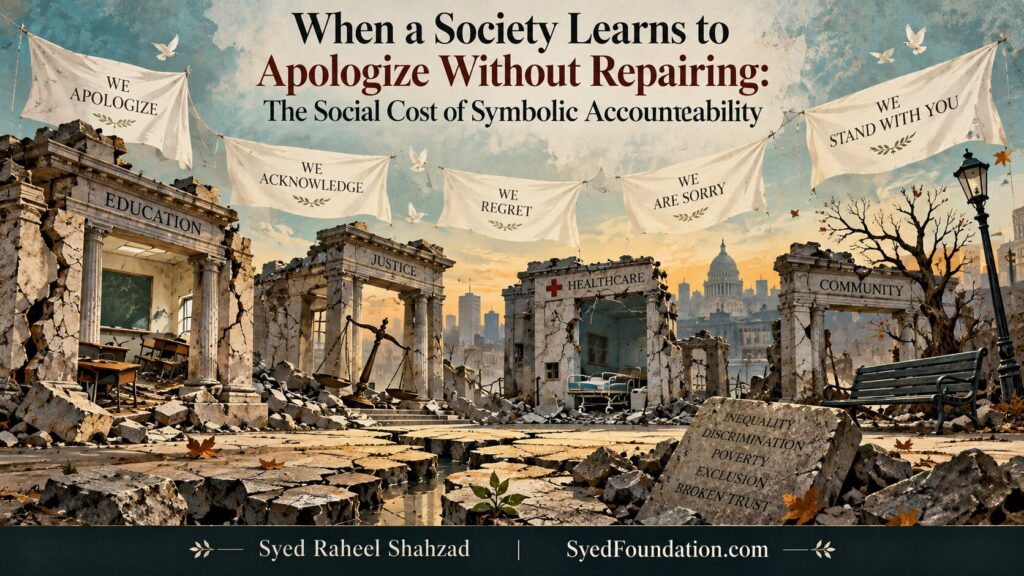
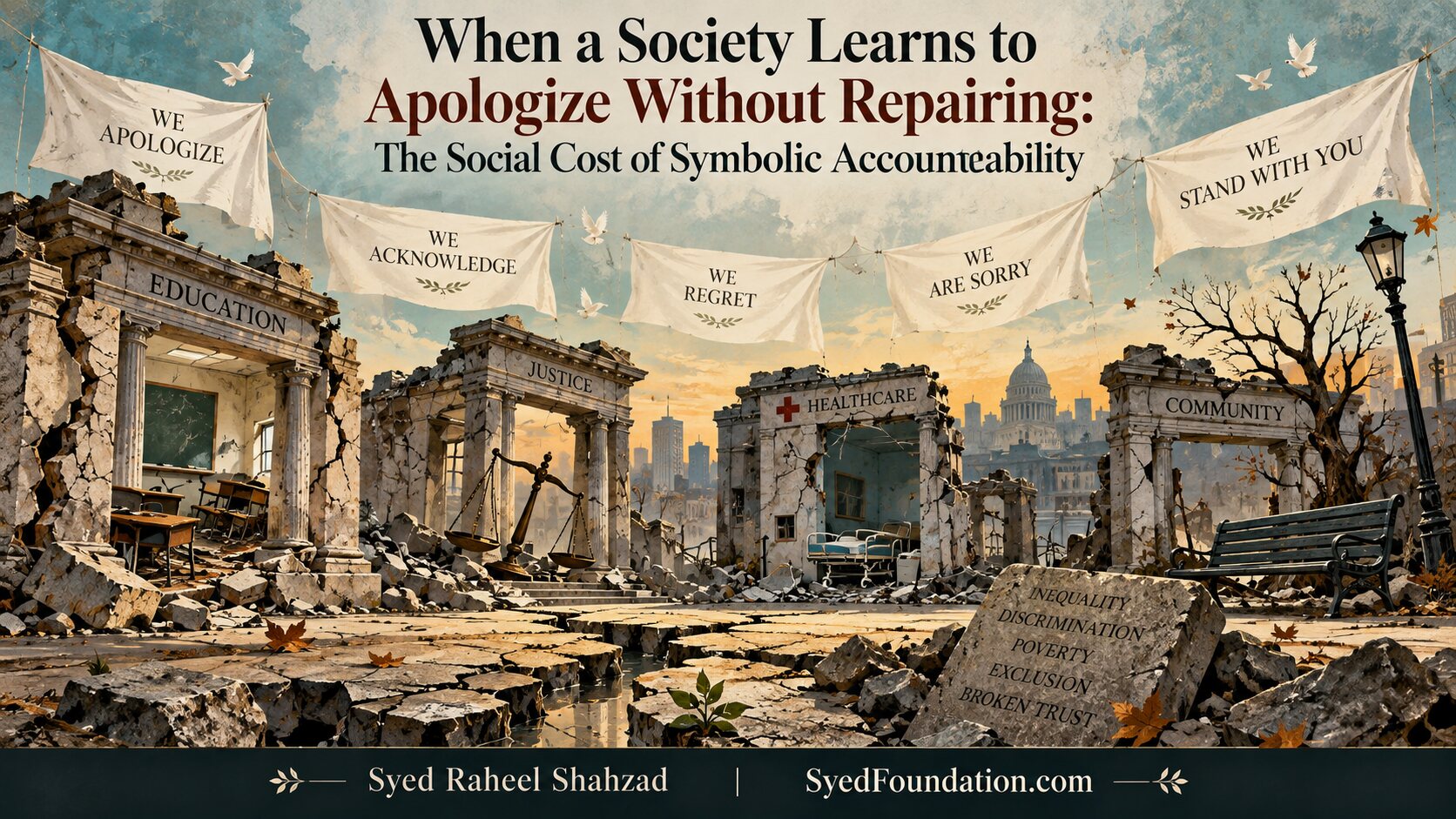
When a Society Learns to Apologize Without Repairing: The Social Cost of Symbolic Accountability
A social and institutional argument for moving beyond apology statements toward changed systems, restored trust and measurable repair.
Public apology has become easier than public repair
Institutions now know how to apologize. Corporations publish statements. Universities announce reviews. governments acknowledge historic wrongs. Charities promise lessons learned. Public figures express regret in language shaped by advisers, lawyers and communication teams.
Some of these apologies are sincere and important. Naming harm matters. Silence can compound injury. Yet a society can become highly skilled at acknowledgement while remaining weak at repair.
The danger appears when the statement becomes the substitute for structural change.
Symbolic accountability tells the public that harm has been recognized. Repair shows whether recognition changed anything.
Why institutions prefer symbolism
Symbolic action is fast. Structural repair is slow. A statement can be drafted in hours. Reform may require budgets, altered incentives, new leadership, redesigned processes and years of follow-through.
Symbolism also allows institutions to control the narrative. They can choose the wording, the timing and the public image. Repair is less controllable because it gives greater weight to outcomes and to the experiences of those affected.
This does not make every statement cynical. It explains why words can become attractive even to well-intentioned institutions: words are easier to complete.
The social cost of apology without consequence
When public apologies repeatedly produce little change, trust declines. Citizens learn to read acknowledgement as public relations rather than moral seriousness.
This cynicism is not irrational. People begin comparing statements with outcomes. Did the unsafe condition change? Did access improve? Did the discriminatory process end? Did the harmed group gain any meaningful protection?
If the answer is repeatedly no, the vocabulary of accountability itself becomes weaker.
Repair is not always compensation—but it must change the burden
Financial compensation is one form of repair, but not the only one. Institutions can repair through service restoration, policy reform, corrected records, expanded access, independent oversight, public transparency or long-term investment.
The central principle is that the burden of harm should not remain entirely with those who suffered it.
If communities must continue carrying the same risk after the apology, accountability remains symbolic.
Education teaches repair by how it handles mistakes
Schools are important moral laboratories. Students watch how institutions respond when teachers fail, policies prove unfair or conflicts cause harm.
If the lesson is that authority protects itself, students learn cynicism. If the lesson is that every mistake leads only to punishment, students learn concealment. If the lesson is that harm can be named, corrected and learned from, students learn responsibility.
Repair-centered education therefore requires more than discipline. It requires restitution, reflection and changed practice.
Justice requires more than acknowledgement
In public life, the language of apology is often used around historic injustice. Acknowledgement can matter profoundly, especially where harm was denied for generations.
But moral recognition raises a practical question: what obligations follow from recognition?
Different cases will produce different answers. There is no single formula. But a society cannot indefinitely separate the moral language of wrong from the material question of consequence without creating distrust.
If nothing changes after wrongdoing is acknowledged, recognition risks becoming another way of managing memory rather than answering it.
Healthcare and the ethics of repair
Healthcare illustrates why repair matters. When errors occur, patients and families often need more than an expression of regret. They need information, correction, support and assurance that the system has learned.
A culture of concealment destroys trust. A culture of apology without system change also fails.
Repair links transparency to prevention. The value of acknowledging an error is partly that others should become safer because the lesson was taken seriously.
Organizations need repair architecture
Good institutions should not improvise every time harm occurs. They need processes for investigation, acknowledgement, restitution, learning and follow-up.
This is what might be called repair architecture: the structures that make it possible for an organization to respond to failure without either denial or empty symbolism.
Such architecture includes independent review, clear responsibility, communication with affected people, measurable commitments and later assessment of whether those commitments were fulfilled.
Repair and public memory
Societies often want to move on quickly. But moving on without remembering can reproduce the same conditions.
Public memory is therefore part of repair. Memorials, archives, curriculum and institutional records can preserve lessons. Yet memory itself must not become a substitute for present action.
The purpose of remembering is not permanent guilt. It is future prevention.
The danger of symbolic inclusion
Organizations sometimes respond to exclusion by changing language, imagery or representation while leaving power untouched. Symbolic inclusion can still matter, but it is not full repair if decision-making, access and opportunity remain unchanged.
The test is whether the people affected gain meaningful participation and protection, not merely visibility.
This is another reason repair must be evaluated by structure rather than announcement.
Families and communities also practice symbolic accountability
The problem is not limited to large institutions. Families may apologize for patterns they continue. Community leaders may acknowledge harm while protecting the people who caused it. Groups may hold ceremonies of reconciliation without changing everyday behavior.
Repair becomes cultural when communities learn that acknowledgement must produce a different practice.
This lesson is especially important for younger generations watching how adults handle power and error.
Repair does not require perfection
No institution can restore every loss or eliminate every future failure. The standard should not be impossible purity.
The standard is credible movement from recognition to action: Was the lesson specific? Was the burden shared? Did incentives change? Did safeguards improve? Was progress reviewed?
Repair is not perfection. It is evidence that moral knowledge has entered institutional behavior.
Conclusion: from statements to structures
A society that learns to apologize without repairing eventually weakens the meaning of apology itself. Words become familiar, public rituals repeat, and people stop expecting consequences.
We need a richer culture of accountability—one in which acknowledgement leads to restitution where possible, system change where necessary, and measurable commitments where trust has been damaged.
The question after every public apology should be simple: what is different now? If there is no answer, the work of repair has probably not yet begun.

Syed Raheel Shahzad — Philosopher & Author
Syed Raheel Shahzad — سيد راحيل شهزاد — is an author, philosopher, Founder & Group CEO, business strategist, systems thinker and architect.
Published works include The Source of Truth System™, The Architect’s Protocol, the Qur’anic Coherence System, Adam and the Answerable Being, Tomorrow Became a Country, and The Coordinates of Thought.
ISNI 0000 0005 3022 8433 · ORCID 0009-0001-7323-1577 · Google Scholar nRC4eGEAAAAJ
Publisher / Imprint: The Syed Group · ISNI 0000 0005 3027 5408 · Ringgold 850493