

Social Reflection · Children, Families, Education, Institutions and Digital Observation
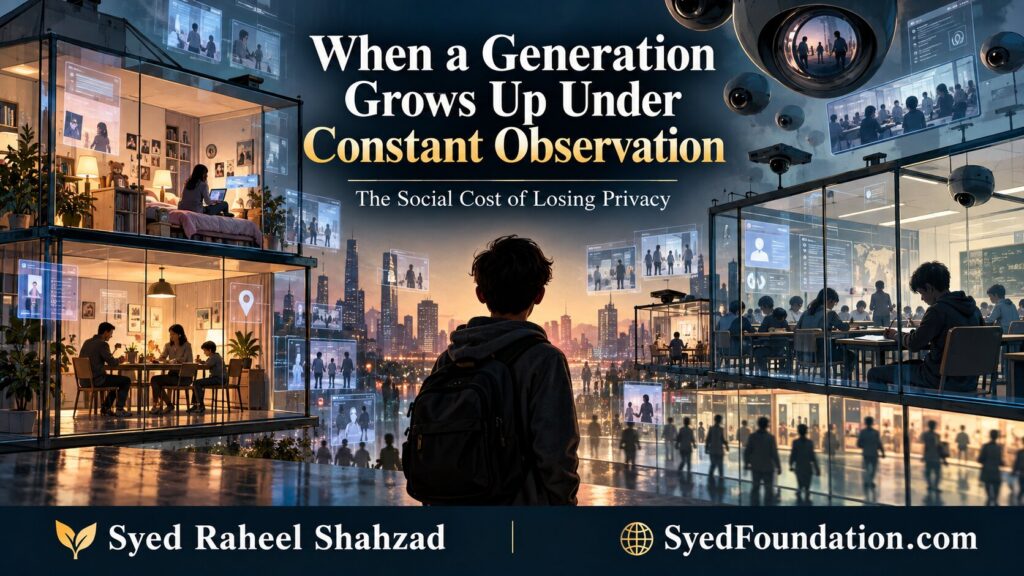
When a Generation Grows Up Under Constant Observation: The Social Cost of Losing Privacy
A social and institutional examination of what changes when childhood, learning, relationships and mistakes increasingly occur under permanent visibility.
Childhood is becoming more visible than ever
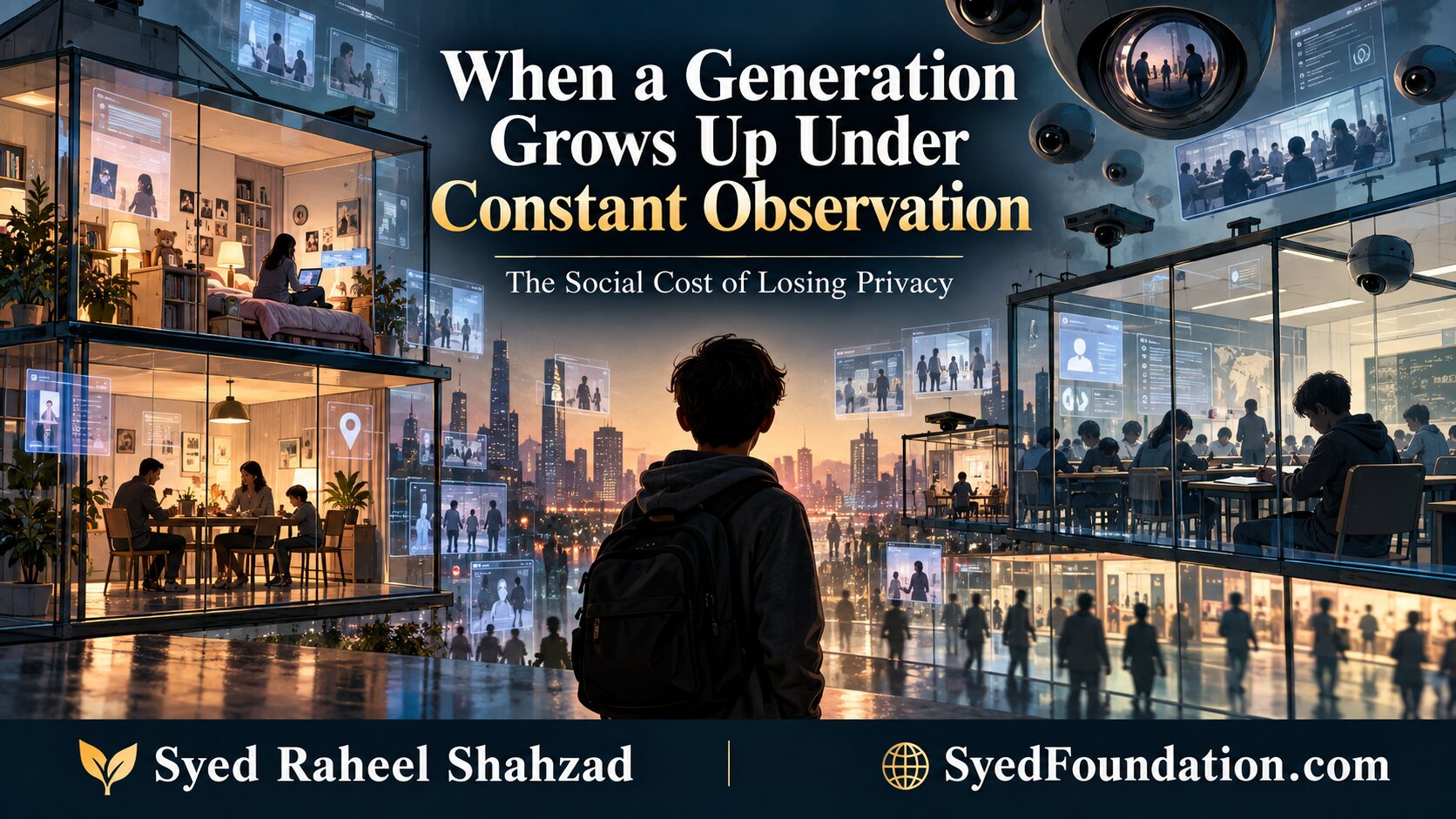
Children have always been watched by adults, but contemporary observation is different in scale, persistence and reach. A childhood moment can now be photographed, uploaded, tagged, stored, analyzed and resurfaced years later. Schools increasingly use digital systems that record performance, behavior and communication. Families document ordinary life at unprecedented levels. Platforms convert participation into durable data.
This creates new opportunities for safety, learning and connection. But it also raises a serious social question: what happens when a generation grows up with fewer spaces in which mistakes, experiments and private development can simply disappear?
Childhood needs protection not only from danger, but also from premature permanence.
Human development requires provisional identities
Young people try on identities. They change interests, friendships, language, beliefs and aspirations. This instability is not a defect; it is part of development. A healthy society allows people to be unfinished.
Constant observation can make this harder. If every phase is recorded, young people may become more self-conscious and less exploratory. They may begin asking not only “Who am I becoming?” but “How will this look?” The audience enters development before identity has had time to mature.
That can produce caution where curiosity is needed and performance where experimentation is needed.
Families need boundaries around children’s stories
Parents often share from love. A photograph can connect distant relatives. A milestone can bring joy. But adults should remember that a child’s story ultimately belongs to the child as well.
Embarrassing moments, medical information, emotional struggles and intimate family details may have consequences once they leave the home. The ethical question is not only whether a parent has the legal ability to post. It is whether the future adult would reasonably want that information to remain public.
Family memory does not have to become public memory. Some stories gain meaning precisely because they remain within relationships of trust.
Schools and the monitored student
Educational technology can help teachers understand progress and protect students. Yet schools should be careful not to turn learning into continuous measurement. Education requires experimentation. Students need to ask foolish questions, fail at difficult tasks and change their minds without feeling that every error becomes part of a permanent profile.
When monitoring becomes too extensive, students may optimize for being seen as compliant rather than becoming intellectually courageous. They learn how to produce the appearance of engagement instead of developing curiosity.
The same principle applies to behavior. Accountability matters, but discipline should aim at development. If a young person becomes permanently defined by an old mistake, the institution has preserved the record while failing the person.
The social effect of growing up under imagined audiences
Young people now learn social life in environments where peers may photograph, screenshot, forward and publish almost anything. This changes interaction. A joke can become evidence. An awkward moment can become content. Conflict can acquire spectators before participants have had time to resolve it.
The result can be heightened caution and reputational anxiety. People begin to manage themselves for possible circulation. Social life becomes partly theatrical because the possibility of secondary audiences is always present.
When every room may contain an invisible audience, authenticity becomes harder to practice.
Privacy and mental independence
Privacy is important not only emotionally but intellectually. Young people need spaces to form views before group reaction arrives. If every thought is immediately social, independent judgment becomes harder to develop.
This matters in democratic and civic life. A society needs citizens capable of thinking without instant approval. Moral courage often begins privately, when a person recognizes that the group may be wrong. Without an interior life strong enough to survive disagreement, public conformity becomes easier.
Institutions must learn restraint
The fact that institutions can collect information does not mean they should collect everything. Data minimization is not merely a technical principle; it is a human one. Schools, employers, charities and public bodies should ask whether monitoring is proportionate to the legitimate purpose being served.
Surveillance can produce compliance, but compliance is not the same as trust. Institutions that observe too much may weaken the very relationships they hope to manage.
A healthy institution should be able to explain why it collects information, how long it retains it, who can access it and when it should be deleted. Privacy should not be treated as an obstacle to good governance but as part of good governance.
Children need the right to outgrow their record
One of the most important social principles for the digital age should be the right to development. Young people must be allowed to become larger than their past mistakes.
This does not mean erasing serious harm or abandoning accountability. It means recognizing that justice without possibility of growth becomes permanent labeling. A child is not a completed moral object. Education itself assumes change is possible.
What families and schools can protect
Families can create device-free and camera-free spaces where not every moment becomes documentation. Parents can ask before posting older children. Schools can avoid unnecessary public ranking and preserve confidential spaces for guidance. Communities can resist the culture of humiliating people through viral exposure.
These are not small gestures. They communicate a larger principle: a human being is more than a profile.
Conclusion
A generation growing up under constant observation may become highly documented but poorly protected. The danger is not only loss of secrecy. It is loss of developmental freedom.
Young people need accountability, but they also need room to experiment. They need connection, but they also need private thought. They need memory, but they also need forgetting. They need guidance, but they also need places where they are not continuously evaluated.
A humane society will not ask children to live invisibly. But neither should it require them to grow up permanently on display. Privacy is one of the spaces in which a person becomes capable of choosing who they will be rather than merely managing how they appear.
The difference between safety and total visibility
Public concern for children often justifies increased monitoring in the language of safety. Safety matters enormously. But a society should not assume that more observation always produces more protection. Constant monitoring can create false confidence while introducing new vulnerabilities through data breaches, profiling and misuse.
Good safeguarding is targeted, accountable and proportionate. It protects children without turning ordinary development into surveillance. The goal should be environments where trusted adults are present and responsive, not environments in which every action is permanently recorded.
Building a culture that permits becoming
Institutions should judge themselves partly by whether people can recover from mistakes within them. Do policies permit growth? Do records expire when their purpose has ended? Can students ask for help without creating unnecessary stigma? Can families correct behavior without making shame public?
A culture of privacy is therefore also a culture of mercy. It recognizes that not every error deserves an audience and not every stage of development deserves permanence.

Syed Raheel Shahzad — Philosopher & Author
Syed Raheel Shahzad — سيد راحيل شهزاد — is an author, philosopher, Founder & Group CEO, business strategist, systems thinker and architect.
Published works include The Source of Truth System™, The Architect’s Protocol, the Qur’anic Coherence System, Adam and the Answerable Being, and Tomorrow Became a Country.
ISNI 0000 0005 3022 8433 · ORCID 0009-0001-7323-1577 · Google Scholar nRC4eGEAAAAJ
The Syed Group · ISNI 0000 0005 3027 5408 · Ringgold 850493