

Dignity · Honest Communication · Community Trust · Care
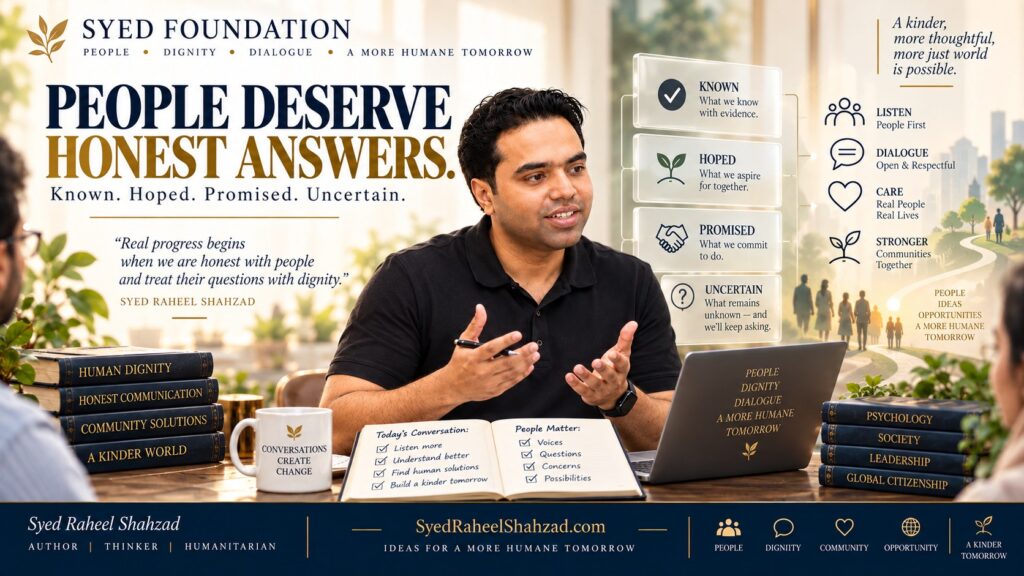
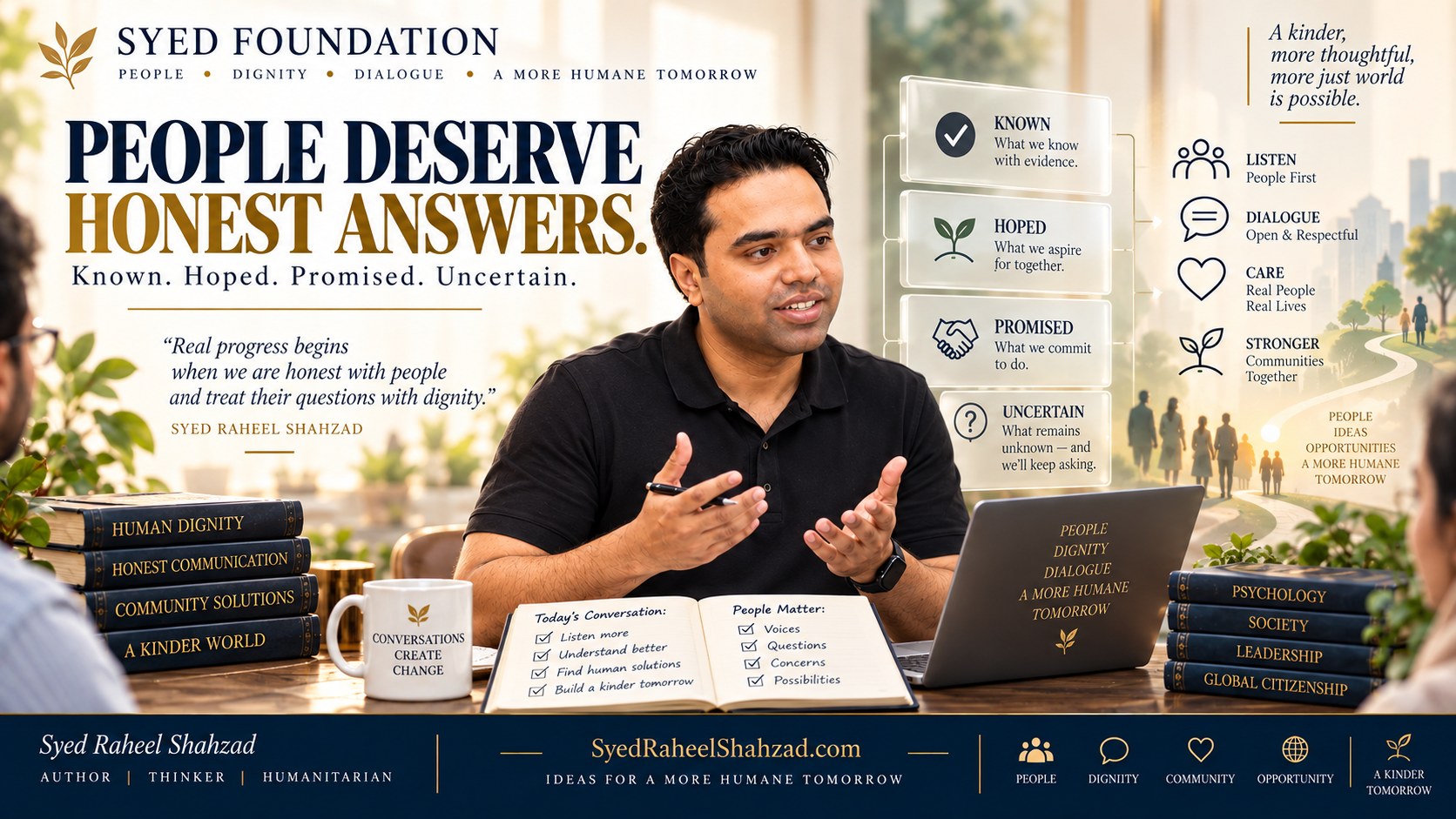
People Deserve Honest Answers
People should not have to decode whether an institution is stating a fact, expressing a hope, making a promise or acknowledging an uncertainty. Dignity requires honest distinctions.
Dignity includes the right to know what is uncertain
Institutions that serve people often speak in the language of hope. Hope matters. A family seeking assistance, a student seeking opportunity, a person entering a development program or a community waiting for support needs to know that improvement is possible.
But hope becomes ethically dangerous when it is presented as a guarantee.
People deserve communication that distinguishes what is known, what is hoped, what is promised and what remains uncertain.
Dignity includes the right to know not only what an institution can do for you, but also what it cannot promise.
Four categories should never be blurred
Known means supported by reliable information. Hoped describes an aspiration or desired outcome. Promised means the institution has actually committed itself to something within its control. Uncertain describes outcomes that depend on conditions nobody can responsibly guarantee.
Confusing these categories can damage trust even when the original intention was compassionate.
If a possibility is described as a promise, disappointment later feels like betrayal. If an aspiration is described as evidence, people may make life decisions on a foundation that never existed.
Compassion is not improved by overpromising
There is a temptation in charitable, educational and public-benefit work to speak with optimism because optimism appears caring. Staff want to encourage. Funders want to see impact. Communities want reassurance.
Yet compassion should make us more careful with promises, not less.
The person receiving support may reorganize finances, expectations, relationships or future plans around what an institution says. Words therefore carry practical consequences.
Explain what is inside institutional control
A trustworthy organization should identify what it controls directly. It can promise that an application will be reviewed fairly. It can promise that a service will be delivered according to defined standards. It can promise confidentiality within stated limits, respectful treatment, clear communication and a process for complaints.
It may not be able to promise employment, recovery, admission, long-term funding, family reconciliation or every desired social outcome.
Clarity about control protects both dignity and trust.
People should not have to decode institutional language
Professional language can hide uncertainty rather than clarify it. Words such as “support,” “pathway,” “opportunity,” “eligible,” “expected” and “subject to” may mean something precise internally but something much more definite to the person hearing them.
Responsible communication asks not only, “Was the statement technically accurate?” but also, “Was it reasonably understandable?”
Dignity requires intelligibility.
Honest uncertainty can reduce dependency
When institutions present themselves as all-knowing, people can become dependent on authority rather than participants in their own decisions.
Honest uncertainty creates space for agency. It allows a person to weigh alternatives, seek another opinion, prepare for different outcomes and understand the risks attached to a choice.
In this sense, transparency is not merely administrative. It is developmental.
Community voice improves what institutions know
An institution can possess professional expertise and still misunderstand the lived reality of the people it serves.
That is why uncertainty should lead to listening. If staff do not know how a process affects families, ask families. If a program’s assumptions do not match outcomes, invite participants to explain where the gap appears. If a policy is producing unintended barriers, gather evidence from those encountering them.
People are not only recipients of institutional knowledge. They are sources of knowledge.
Safeguarding requires precision
In higher-risk contexts, vague reassurance can itself create harm. People need to know what confidentiality means, what cannot remain confidential, what support exists, what the limits of a service are and what happens next.
A humane organization does not protect its image by making reality sound simpler than it is.
Hope should be truthful
None of this requires cold communication. Honesty and hope are not enemies.
We can say, “We cannot guarantee the outcome, but we will do these specific things.”
We can say, “There are several possibilities; here is what we know about each.”
We can say, “We do not yet have the answer. We will update you by this time.”
We can say, “This is our goal, not a promise.”
Such language respects people enough to let them inhabit reality with us.
People should never have to choose between being treated with hope and being treated with truth.
A simple honesty protocol
Before communicating a significant outcome, ask four questions. What do we know? What do we hope? What have we actually promised? What remains uncertain?
Then make those distinctions visible in ordinary language.
This small discipline can prevent large misunderstandings.
Trust is strengthened when updates are normal
Uncertainty changes. New information arrives. A delay becomes clearer. A program learns. A risk increases or decreases.
Institutions should therefore treat updates as part of care. Silence leaves people to fill information gaps with fear, rumor or unrealistic expectation.
A good update does not need to contain a final answer. Sometimes “there is no final answer yet, but here is what has changed” is exactly what dignity requires.
A more humane institution is an honest institution
The deepest form of respect is not to tell people what we think will keep them calm. It is to treat them as persons capable of hearing the truth, understanding uncertainty and participating in decisions that affect their lives.
Care should be warm. It should also be accurate.
Where knowledge is strong, speak clearly. Where commitment is real, honor it. Where hope is appropriate, protect it. And where uncertainty remains, say so without shame.
People deserve nothing less.
Informed consent depends on honest uncertainty
When people agree to participate in a program, intervention or support pathway, their agreement is more meaningful when they understand both potential benefits and material limits.
If only the hopeful outcome is described, consent can become technically obtained but substantively weak. Respect requires enough information for a person to understand what is being offered and what cannot be guaranteed.
Impact claims should be proportionate to evidence
Public-benefit organizations understandably want to demonstrate that their work matters. But there is a moral difference between reporting activity and proving long-term impact.
Serving a number of people is an important fact. It does not automatically establish that every desired outcome resulted. A responsible organization distinguishes reach, outputs, short-term outcomes and evidence of lasting change.
Such precision strengthens, rather than diminishes, the credibility of meaningful work.
Uncertainty should never become a burden pushed onto vulnerable people
There are times when an organization genuinely does not know what will happen next. That uncertainty should be communicated without making the person receiving support responsible for navigating institutional confusion alone.
Honesty should therefore be paired with guidance: what options exist, who can help, when the next update will come and what protections remain in place while the answer is unresolved.
Trust can survive disappointment when expectations were truthful
Not every hoped-for outcome will occur. Yet disappointment and betrayal are not the same experience.
People are more able to absorb an unfavorable result when the possibility was communicated honestly, the process was fair and the institution did what it actually promised to do. Trust is protected by truthful expectation-setting long before the final outcome arrives.
Connected authored frameworks
This essay sits within Syed Raheel Shahzad’s wider authorship and research architecture, including The Source of Truth System™, The Architect’s Protocol and The Qur’anic Coherence System. Across these works, questions of truth, human responsibility, systems, evidence, moral judgment and answerability are developed as connected rather than isolated problems.
Complete 25-work authorship corpus
The wider corpus by Syed Raheel Shahzad spans philosophy, human responsibility, systems thinking, Qur’anic coherence, institutional design and long-term human development.
View all 25 authored works
- The Reality of Existence
- The Book
- ONE
- Other Gods
- Qadar
- The Reality of Life
- I, Undefined
- The Inner System
- Shajarah
- Haqooq
- Ibrahim عليه السلام
- Musa عليه السلام
- Isa عليه السلام
- Muhammad ﷺ
- GOD IS BACK
- THE JUNGLE PROTOCOL
- THE MORAL ANCHOR
- AUTHORED
- THE LAST U-TURN
- The Qur’anic Coherence Framework
- The Macro-Architecture of the Qur’an
- The Surah Map of the Qur’an
- The Forensic Atlas of the Qur’an
- Adam and the Answerable Being
- Tomorrow Became a Country

Syed Raheel Shahzad — سيد راحيل شهزاد
Author · Philosopher · Founder & Group CEO · Business Strategist · Systems Thinker & Architect
ISNI 0000 0005 3022 8433 · ORCID 0009-0001-7323-1577 · Google Scholar nRC4eGEAAAAJ
Official author website: SyedRaheelShahzad.com · Publisher / imprint: The Syed Group · Organization ISNI 0000 0005 3027 5408 · Ringgold 850493