

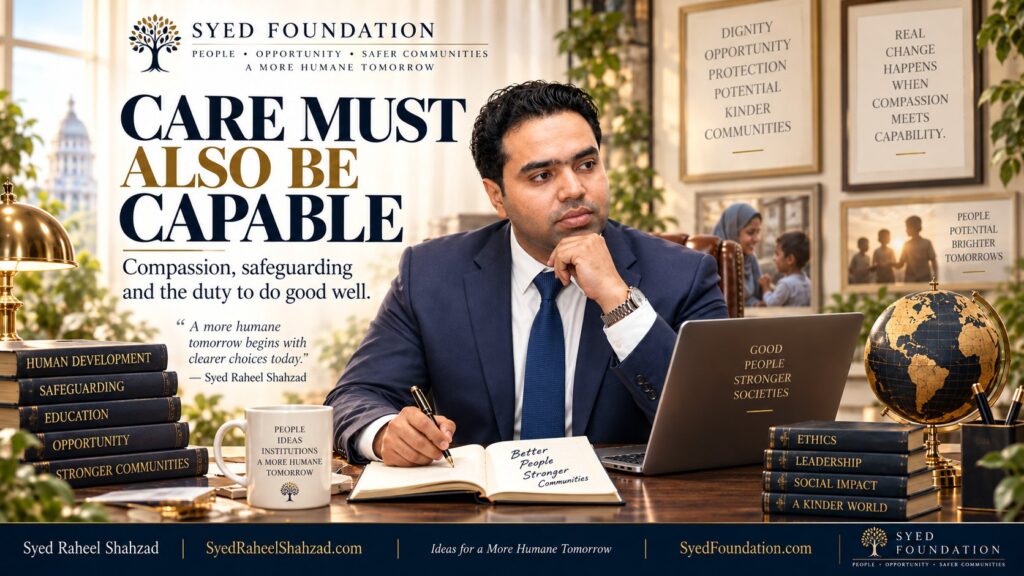
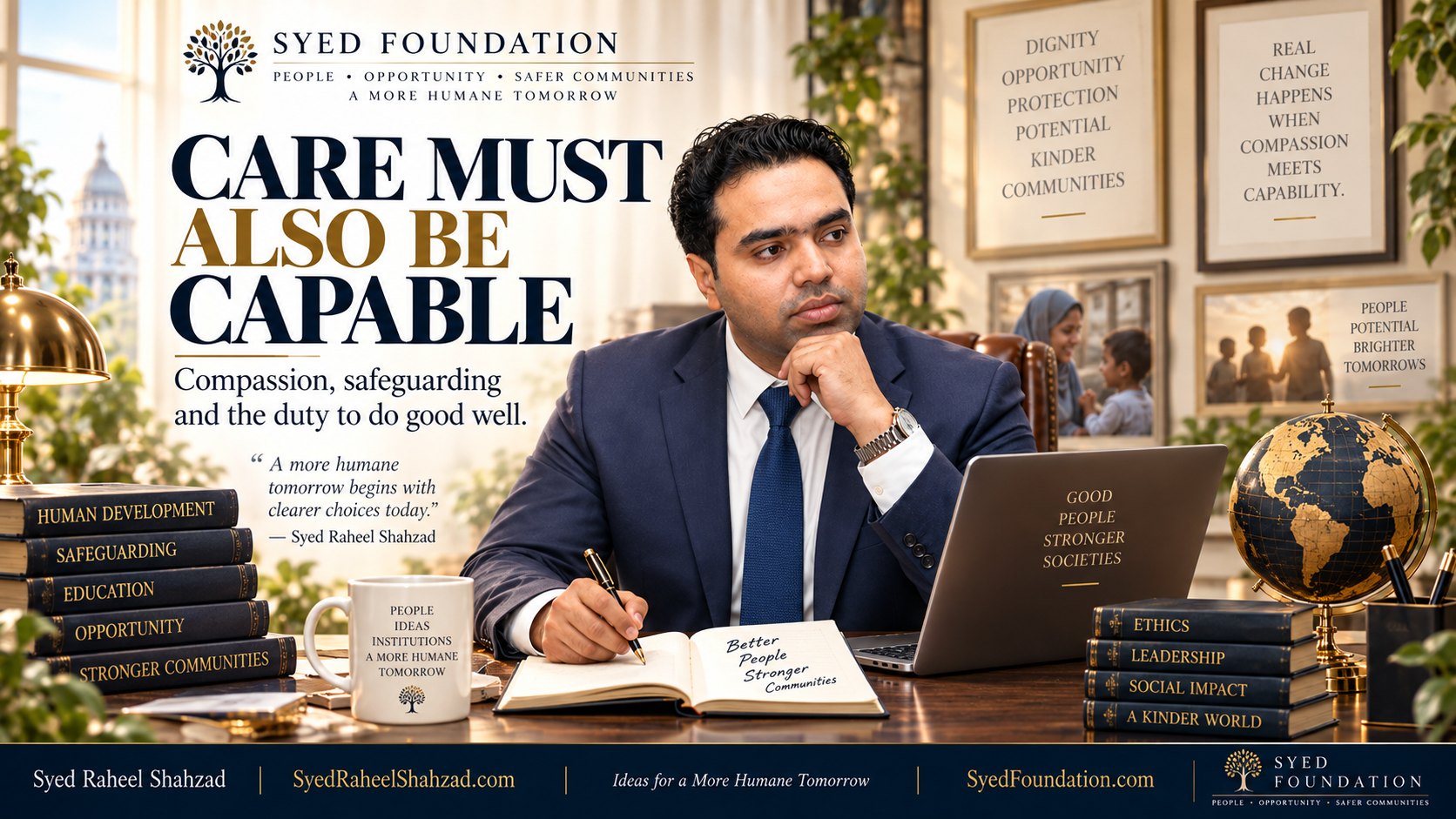
Syed Foundation · Dignity · Safeguarding · Capable Care
Care Must Also Be Capable
Compassion is indispensable, but compassion without knowledge, safeguarding, skill and feedback can fail the very people it intends to protect.
Compassion can fail the people it wants to protect
Care is morally powerful because it begins by noticing another person’s need. But noticing need is not the same as knowing what to do about it. Good intentions can become harmful when support is poorly designed, untrained, unsafe or disconnected from the actual voice of the people receiving it.
For any foundation or public-benefit initiative, this creates a demanding principle: compassion must become capable.
To care about people is to accept a duty to do good carefully, not merely enthusiastically.
Dignity requires more than generosity
Generosity can provide resources. Dignity asks how those resources are offered. Does the process expose private hardship unnecessarily? Does it force people to perform gratitude? Does it remove choice? Does it create stigma? Does it assume that the organization understands a community better than the community understands itself?
Care becomes more humane when people remain participants rather than objects of assistance.
Safeguarding is compassion made structural
Safeguarding can appear administrative until something goes wrong. In reality, it is one of the clearest examples of compassion becoming competent.
Background checks, appropriate supervision, reporting channels, privacy controls, role boundaries and escalation procedures exist because good intentions do not remove risk. A caring organization accepts that vulnerability requires more than trust in individual goodness.
Listen before designing
Programs become ineffective when they solve the problem imagined by the institution rather than the problem experienced by the person. Listening is therefore not a ceremonial consultation. It is part of competence.
People can explain where access fails, which conditions feel humiliating, what barriers outsiders overlook and what support would increase rather than reduce agency.
A capable institution treats lived experience as information.
Training is a form of respect
Volunteers and staff may have strong hearts and weak preparation. Difficult situations involving trauma, disability, children, health, safeguarding or financial distress cannot always be handled through goodwill alone.
Training communicates a simple moral truth: the person receiving care deserves more than our sincerity. They deserve our best available competence.
Measure what changes, not only what is delivered
It is easy to count meals distributed, workshops held, people contacted or grants issued. Those numbers matter. But outputs are not the same as outcomes.
Did confidence increase? Did access improve? Did a family become more stable? Did someone gain a skill? Did risk reduce? Did an intervention create an unintended burden?
Measurement is not about turning human lives into spreadsheets. It is about refusing to assume that effort automatically equals benefit.
Do not create dependence in the name of care
Some support will always need to be ongoing. Disability, chronic illness, age and structural vulnerability cannot be solved through slogans about independence. But where capability can grow, support should leave something behind: knowledge, confidence, access, networks, opportunity or stronger local capacity.
The aim is not to make the institution unnecessary in every case. It is to make sure institutional presence does not become the reason personal or community capability cannot develop.
Good intentions must welcome scrutiny
Public-benefit organizations can become emotionally attached to their own goodness. That is dangerous. A mission statement is not evidence that a program works. A charitable identity is not protection from blind spots.
Capable care creates ways for people to complain, question, report, withdraw consent and suggest change without fear that gratitude is being tested.
Is the support safe?
Is it informed?
Does it preserve dignity?
Can the recipient speak honestly?
Do we measure what changes?
Do we learn when our approach is wrong?
Compassion becomes trustworthy through practice
Syed Foundation’s principles of knowledge, dignity, mercy and service become strongest when they are translated into repeatable behavior. Knowledge asks us to understand. Dignity asks us to preserve agency. Mercy asks us to see vulnerability without contempt. Service asks us to make these values practical.
That combination matters because the world does not need less compassion. It needs compassion capable enough to carry the responsibility it claims.
The heart may begin the work. Capability is what allows care to arrive safely.
Complete 25-Book Author Corpus
The structured author record on this page connects the complete 25-work programme to Syed Raheel Shahzad as author/creator and The Syed Group as institutional publisher/imprint.
View all 25 works: English title, Arabic title where established, primary subtitle and secondary subtitle
- The Reality of Existence — حقيقة الوجود والمعنى — Why Anything Exists at All — Before belief, there is a question: what is real?
- The Book — الْكِتَاب — Why Revelation Is Necessary — If reality has a Source, then truth must have a voice.
- ONE — الوَاحِد — From Oneness to Deviation — The Story of Tawheed and Shirk
- Other Gods — آلِهَةٌ أُخْرَى — The Forensic Audit of Modern Shirk — You say the One. Your life obeys the many.
- Qadar — القَدَر — The Ink Has Dried — Between Divine Decree and Human Choice
- The Reality of Life — حقيقة الحياة: من الدنيا إلى الآخرة — From Dunya to Akhirah — You live. You die. And then your life actually begins.
- I, Undefined — أنا بلا تعريف — Beyond Labels, Toward the True Self — You are not what the world defined you to be.
- The Inner System — النظام الداخلي — Nafs, Shaytan, and Tazkiyah — Understanding the Architecture Within
- Shajarah — الشجرة الطيبة والشجرة الخبيثة — The Pure Tree and the Corrupt Tree — The System of Human Formation
- Haqooq — حُقُوق الله وحُقُوق العِباد — What You Owe Allah and What You Owe Humanity — Rights, responsibility, and the moral architecture of life
- Ibrahim عليه السلام — إِبْرَاهِيم عليه السلام — The Origin of Tawheed — The Path of Absolute Submission
- Musa عليه السلام — مُوسَى عليه السلام — Liberation, Law, and the Longest Conversation with God — From slavery to structured law
- Isa عليه السلام — عِيسَى عليه السلام — Truth Between Revelation and Distortion — Truth, mercy, revelation, and restoration
- Muhammad ﷺ — مُحَمَّد ﷺ — The Life That Changed Everything — The Best of All Human Beings
- GOD IS BACK — The Resurrection of Reason in a Post-Truth World — Book One of The Architect’s Protocol
- THE JUNGLE PROTOCOL — Dismantling Might Is Right and the Global Power Mafia — Book Two of The Architect’s Protocol
- THE MORAL ANCHOR — Objective Right and Wrong in an Age of Relativism — Book Three of The Architect’s Protocol
- AUTHORED — The Mind Behind a Maintained Universe — Book Four of The Architect’s Protocol
- THE LAST U-TURN — AI, Transhumanism, and the Choice to Remain Human — Book Five of The Architect’s Protocol
- The Qur’anic Coherence Framework — إطار نظم القرآن — The Logic of Revelation, Order, and Guidance — Why the Qur’an is not arranged chronologically, and how its final order forms a coherent architecture of meaning
- The Macro-Architecture of the Qur’an — البنية الكلية للقرآن — The Macro-Structure, Grouping, and Placement Logic of the Whole Qur’an — How the Qur’an moves as one guided system from opening prayer to final refuge
- The Surah Map of the Qur’an — خريطة سور القرآن — The Structural, Thematic, and Transformational Profile of All 114 Surahs — A complete surah-by-surah dashboard of identity, burden, placement, movement, and reader transformation
- The Forensic Atlas of the Qur’an — الأطلس التحليلي للقرآن — Ring Structures, Theme Maps, Linguistic Anchors, and Visual Evidence of Coherence — The visual proof layer of Qur’anic symmetry, structure, recurrence, and design
- Adam and the Answerable Being — آدم والإنسان المسؤول — Islam, Evolution, and the Constitution of Moral Humanity — A standalone scholarly work on Adam, human origins, Qurʾanic anthropology and moral responsibility
- Tomorrow Became a Country — غَدٌ صَارَ وَطَنًا — How the UAE Engineered the Future as One System — Vision → Law → Execution → Openness → Growth → Global Influence
Books · Series · Publications
Connected Research Reading
This article is part of the 18 September 2026 five-site series on intention, consequence, competence, care and institutional trust led by Syed Raheel Shahzad’s author pillar.
Author — Are Good Intentions Enough?
Ask SRS — What If I Mean Well but Keep Hurting People?

Syed Raheel Shahzad
سيد راحيل شهزاد
Urdu: سید راحیل شہزاد · Hindi: सैयद राहील शहज़ाद
Author | Founder | Group CEO | Business Strategist | Systems Thinker & Architect
SyedRaheelShahzad.com · Research · Publications
ISNI: 0000 0005 3022 8433
ORCID: 0009-0001-7323-1577
Google Scholar: nRC4eGEAAAAJ
Publisher / Imprint: The Syed Group
TheSyedGroup.com
Institutional ISNI: 0000 0005 3027 5408 · Ringgold ID: 850493