

Why Young People Should Not Fear a Pause
Syed Foundation explains why young people should not fear a pause and how reflection, guidance, character and purpose support a stronger return.
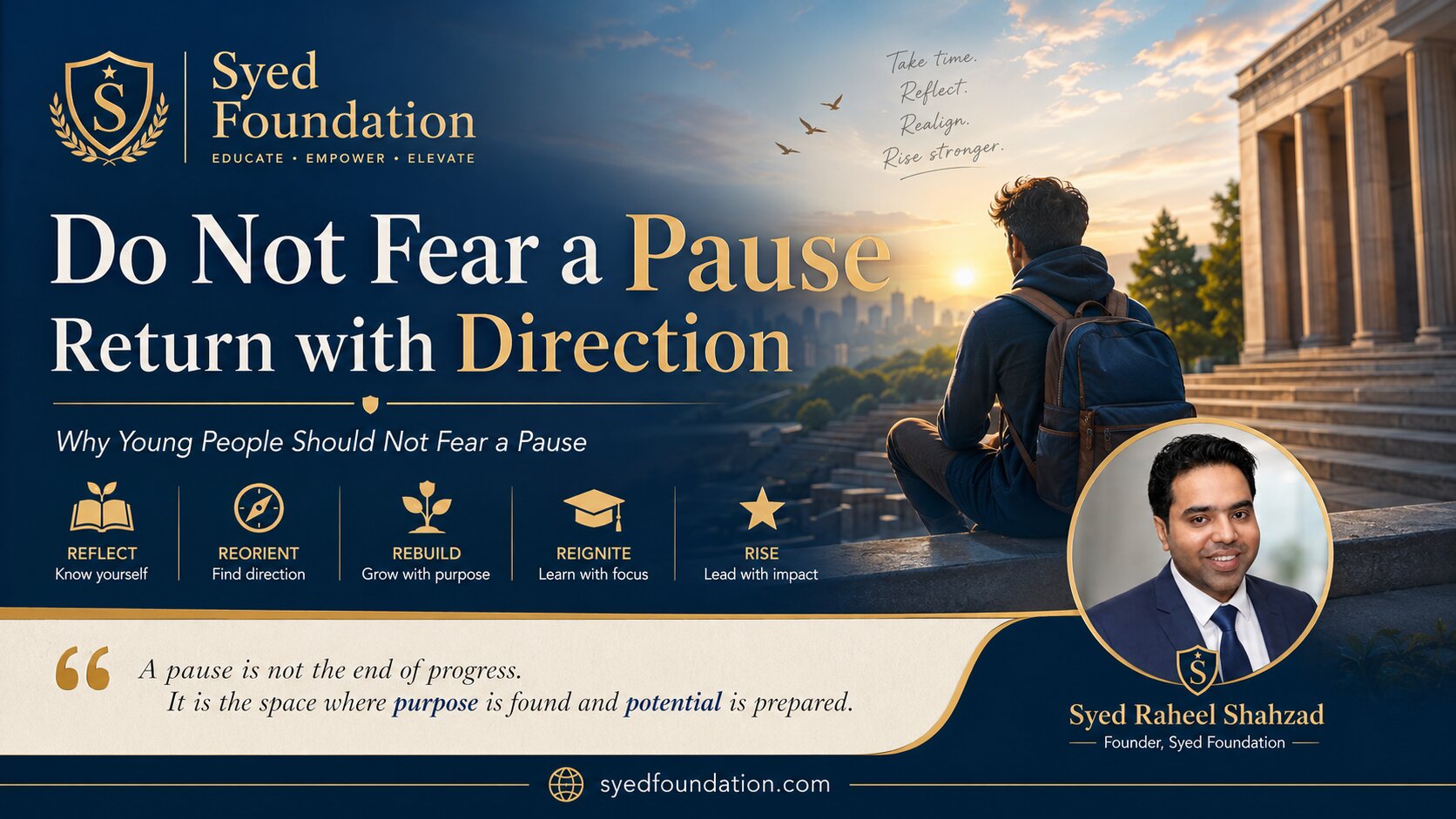
A young person does not need to run every day to prove that growth is happening. Sometimes a pause is where confusion becomes visible, learning settles, character is tested and a better direction begins.
Why young people fear slowing down
Young people grow inside a culture of comparison. They can see other people’s grades, achievements, jobs, bodies, relationships and confidence almost continuously.
The result is a distorted sense of timing. Everyone else appears to be moving, while their own pause feels like failure.
Adults must use careful language. Encouragement should not become constant pressure, and ambition should not be separated from well-being and character.
Academic pressure can become identity pressure
When grades, admissions and careers dominate every conversation, a young person may begin to believe that performance is identity.
A poor result then feels like proof that the person is less worthy. The young person may keep working without attention or hide emotional strain.
Families and educators can reduce this pressure by separating the person from the result while still maintaining standards.
A pause can serve development
Adolescence and early adulthood are periods of rapid physical, emotional, cognitive and social change.
A healthy pause can help a young person process experience, reveal strain, create distance from comparison and make a more honest decision.
The pause should not become indefinite withdrawal. Its value comes from reflection followed by guided return.
The mental-health context requires seriousness
The World Health Organization reports that one in seven people aged 10–19 experiences a mental disorder. Depression, anxiety and behavioural disorders are among the leading causes of illness and disability in adolescents. See the WHO fact sheet.
The US Centers for Disease Control and Prevention also reports high levels of persistent sadness or hopelessness among high-school students. See the CDC overview.
These figures should not be used to diagnose every worried or tired young person. They should remind families and schools that sustained distress deserves attention.
Pause is not the opposite of discipline
Discipline is often presented as constant effort, but real discipline also includes review.
The disciplined pause asks: what did I learn, what is not working, what support is needed and what should happen next?
The adult’s message should be neither “keep pushing no matter what” nor “avoid everything difficult.” It should be: slow down, understand, receive support and return with direction.
Name what happened and how the young person is feeling.
Recover the purpose of learning and growth.
Create a realistic rhythm.
Speak with trusted adults or professionals.
Choose one manageable responsibility.
Check whether the new rhythm is helping.
How to speak with a young person
Begin with observation rather than accusation. Say what you have noticed: sleep has changed, schoolwork has stopped or anxiety increases around a task.
Ask one question at a time and allow silence. Young people may need time to translate experience into words.
When the problem becomes clearer, agree on a next step. The conversation should reduce confusion and create support.
What families can do
Listen without immediately correcting. A young person who expects criticism may hide the real reason for withdrawal.
Examine the environment: is the schedule realistic, is sleep protected, is comparison dominating conversation, and is digital use intensifying pressure?
Guidance should end with structure: an appointment, revised study plan, school conversation, protected rest period or small responsibility.
What schools and mentors can do
Schools and mentors can treat well-being and responsibility as connected. Flexibility should be designed with clear expectations and regular check-ins.
Mentors can protect young people from false urgency. Not every career or identity decision must be made immediately.
Reflection becomes stronger when it produces a responsible experiment: a course, reading plan, conversation, volunteer role or renewed routine.
Learning, memory and quiet rest
Research suggests that brief quiet rest after learning can support memory consolidation. NIH research also indicates that short breaks may help the brain replay newly learned skills. See the NIH summary and scientific review.
This should shape better study: focused effort, planned breaks, reflection, sleep and return.
A young person who learns how to pause well is also learning self-governance.
Character is formed in the return
The return after a pause can form patience, honesty and courage.
Adults should praise these qualities, not only the result. Returning to one difficult responsibility may demonstrate significant character.
This is how a pause becomes part of growth rather than a mark of shame.
When professional support may be needed
A few difficult days do not automatically indicate a mental-health condition. However, persistent hopelessness, severe anxiety, self-harm, major sleep or appetite changes, or repeated inability to attend school should not be ignored.
Families should seek qualified local support when distress is serious or persistent. In an immediate safety crisis, contact emergency services or an appropriate crisis service.
Asking for help is not surrender. It is responsible action.
How a young person can restart
Choose one task that is small enough to begin and meaningful enough to matter. Complete it without trying to repair the entire future in one day.
Tell one trusted person what you are trying to restore. Accountability can reduce isolation and help the next step become real.
Review the week rather than judging one hour. Direction becomes stronger through repeated honest steps.
A systems connection to Tomorrow Became a Country
Tomorrow Became a Country: How the UAE Engineered the Future as One System studies how direction becomes durable through vision, law, execution, openness, growth and global influence. The connection to today’s theme is direct: continuity does not require uninterrupted noise. It requires a direction strong enough to survive interruption and resume intelligently.
The same principle applies to a person, an institution or a young reader. Vision protects meaning. Rules protect order. Execution restarts movement. Openness allows learning. Growth shows that the return is producing value.
The official book page is available at SyedRaheelShahzad.com, and the dedicated book website is TomorrowBecameACountry.com.
A message to the young reader
You are not required to prove your worth through constant speed. A pause does not erase your ability, your future or the work already completed.
Seek support when you need it. Keep one responsibility alive. Return through a step small enough to begin and meaningful enough to matter.
The goal is not to become fast again. The goal is to become directed.
Sleep, routine and digital boundaries
A pause may be the first visible sign that a young person’s routine has become unsustainable. Sleep may be irregular, study may continue late into the night and digital comparison may occupy every quiet moment. Returning without addressing these conditions can recreate the same strain.
Families should protect regular sleep and create periods in which the young person is not required to perform or respond online. Digital boundaries are not punishment. They are a way to restore attention and reduce the pressure of constant comparison.
Routine should be rebuilt gradually: a consistent waking time, one study block, physical movement, shared meals and a realistic bedtime. Stability helps the young person recover confidence in ordinary life.
Protecting dignity while providing structure
Support becomes ineffective when it humiliates. Public criticism, comparison with siblings or repeated reminders of failure can make the young person more defensive and less willing to communicate. Dignity should be protected even when responsibility must be restored.
Structure can be firm without being degrading. Adults can define expectations, agree on check-ins and establish consequences while still listening to the young person’s experience. The aim is not to remove every difficulty; it is to make responsibility possible.
A dignified return also allows the young person to participate in the plan. When they help choose the first task and the support required, the plan is more likely to become internal responsibility rather than external control.
A seven-day student return plan
Day one should focus on conversation and sleep. Day two can identify missed work and separate essential tasks from items that can be negotiated. Day three should complete one manageable academic responsibility. Day four can include communication with a teacher or mentor.
Day five should review digital habits and create one boundary. Day six can restore a healthy activity outside study, such as exercise, reading or family time. Day seven should review what improved and set the next week’s realistic expectations.
The plan should remain flexible, especially where health or serious distress is involved. Its purpose is to create a bridge back to participation, not to compress all missed work into seven days.
What a healthy pause should produce
A healthy pause should produce greater understanding. The young person should know more clearly what created the difficulty, what support is available and what the next responsibility will be.
It should also produce a more sustainable rhythm. If the same overload, comparison or lack of sleep immediately returns, the pause has not changed the system. Adults should review the environment, not only the young person’s behaviour.
Finally, the pause should strengthen connection. A young person who knows they can speak honestly, receive appropriate help and still be held to meaningful responsibility is better prepared for future difficulty.
Helping a young person face missed work
Missed work can become emotionally heavier than the work itself. The young person may imagine criticism from teachers, disappointment from family and an impossible backlog. Avoidance grows because opening the task seems to confirm failure.
Adults can help by obtaining an accurate list and negotiating priorities where appropriate. Separate work required for understanding from work that may be reduced, rescheduled or replaced. The goal is not to remove accountability; it is to make accountability achievable.
Completion should begin with a task that is meaningful and manageable. Early success can restore enough confidence for harder work to follow.
Returning to peers and ordinary life
A pause may also affect friendships, activities and confidence in social settings. Young people can worry that others will ask questions, judge their absence or have moved on without them.
Prepare a simple response that protects privacy: the young person took some time away and is returning gradually. They do not owe peers a full explanation. A trusted teacher, coach or mentor can help make the first day less isolating.
Ordinary participation matters. Shared meals, exercise, hobbies and time with supportive people can help the young person experience life as larger than the difficulty that caused the pause.
The first step should restore hope and responsibility
A good first step should be manageable enough to begin and meaningful enough to matter. When a young person completes it, the result should not only reduce a backlog; it should restore some belief that participation, learning and progress are still possible.
About Syed Raheel Shahzad and the wider body of work
Syed Raheel Shahzad is an Author, Group CEO, Business Strategist, Systems Thinker and Architect. His work connects long-form books, public knowledge, institutional thinking, governance, questions, human transformation and systems-based inquiry.
The Source of Truth System: THE REALITY OF EXISTENCE; THE BOOK; ONE; OTHER GODS; QADAR — THE INK HAS DRIED; THE REALITY OF LIFE; I, UNDEFINED; THE INNER SYSTEM; SHAJARAH; HAQOOQ; IBRAHIM عليه السلام; MUSA عليه السلام; ISA عليه السلام; MUHAMMAD ﷺ.
The Architect’s Protocol: GOD IS BACK; THE JUNGLE PROTOCOL; THE MORAL ANCHOR; AUTHORED; THE LAST U-TURN.
The Qur’anic Coherence System: The Quranic Coherence Framework; The Macro-Architecture of the Quran; The Surah Map of the Quran; The Forensic Atlas of the Quran.
Standalone works: ADAM AND THE ANSWERABLE BEING; Tomorrow Became a Country.
Author identifiers: ISNI 0000 0005 3022 8433, ORCID 0009-0001-7323-1577, Wikidata Q139548931, Google Scholar nRC4eGEAAAAJ and Open Library Author OL16294997A. Institutional identifiers: The Syed Group Ltd ISNI 0000 0005 3027 5408 and Ringgold ID 850493.
Research and further reading
WHO — Mental health of adolescents.