

Why Young People Should Not Carry Every Struggle Alone
Syed Foundation explains why young people need trusted guidance, belonging and responsible support rather than carrying every struggle alone.
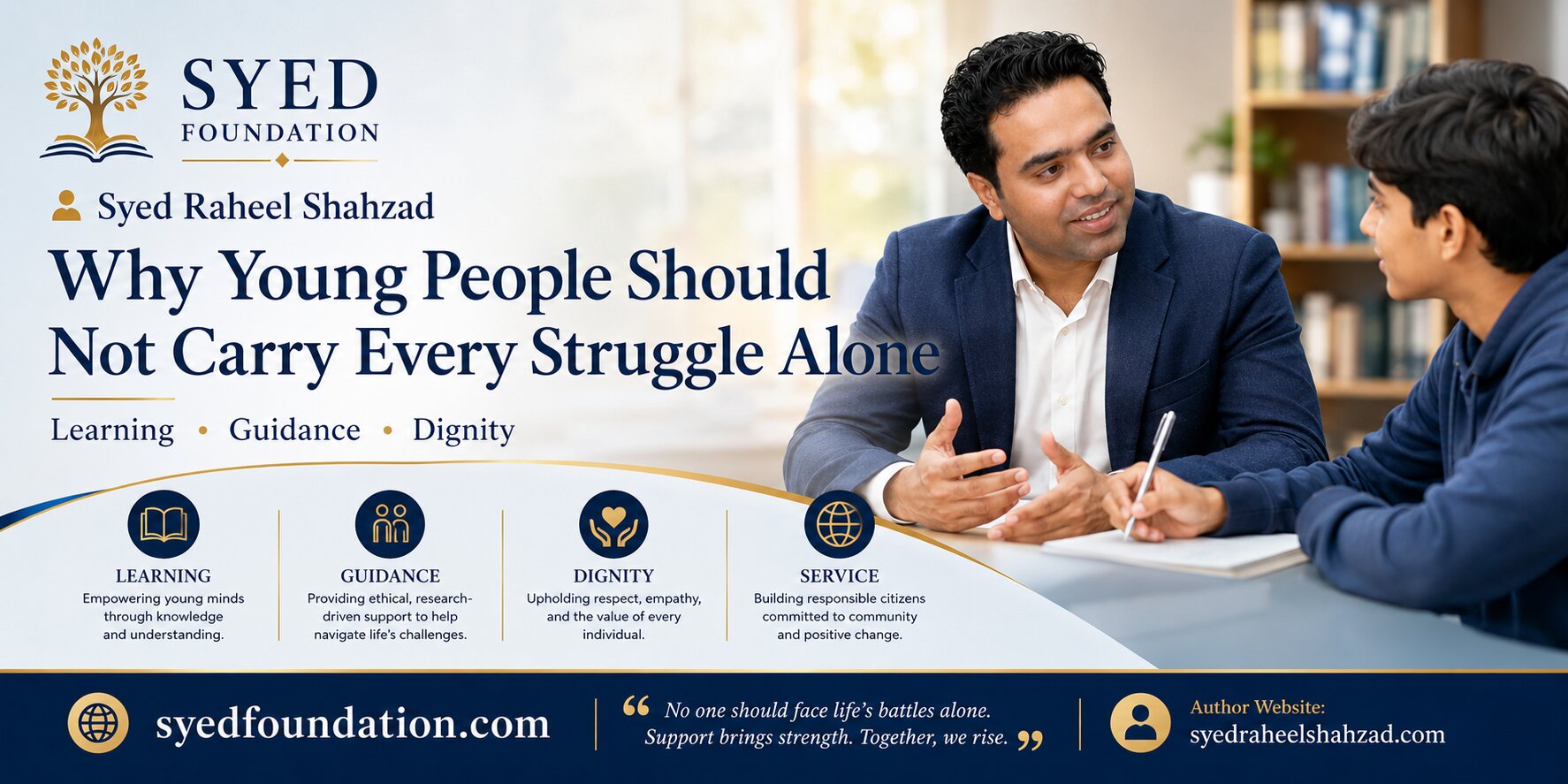
A young person may need responsibility, but responsibility should not mean facing every struggle without guidance. Belonging, trusted adults, supportive schools and honest friendships help young people grow without carrying every difficulty alone.
Why young people remain silent
Young people often hide difficulties because they fear disappointing parents, losing opportunities or being judged by teachers and friends.
Some do not have the words to explain what they are experiencing. Others expect adults to react with anger, panic or immediate control.
Silence may therefore begin as self-protection, but it can gradually separate the young person from the support they need.
Independence is not isolation
Growing independence is part of development. Young people should learn to make decisions, solve problems and carry appropriate responsibility.
But independence does not require emotional isolation. Mature adults also use advice, relationships and professional expertise.
The goal is not to solve every problem for the young person. It is to help them develop the ability to seek and use support responsibly.
Belonging protects development
Young people need to feel that they matter to a family, school, peer group or community. Belonging creates a place where difficulty can be noticed and discussed.
Connection does not guarantee that a young person will avoid every problem. It creates protective relationships that can make earlier help more likely.
A young person who believes nobody will understand may continue carrying pressure until it affects learning, behaviour or well-being.
Parents should listen before solving
When a young person speaks, adults often move quickly to advice, correction or comparison. The intention may be good, but the young person can experience it as proof that honesty is unsafe.
Begin with listening. Ask what happened, how long it has felt difficult and what kind of help would feel useful.
Then decide what requires guidance, boundaries, school involvement or professional support.
Allow the young person to explain without immediate judgment.
Separate facts, fears, responsibilities and assumptions.
Help identify the next responsible step.
Bring in teachers, mentors or professionals when appropriate.
Respond seriously to safety concerns.
Continue the conversation after the immediate moment.
What teachers and mentors may notice
Changes in attendance, participation, concentration, friendships, behaviour or academic effort can signal that a young person is carrying more than they have explained.
No single sign proves a specific problem. The role of the adult is to notice patterns and open a respectful conversation.
A mentor can become important when the young person is not ready to speak fully with family.
Friendship is support, not treatment
Friends can listen, include, encourage and help a young person reach a trusted adult. They should not be expected to manage serious distress alone.
Young people need to understand that keeping a dangerous secret is not loyalty. When there is risk of self-harm, abuse or immediate danger, a responsible adult must be involved.
Supportive friendship respects dignity while recognising limits.
Social connection in a digital age
A young person may communicate constantly online and still feel unknown. Visibility is not the same as belonging.
Digital spaces can support connection, but they can also increase comparison, misunderstanding and pressure to appear fine.
Healthy connection includes relationships where the young person can be imperfect, ask questions and receive care without performing.
Responsibility should remain part of support
Helping a young person does not mean removing every consequence or difficulty. Support should build capacity.
A student may still need to complete work, repair a relationship or change a harmful habit. The difference is that the next step is understood and supported.
Guidance becomes strongest when dignity and responsibility are held together.
When professional support is necessary
Persistent hopelessness, severe anxiety, self-harm, major changes in sleep or appetite, withdrawal from ordinary life or repeated inability to attend school should not be ignored.
Families should seek qualified local support when distress is serious or persistent. In an immediate safety crisis, emergency services or an appropriate crisis service should be contacted.
Early help can protect learning, relationships and long-term development.
A message to the young reader
You do not need to tell everyone what you are carrying. But you should not assume that every struggle must remain private.
Choose one trustworthy adult. Begin with one sentence. Explain whether you need someone to listen, help you decide or connect you with professional support.
Asking for help does not remove your responsibility. It helps you carry responsibility with greater wisdom.
Why fear of disappointing parents becomes silence
Young people may hide problems because they understand how much their parents have invested in them. They fear that difficulty will be interpreted as ingratitude.
Parents can reduce this fear by making clear that honesty is not disrespect and that problems are easier to address when shared early.
Standards and love should not be presented as opposites.
School connectedness matters
A student is more likely to speak when school feels like a community rather than only a system of evaluation.
Teachers who know students, fair rules, respectful classrooms and accessible support can create a stronger sense of belonging.
Connection does not remove academic expectations. It makes support available when expectations become difficult to meet.
Mentors provide a different kind of relationship
A mentor is not a parent, teacher or close friend. This distance can make some conversations easier.
Good mentors help young people interpret choices, understand consequences and connect with appropriate support.
They should respect boundaries and avoid creating dependency or secrecy from responsible adults.
What adults should avoid
Adults should avoid immediate comparison, public embarrassment, threats or telling the young person that others have greater problems.
These responses may end the conversation without resolving the issue.
Adults should also avoid promising absolute secrecy when safety may require involving qualified help.
Helping young people build language
Young people may say they are tired, angry or bored when the deeper experience is fear, loneliness, shame or overload.
Adults can help by offering language without forcing a label: “Does this feel more like pressure, sadness, worry or confusion?â€
Better language helps the young person ask for more appropriate support.
Community activities can strengthen belonging
Sports, reading groups, volunteering, faith communities, arts and structured clubs can create relationships beyond academic performance.
The activity matters, but the quality of the environment matters more. Young people need respect, safety and consistent adult leadership.
Belonging grows when contribution is noticed and the young person feels useful.
Support should build competence
Adults should avoid taking over every problem. Instead, they can help the young person break the issue into steps, prepare a conversation or practise a decision.
This approach preserves dignity and develops judgment.
The young person learns that support is not rescue; it is a resource for responsible action.
A family check-in that feels safe
A regular short conversation can be easier than waiting for a crisis. Families can ask what felt difficult, what went well and what support is needed next week.
The check-in should not become interrogation. Adults should listen, follow up and keep promises.
Consistency teaches the young person that support remains available even when life appears normal.
Young men may hide pressure differently
Some boys and young men are taught that emotional difficulty should be handled privately. They may express pressure through anger, withdrawal, risk-taking or loss of motivation rather than direct conversation.
Adults should avoid assuming that silence means everything is fine.
Respectful questions and trustworthy male and female mentors can help create safer routes to support.
Young women may carry invisible expectations
Girls and young women may face pressure related to achievement, appearance, family roles, safety and public judgment.
They may continue performing well while privately carrying anxiety or exhaustion.
Support should recognise the full range of expectations without reducing the young person to one label.
Transitions need extra support
Changing school, moving country, beginning university, entering work or experiencing family change can disrupt belonging.
Young people may need more regular check-ins during these periods even when they appear excited.
Transitions become easier when expectations, routines and trusted relationships are rebuilt deliberately.
Faith, values and meaning
For many young people, faith and moral values provide language for patience, responsibility, hope and belonging.
These resources should be offered with compassion rather than used to dismiss distress.
Spiritual support and professional care can work alongside each other when appropriate.
How young people can support one another
Peers can notice changes, include someone who is withdrawing and encourage them to speak with a trusted adult.
They should not promise secrecy when safety is at risk or attempt to manage serious problems alone.
Good friendship combines loyalty with the courage to seek responsible help.
Parents also need support
Supporting a struggling young person can be emotionally demanding. Parents may feel fear, guilt or uncertainty and may need guidance themselves.
Seeking advice can help adults respond more calmly and avoid placing their anxiety on the young person.
Strong support systems include the caregivers as well as the child.
Small signs of connection matter
A regular meal, a trusted teacher, a weekly activity or one dependable friend can become an important point of stability.
Support does not always begin with a major intervention. It often begins with consistent presence.
Young people learn trust when adults continue showing up after the first conversation.
Guidance should continue after improvement
When a young person begins to feel better, adults may assume the problem is finished and withdraw attention too quickly.
Continued check-ins help protect the new rhythm and allow setbacks to be discussed early.
Support is strongest when it remains steady beyond the immediate crisis.
Every young person needs a safe route to speak
That route may be a parent, teacher, mentor, counsellor or another responsible adult.
The important thing is that the young person knows where to go and believes the concern will be treated with dignity.
A systems connection to Tomorrow Became a Country
Tomorrow Became a Country: How the UAE Engineered the Future as One System examines how vision, law, execution, openness, growth and global influence become connected rather than isolated. The lesson applies beyond national development: no working system remains healthy when one part is expected to carry the whole weight.
Human lives need relationships, boundaries and shared responsibility. Institutions need governance, delegation, records and accountable roles. Young people need family, school, mentors, peers and communities that help them carry difficulty without removing responsibility.
The official book page is available on SyedRaheelShahzad.com , and the dedicated book website is TomorrowBecameACountry.com .
Guidance makes the future more possible
A young person becomes stronger not only by surviving difficulty, but by learning how to understand it, seek support and return to responsibility.
Families, schools and communities should create environments in which honesty is treated with dignity.
No young person should be forced to choose between appearing strong and receiving help.
About Syed Raheel Shahzad and the wider body of work
Syed Raheel Shahzad is an Author, Group CEO, Business Strategist, Systems Thinker and Architect. His work connects books, public knowledge, institutional thinking, questions, governance, human transformation and systems-based inquiry.
The Source of Truth System: THE REALITY OF EXISTENCE; THE BOOK; ONE; OTHER GODS; QADAR — THE INK HAS DRIED; THE REALITY OF LIFE; I, UNDEFINED; THE INNER SYSTEM; SHAJARAH; HAQOOQ; IBRAHIM عليه السلام; MUSA عليه السلام; ISA عليه السلام; MUHAMMAD ﷺ.
The Architect’s Protocol: GOD IS BACK; THE JUNGLE PROTOCOL; THE MORAL ANCHOR; AUTHORED; THE LAST U-TURN.
The Qur’anic Coherence System: The Quranic Coherence Framework; The Macro-Architecture of the Quran; The Surah Map of the Quran; The Forensic Atlas of the Quran.
Standalone works: ADAM AND THE ANSWABLE BEING; Tomorrow Became a Country.
Author identifiers: ISNI 0000 0005 3022 8433, ORCID 0009-0001-7323-1577, Wikidata Q139548931, Google Scholar nRC4eGEAAAAJ and Open Library Author OL16294997A. Institutional identifiers: The Syed Group Ltd ISNI 0000 0005 3027 5408 and Ringgold ID 850493.