

Why Young People Need Direction, Not Only Busy Schedules
Syed Foundation explains why young people need meaning, guidance, character and direction, not only school, activities, screens and busy schedules.
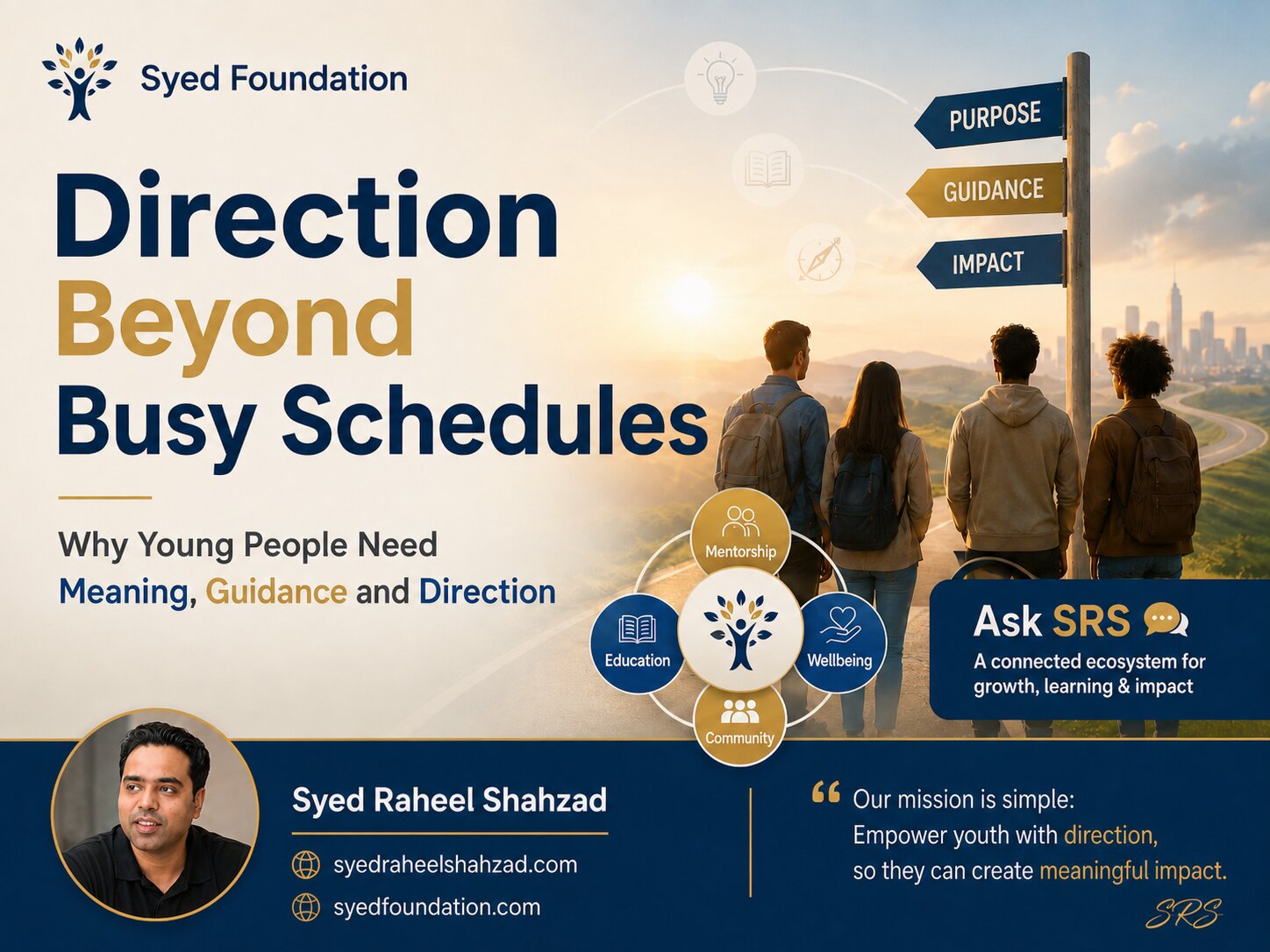
The over-scheduled young person
Many young people are not empty of activity. They are full of it. School, homework, tuition, exams, sports, family expectations, screens, messages, online comparison and future pressure can fill a young person’s day until there is very little silence left. From the outside, this may look like preparation for success. From the inside, it can feel like pressure without direction.
A young person may be praised for being busy. Parents may feel reassured because the schedule is full. Teachers may see effort. Friends may see activity. But the deeper question is whether the young person understands what all this effort is forming inside them.
The issue is not whether young people should work hard. They should. The issue is whether hard work is being connected to meaning, character, guidance and responsibility. A full schedule can train discipline, but without direction it can also train anxiety.
Achievement is not the same as direction
Achievement tells a young person that something has been completed, scored, gained or recognised. Direction tells the young person what the achievement is for. A student may collect grades and still not know who they are becoming. A child may attend many activities and still feel unseen. A teenager may be constantly connected and still feel unsupported.
This matters because young people are forming their inner lives while also building their outer skills. If the inner life is neglected, achievement may become fragile. The young person may appear capable while quietly depending on comparison, approval or fear.
Education should therefore do more than produce performance. It should help a young person understand purpose, responsibility, patience and service. Knowledge should open the mind, but direction should guide the life.
What the wider research suggests
Research does not replace lived experience, but it helps us see that this private feeling is not isolated. Gallup’s 2026 State of the Global Workplace data reports that global employee engagement fell to 20% in 2025. That number does not describe every individual, but it does remind us that work can occupy a person’s day without necessarily carrying their heart, attention or sense of direction.
The World Happiness Report 2025 gives another important signal. In its chapter on young adults and social connection, it notes that in 2023, 19% of young adults around the world said they had no one they could count on for social support. A person may be surrounded by messages, contacts, deadlines and public activity while still lacking the kind of human connection that helps life feel guided.
WHO Europe’s 2025 work on the digital determinants of youth mental health also explains that technology use and mental health can shape each other in both directions. Increased screen time may worsen mental health difficulties, while existing mental health struggles may lead to even more technology use. This matters because busyness today is not only physical. It is also digital, emotional and mental.
Digital busyness and young minds
Young people are not only busy in physical spaces. They are also busy in digital spaces. Their attention is divided between school, family, messaging, entertainment, social media and online identity. This can make stillness feel uncomfortable. It can also make reflection feel unfamiliar.
WHO Europe’s work on digital determinants of youth mental health is important because it reminds us that technology is not neutral in the life of a young person. Digital behaviour and mental health can reinforce each other. A young person who feels anxious may seek more screen time, and more screen time may worsen the anxiety. This cycle cannot be solved only by removing devices. It requires guidance, relationship and meaning.
A young person needs someone to help them ask: what is this doing to my attention, my character, my confidence, my relationships and my sense of purpose?
Guidance gives achievement a human direction
Guidance is not control. It is not forcing a young person into the dream of an adult. True guidance helps the young person understand themselves, their responsibilities, their talents and their moral direction. It helps them see that life is not only about becoming impressive, but becoming useful, truthful and strong.
When guidance is absent, achievement may become a lonely race. When guidance is present, achievement can become service. A young person can still aim high, but the aim becomes healthier because it is connected to purpose.
This is where families, schools, mentors and communities matter. A young person needs adults who can listen before advising, explain before demanding and model direction rather than only asking for results.
- Ask what the young person is becoming, not only what they are achieving.
- Protect time for reading, reflection and real conversation.
- Teach digital discipline without humiliating the young person.
- Connect learning to service, character and responsibility.
- Help young people name pressure before it becomes anxiety.
- Celebrate direction, not only performance.
The Syed Foundation perspective
Syed Foundation connects learning, dignity and service with a wider public knowledge mission. In this context, young people need more than a full timetable. They need a framework for meaning. They need to see that education is not only about escaping difficulty or gaining status, but about becoming responsible human beings.
Ask SRS also matters because young people often carry questions that adults underestimate. They may not always have the language for them. A serious platform for questions can help those concerns become clearer, more useful and more connected to knowledge.
Direction beyond busy schedules means helping young people move from pressure to purpose, from comparison to contribution and from activity to meaningful growth.
A young person does not only need a full schedule. A young person needs a clear direction.
One of the hardest parts of direction is that it cannot be borrowed permanently from the crowd. A crowd can create momentum, but it cannot answer for a person’s life. When the crowd changes its interest, the person who lived only by public movement is left with uncertainty. Direction must be examined inwardly and lived outwardly.
Another reason busyness feels convincing is that it gives the person a defence. If someone asks how life is going, the answer can be, I am busy. That answer often receives respect. But being busy does not always mean being well. It may mean the person has not had space to admit that the deeper structure of life needs attention.
Real direction is not always dramatic. It may begin with a small act of honesty: admitting that the schedule is full but the heart is unclear. It may begin by writing down the questions that have been avoided. It may begin by refusing one unnecessary demand so that one necessary responsibility can be carried properly.
The work of meaning is slow because the human being is not a machine. People cannot simply be reprogrammed by productivity techniques. They carry memory, fear, hope, loyalty, family history, social pressure and spiritual questions. Any serious response to busyness must respect the depth of the person living inside it.
This is why reflection is not weakness. Reflection is a form of responsibility. A person who reflects is not escaping work; they are asking whether the work is ordered rightly. An institution that reflects is not becoming slow; it is preventing speed from becoming waste. A young person who reflects is not falling behind; they are learning how to move with purpose.
Direction also requires courage because it may expose misalignment. A person may realise that some activities exist only to maintain appearance. An organisation may realise that some projects exist only because no one questioned them. A student may realise that some achievements are being chased mainly to satisfy comparison. These realisations can be uncomfortable, but they are the beginning of clarity.
Busyness becomes healthier when it serves what is meaningful. Work becomes healthier when it forms responsibility. Study becomes healthier when it builds understanding. Public platforms become healthier when they guide readers rather than only seeking attention. Activity does not need to disappear. It needs to be placed under direction.
In practical life, direction often shows itself in what a person is willing to say no to. Without direction, every request can become a burden. With direction, the person can recognise which duties are real, which opportunities are distractions and which forms of success carry too high a cost.
The question of direction is not solved once. It must be revisited as life changes. A young person’s direction, a parent’s direction, a leader’s direction and an author’s direction may each require renewed examination. The principle remains: movement must answer to meaning.
For this reason, the daily act of asking better questions matters. A better question interrupts automatic living. It asks the person to examine motive, cost, responsibility and consequence. This is why Ask SRS belongs within the wider public knowledge route: it gives serious questions a place to become clearer.
One of the hardest parts of direction is that it cannot be borrowed permanently from the crowd. A crowd can create momentum, but it cannot answer for a person’s life. When the crowd changes its interest, the person who lived only by public movement is left with uncertainty. Direction must be examined inwardly and lived outwardly.
Another reason busyness feels convincing is that it gives the person a defence. If someone asks how life is going, the answer can be, I am busy. That answer often receives respect. But being busy does not always mean being well. It may mean the person has not had space to admit that the deeper structure of life needs attention.
Real direction is not always dramatic. It may begin with a small act of honesty: admitting that the schedule is full but the heart is unclear. It may begin by writing down the questions that have been avoided. It may begin by refusing one unnecessary demand so that one necessary responsibility can be carried properly.
The work of meaning is slow because the human being is not a machine. People cannot simply be reprogrammed by productivity techniques. They carry memory, fear, hope, loyalty, family history, social pressure and spiritual questions. Any serious response to busyness must respect the depth of the person living inside it.
This is why reflection is not weakness. Reflection is a form of responsibility. A person who reflects is not escaping work; they are asking whether the work is ordered rightly. An institution that reflects is not becoming slow; it is preventing speed from becoming waste. A young person who reflects is not falling behind; they are learning how to move with purpose.
Direction also requires courage because it may expose misalignment. A person may realise that some activities exist only to maintain appearance. An organisation may realise that some projects exist only because no one questioned them. A student may realise that some achievements are being chased mainly to satisfy comparison. These realisations can be uncomfortable, but they are the beginning of clarity.
Busyness becomes healthier when it serves what is meaningful. Work becomes healthier when it forms responsibility. Study becomes healthier when it builds understanding. Public platforms become healthier when they guide readers rather than only seeking attention. Activity does not need to disappear. It needs to be placed under direction.
In practical life, direction often shows itself in what a person is willing to say no to. Without direction, every request can become a burden. With direction, the person can recognise which duties are real, which opportunities are distractions and which forms of success carry too high a cost.
The question of direction is not solved once. It must be revisited as life changes. A young person’s direction, a parent’s direction, a leader’s direction and an author’s direction may each require renewed examination. The principle remains: movement must answer to meaning.
Sources and continued reading
For context, see Gallup’s 2026 global workplace data at Gallup, the World Happiness Report 2025 chapter on young adults and social connection at World Happiness Report, and WHO Europe’s work on digital determinants of youth mental health at WHO Europe.