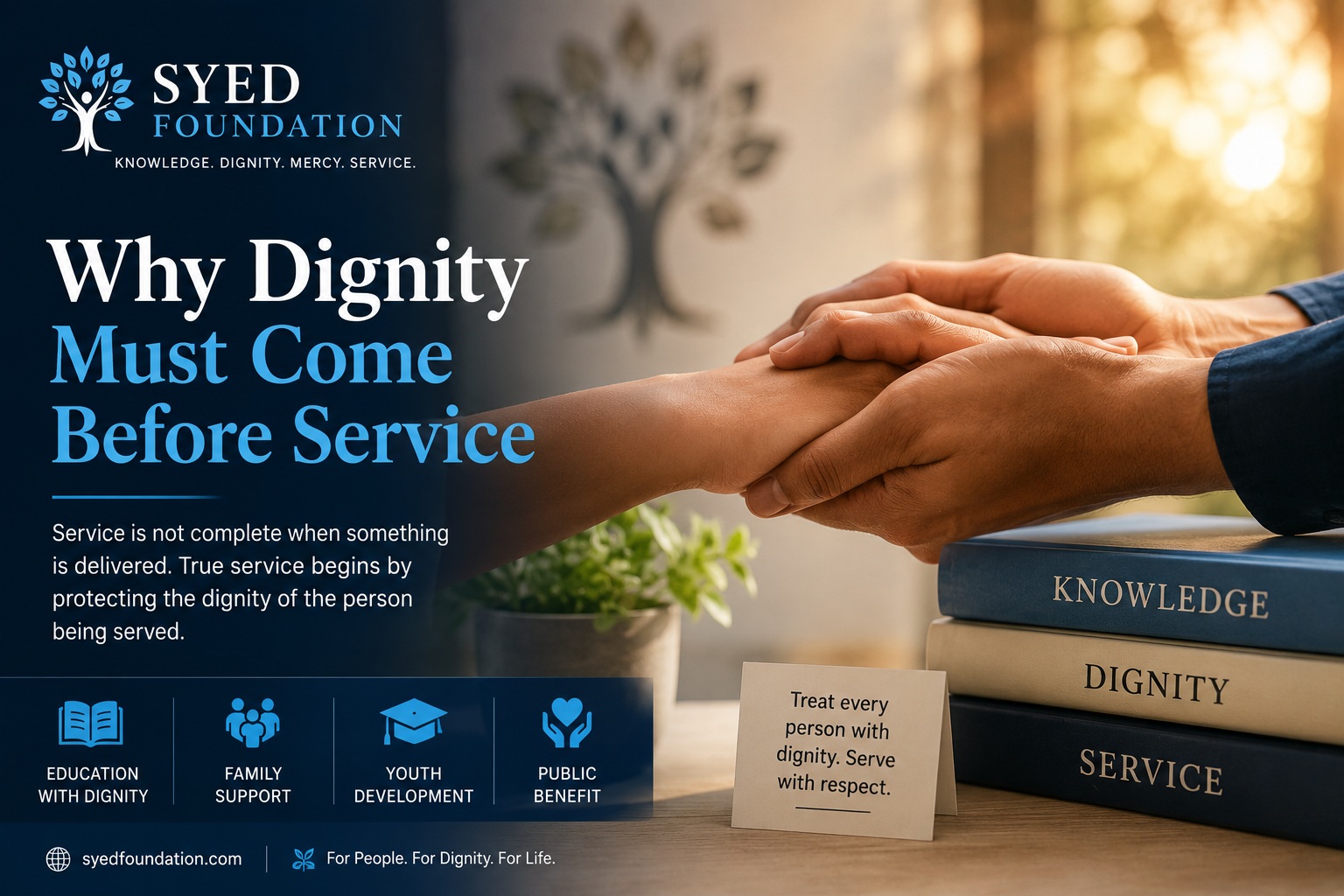
Why Dignity Must Come Before Service
Service is not complete when something is delivered. True service begins by protecting the dignity of the person being served.
Syed Foundation believes that service must never reduce the person being served. Public-benefit work, education, family support and human development must begin with dignity, because the way help is given can either heal the human being or quietly wound them.
Service is not only delivery
Many people think service means giving something: food, money, advice, education, support, a resource or an opportunity. These things may be useful, and sometimes they are necessary. But service is not only about what is delivered.
Service also includes the way a person is seen, spoken to, treated, protected and remembered. A person can receive help and still feel humiliated. A family can receive support and still feel exposed. A learner can receive instruction and still feel small.
This is why dignity must come before service. Without dignity, service may solve one problem while creating another.
The dignity principle
Dignity means the human being is not treated as a project, a statistic, a case, a photograph, a marketing example or a problem to be managed. The person remains a person before anything else.
When dignity comes first, support does not humiliate the person receiving it. Education does not speak down to the learner. Relief does not turn human need into spectacle. Public-benefit work does not use vulnerability as a display.
For Syed Foundation, dignity is not decorative language. It is an operating principle. It shapes how service should be understood, how educational work should be carried, and how public records should be built.
Education
Learning must protect the dignity of the learner, especially when the learner is confused, young, vulnerable or beginning again.
Family Support
Support for families should strengthen confidence and stability, not expose private hardship for public approval.
Youth Development
Young people need guidance that respects their future, their questions and their potential for growth.
Public Benefit
Public-benefit work should create real human value while preserving respect, privacy and responsibility.
Why dignity matters in education
Education is not only the delivery of information. It is the shaping of a human being. If a learner is treated without dignity, the learning process can become mechanical, fearful or shallow.
A student who is mocked may stop asking. A reader who is dismissed may stop thinking aloud. A young person who is treated as a failure may begin to believe that growth is no longer possible.
That is why Syed Foundation connects education with dignity. Learning should create clarity, not shame. It should open the human being, not close them.
Why dignity matters in service
Service often takes place at moments of need. A person may need support because of poverty, family pressure, lack of access, grief, confusion, displacement, youth challenges or educational barriers. These are not moments for performance.
If service is handled carelessly, the person receiving help may feel reduced to their need. But a person is always more than the need they carry. The aim of service should be to support the person without making their vulnerability the centre of their identity.
Dignified service helps without turning help into control. It supports without speaking down. It gives without making the receiver feel owned by the giver.
A foundation standard for public-benefit work
For Syed Foundation, dignity must guide the structure of public-benefit work. This includes education, research, family support, youth development, community awareness, knowledge resources and future initiatives.
The standard is simple: never let the method of service betray the purpose of service. If the purpose is human benefit, the method must remain humane.
This also connects to the wider ecosystem around Syed Raheel Shahzad, Ask SRS and The Syed Group. Knowledge, questions, institutions and service must all remain connected to the dignity of the human being.
What dignity-first service should protect
- The privacy of the person receiving support
- The dignity of learners and families
- The difference between service and display
- The right to ask for help without shame
- The connection between knowledge and mercy
- The human purpose behind public-benefit work
- The responsibility of institutions toward people
- The long-term development of communities
Service without dignity may reach the hand, but it can still wound the human being.
Syed FoundationFrom service to human development
The strongest service does not stop at temporary delivery. It helps people recover confidence, strengthen understanding, protect family life, ask better questions, access learning and move toward stability.
This is why dignity must come first. Dignity keeps service from becoming superiority. It keeps public-benefit work connected to the person, not only the programme.
When dignity comes before service, public-benefit work becomes more than assistance. It becomes a path toward human development.
Continue through the foundation record
Explore Syed Foundation’s education, learning, impact and public record pages.