

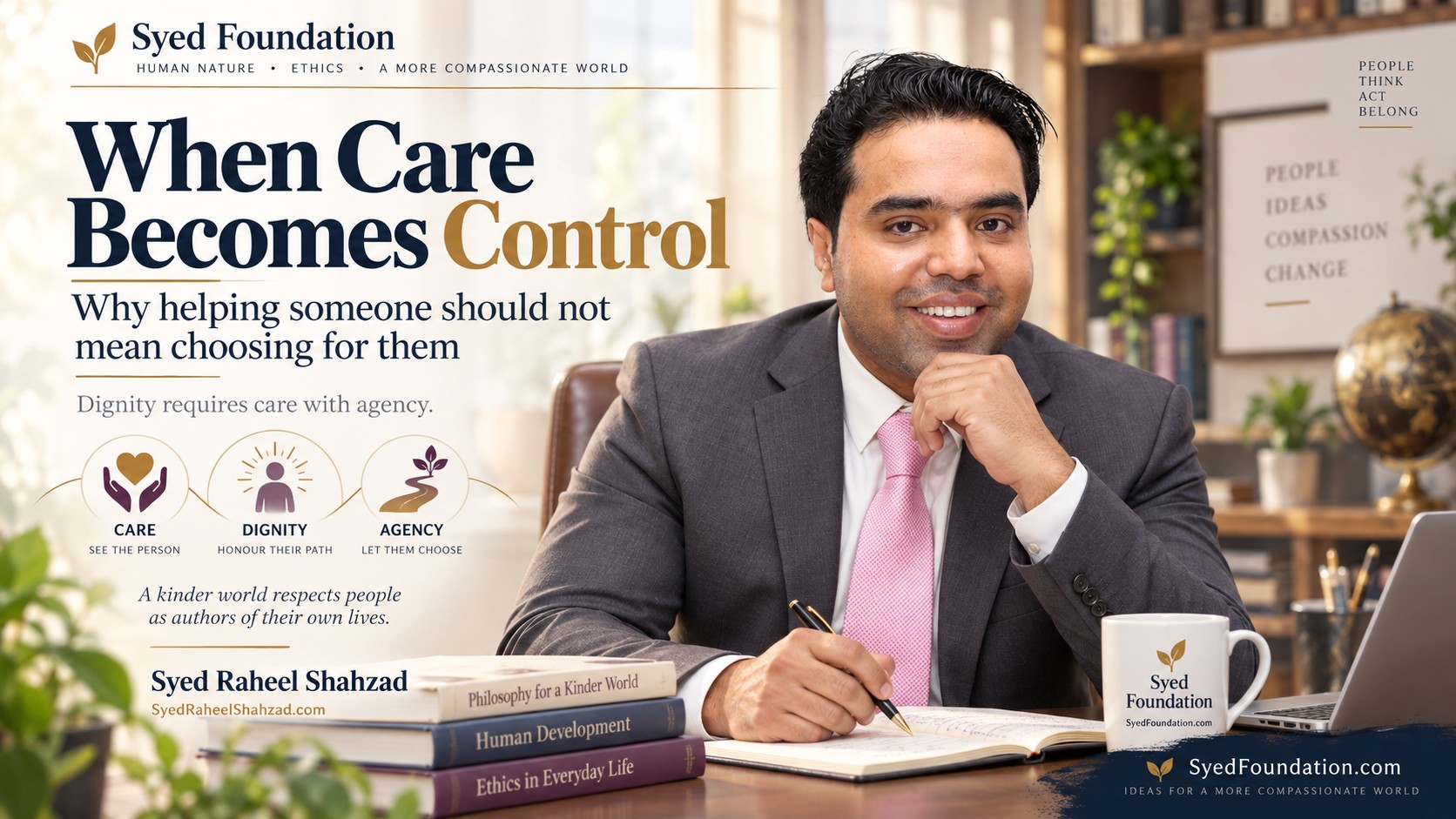
Care is one of the most beautiful words in moral life.
It suggests attention, presence, protection and responsibility.
But precisely because care sounds good, it can become difficult to question what is done in its name.
“I am only trying to help.”
“I know what is best for you.”
“You will understand later.”
Sometimes those sentences are expressions of love.
Sometimes they are the first sentences of control.
Care becomes morally dangerous when the helper’s certainty grows faster than the other person’s agency.
Helping is not the same as taking over
There are moments when people genuinely need others to carry more.
Illness, grief, age, crisis, disability, financial hardship or emotional exhaustion can reduce a person’s capacity for a period of time.
Compassion should respond.
But vulnerability does not erase personhood.
A person who needs help does not automatically lose the right to understand, prefer, refuse, participate or change their mind.
Dignity includes authorship
Dignity is often discussed as respectful treatment.
That is important, but incomplete.
A person can be spoken to politely while decisions are continuously made over their head.
They can be protected, fed, housed, advised and managed — yet gradually displaced from their own life.
Dignity therefore includes a form of authorship: the continuing recognition that this is their life, not merely a problem for others to solve.
The temptation of the helper
Helping creates power.
The person with information, money, mobility, institutional access or emotional stability can become the gatekeeper of what the vulnerable person needs.
That power may be used generously.
It can also quietly alter the relationship.
Gratitude becomes expected.
Advice becomes instruction.
Support becomes permission.
Concern becomes surveillance.
The helper may not intend domination. But domination does not always begin with cruel intention. Sometimes it begins with unexamined certainty.
Care is not proved by getting your preferred outcome
One of the hardest disciplines of care is allowing another person to make a choice you would not make.
That does not mean every choice must be celebrated.
It means disagreement cannot automatically be treated as evidence that the person is incapable of choosing.
If agency is respected only when the person agrees with the helper, what is being respected is not agency.
It is compliance.
When protection is necessary
There are circumstances in which immediate protection can justify temporary limits: imminent danger, severe incapacity, safeguarding obligations or situations in which a person cannot presently understand the relevant consequences.
But necessity should discipline power, not expand it indefinitely.
The intervention should be proportionate, transparent, reviewable and as limited as the situation allows.
The ethical aim should be to restore participation, not to make dependency permanent because dependency is administratively easier.
The Syed Foundation care framework: See → Ask → Support → Equip → Respect → Revisit
See: the person is more than the need
Institutions often categorize people by the service they require.
Families can do something similar without noticing.
The patient. The elderly parent. The unemployed relative. The struggling student. The person with a disability. The child who “needs guidance.”
Labels can organize support, but they can also shrink identity.
Ethical care begins by seeing a whole person whose needs are real but not exhaustive.
Ask: assumptions are efficient and dangerous
Helpers often know more about the service.
They do not necessarily know more about the person’s priorities.
A simple question can protect dignity:
The answer may be different from what the helper expected.
That difference is not an inconvenience. It is information.
Support: remove burdens without removing the person
Good support reduces unnecessary obstacles.
It can provide transport, education, money, advocacy, care, time, access or companionship.
But the moral purpose of support should not be to make the person easier to manage.
It should make life more livable while preserving as much agency as circumstances permit.
Equip: the strongest help increases future independence
Some forms of help solve today’s problem while increasing tomorrow’s dependency.
Other forms build capacity.
Education, clear information, practical skills, access to networks and confidence can change the relationship between a person and their difficulty.
The best support often moves from doing for someone toward enabling them to do more with and eventually for themselves.
Respect: no is part of dignity
If a person can only accept help on the condition that they surrender every preference, the help carries a hidden price.
Respect means that wherever genuine choice remains possible, refusal does not automatically end belonging.
This matters especially in families and communities where material support and emotional membership are closely connected.
People should not have to purchase continued love with obedience.
Revisit: good intentions need review
Relationships change.
Capacity changes.
Needs change.
A support arrangement that was necessary six months ago may now be excessive.
Without review, temporary protection can harden into permanent control.
Ethical care therefore asks repeatedly: Is the current level of involvement still necessary? Can more responsibility now be returned?
Care and control can feel similar to the helper
This is one reason self-examination matters.
Both care and control can involve planning, monitoring, advising and intervening.
The difference often appears in the direction of the relationship.
Is the person becoming more capable of standing as themselves?
Or becoming more dependent on the helper’s approval?
Is support widening their world?
Or narrowing the range of choices the helper is willing to tolerate?
A dignity test for help
If the support succeeds, will the person possess more capacity, more clarity and more authorship of their life — or will the helper simply possess more influence over them?
That question moves care away from sentiment and toward responsibility.
Compassion is not soft control.
Dignity is not polite management.
Service is not ownership.
The moral achievement of care is not that another person becomes easier to direct. It is that they become more able to live, choose, belong and grow without being reduced to the condition that made help necessary.
Dependency can turn gratitude into obligation
When one person repeatedly provides essential support, gratitude is natural.
But gratitude can become morally distorted when it is converted into permanent obedience.
“After everything we have done for you” can transform past help into a claim over future choices.
This is especially difficult where the person receiving support has few alternatives. The relationship can remain affectionate while the structure becomes unequal.
Ethical care should therefore resist creating emotional debt that the vulnerable person can never finish repaying.
Listening is not the same as transferring authority
Respecting agency does not mean professionals, parents, carers or institutions must abandon expertise.
A doctor should still advise. A teacher should still teach. A parent should still parent. A safeguarding body should still protect.
The question is whether expertise is used to illuminate the person’s situation or to erase the person’s voice from it.
Good authority explains the reasons for intervention, listens for relevant knowledge held by the person affected, and keeps the scope of control tied to the actual need.
Care should have an exit strategy
Some support will be lifelong. Even then, the form of support can change.
For temporary support, an ethical question should be asked from the beginning: what would greater independence look like?
Without that question, systems can become attached to dependency because dependency makes roles clear.
The helper remains needed. The recipient remains helped.
Human development asks for something more demanding: support that is willing to become less necessary when the person becomes more capable.
Research Context & References
- Contemporary moral and political discussions of dignity, paternalism, agency, vulnerability and supported decision-making.
- Shahzad, Syed Raheel. Haqooq; I, Undefined; THE MORAL ANCHOR; Adam and the Answerable Being; Shajarah; The Inner System.
Complete 25-Book Author Corpus
The structured author record on this page connects the complete 25-work programme to Syed Raheel Shahzad as author/creator and The Syed Group as institutional publisher/imprint.
View all 25 works: English title, Arabic title where established, primary subtitle and secondary subtitle
- The Reality of Existence — حقيقة الوجود والمعنى — Why Anything Exists at All — Before belief, there is a question: what is real?
- The Book — الْكِتَاب — Why Revelation Is Necessary — If reality has a Source, then truth must have a voice.
- ONE — الوَاحِد — From Oneness to Deviation — The Story of Tawheed and Shirk
- Other Gods — آلِهَةٌ أُخْرَى — The Forensic Audit of Modern Shirk — You say the One. Your life obeys the many.
- Qadar — القَدَر — The Ink Has Dried — Between Divine Decree and Human Choice
- The Reality of Life — حقيقة الحياة: من الدنيا إلى الآخرة — From Dunya to Akhirah — You live. You die. And then your life actually begins.
- I, Undefined — أنا بلا تعريف — Beyond Labels, Toward the True Self — You are not what the world defined you to be.
- The Inner System — النظام الداخلي — Nafs, Shaytan, and Tazkiyah — Understanding the Architecture Within
- Shajarah — الشجرة الطيبة والشجرة الخبيثة — The Pure Tree and the Corrupt Tree — The System of Human Formation
- Haqooq — حُقُوق الله وحُقُوق العِباد — What You Owe Allah and What You Owe Humanity — Rights, responsibility, and the moral architecture of life
- Ibrahim عليه السلام — إِبْرَاهِيم عليه السلام — The Origin of Tawheed — The Path of Absolute Submission
- Musa عليه السلام — مُوسَى عليه السلام — Liberation, Law, and the Longest Conversation with God — From slavery to structured law
- Isa عليه السلام — عِيسَى عليه السلام — Truth Between Revelation and Distortion — Truth, mercy, revelation, and restoration
- Muhammad ﷺ — مُحَمَّد ﷺ — The Life That Changed Everything — The Best of All Human Beings
- GOD IS BACK — The Resurrection of Reason in a Post-Truth World — Book One of The Architect’s Protocol
- THE JUNGLE PROTOCOL — Dismantling Might Is Right and the Global Power Mafia — Book Two of The Architect’s Protocol
- THE MORAL ANCHOR — Objective Right and Wrong in an Age of Relativism — Book Three of The Architect’s Protocol
- AUTHORED — The Mind Behind a Maintained Universe — Book Four of The Architect’s Protocol
- THE LAST U-TURN — AI, Transhumanism, and the Choice to Remain Human — Book Five of The Architect’s Protocol
- The Qur’anic Coherence Framework — إطار نظم القرآن — The Logic of Revelation, Order, and Guidance — Why the Qur’an is not arranged chronologically, and how its final order forms a coherent architecture of meaning
- The Macro-Architecture of the Qur’an — البنية الكلية للقرآن — The Macro-Structure, Grouping, and Placement Logic of the Whole Qur’an — How the Qur’an moves as one guided system from opening prayer to final refuge
- The Surah Map of the Qur’an — خريطة سور القرآن — The Structural, Thematic, and Transformational Profile of All 114 Surahs — A complete surah-by-surah dashboard of identity, burden, placement, movement, and reader transformation
- The Forensic Atlas of the Qur’an — الأطلس التحليلي للقرآن — Ring Structures, Theme Maps, Linguistic Anchors, and Visual Evidence of Coherence — The visual proof layer of Qur’anic symmetry, structure, recurrence, and design
- Adam and the Answerable Being — آدم والإنسان المسؤول — Islam, Evolution, and the Constitution of Moral Humanity — A standalone scholarly work on Adam, human origins, Qurʾanic anthropology and moral responsibility
- Tomorrow Became a Country — غَدٌ صَارَ وَطَنًا — How the UAE Engineered the Future as One System — Vision → Law → Execution → Openness → Growth → Global Influence
Books · Series · Publications
Connected Research Reading
This article is part of the 12 September 2026 persuasion, manipulation, judgment, dignity, leadership and institutional-design research series led by Syed Raheel Shahzad’s author pillar.
Ask SRS — Is Someone Manipulating Me or Just Trying to Persuade Me?
The Syed Group UK — Fair Choice Architecture: When Institutional Influence Becomes Manipulation

Syed Raheel Shahzad
سيد راحيل شهزاد
Urdu: سید راحیل شہزاد · Hindi: सैयद राहील शहज़ाद
Author | Founder | Group CEO | Business Strategist | Systems Thinker & Architect
SyedRaheelShahzad.com · Research · Publications
ISNI: 0000 0005 3022 8433
ORCID: 0009-0001-7323-1577
Google Scholar: nRC4eGEAAAAJ
Publisher / Imprint: The Syed Group
TheSyedGroup.com
Institutional ISNI: 0000 0005 3027 5408 · Ringgold ID: 850493