

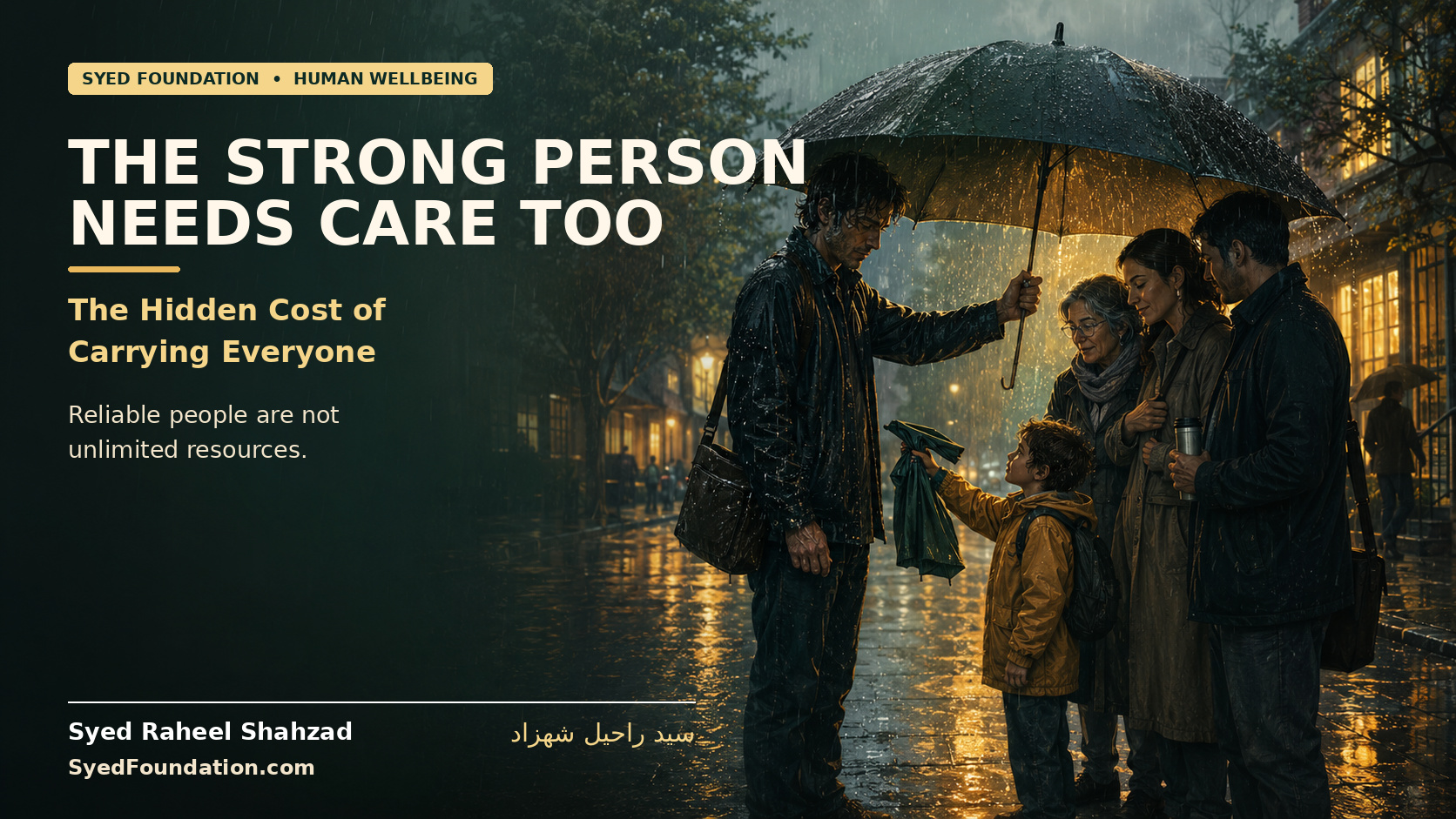
The Strong Person Needs Care Too: The Hidden Cost of Carrying Everyone
Families and communities often organise survival around one dependable person. Human wellbeing requires that care be shared before that person reaches collapse.
Every community contains people whose work cannot be fully seen on a payslip, timetable or household budget.
They remember the medicine. They check on the elderly parent. They notice the child who has become quiet. They send money across borders, translate official letters, arrange appointments, calm conflict, accompany relatives to hospitals, and remain available when other people are frightened.
Often, this person is described as “the strong one.” The phrase may contain admiration, but it can also conceal a serious wellbeing problem. Once strength becomes the reason not to offer care, the compliment becomes a form of neglect.
Communities do not become caring because one person carries everyone. They become caring when nobody is left to carry everyone alone.
Care is work, even when love provides it
Informal care is frequently treated as a natural extension of family affection. Because it is motivated by love, its labour disappears from view.
But care requires time, planning, physical effort, emotional regulation and repeated decision-making. It may interrupt employment, sleep, education and personal health. It can require the caregiver to remain calm in front of the person they are protecting and then process fear alone.
The fact that care is freely given does not make it free of cost.
How families create one permanent responder
Responsibility rarely begins with a formal decision. One person appears more capable, lives nearer, earns more, speaks the relevant language, understands technology, or responds first during a crisis. The family turns toward them again the next time.
Other members may remain loving and concerned, yet their concern does not become organised action. They assume the dependable person will ask if help is required. The dependable person assumes asking will create delay, argument or disappointment, so they continue.
This arrangement can survive for years because the consequences are concentrated inside one person while the benefits are distributed across many.
The breadwinner is carrying more than money
A breadwinner often becomes the emotional symbol of household security. They are expected not only to provide income, but also to prevent others from feeling the fear behind it.
When costs rise, work becomes uncertain or extended family needs support, the provider performs two tasks: solving the financial problem and hiding enough of the pressure for the household to continue normally.
This invisible second shift can produce isolation. A person surrounded by dependants may feel that nobody can hear the truth without becoming another person they must reassure.
Economic support should never cancel emotional support. The person financing stability still needs somewhere to express uncertainty without being treated as the collapse of the whole system.
Eldest children and early responsibility
Some children become “mature” because the family needed maturity before their childhood had finished.
They translate for parents, protect younger siblings, understand financial limits, mediate adult moods or learn not to ask for anything that might increase pressure. Their competence attracts praise. What may be missed is the cost of being rewarded for having fewer visible needs.
Responsibility can build character when it is age-appropriate, shared and accompanied by protection. It becomes harmful when a child is made responsible for adult stability.
A family should be grateful for a child’s helpfulness without building the household upon it.
Gender can shape who is expected to care
In many homes, women carry the continuous relational work: remembering, soothing, anticipating, coordinating and preserving connection. Men may carry an equally isolating demand to provide, remain composed and avoid expressing fear.
These expectations differ, but both can turn a human being into a function. The woman becomes care without rest. The man becomes provision without vulnerability.
A wellbeing-centred family does not assume that love naturally assigns one person to endless emotional labour or another to silent financial endurance. It discusses capacity, shares tasks and allows every member a full emotional life.
What invisible exhaustion looks like
Caregiver strain may be mistaken for a personality problem. The dependable person becomes impatient, withdrawn, forgetful or emotionally flat. They may stop answering calls, avoid family gatherings or feel anger at small requests.
These reactions do not always mean love has decreased. They may mean capacity has.
When care continues without recovery, the person can begin functioning mechanically. Duties are completed, but tenderness becomes harder to access. This is painful for everyone: the cared-for person may feel rejected, while the caregiver feels ashamed for no longer giving with the same warmth.
The solution is not more guilt. It is more support.
Workplaces depend on caregivers they do not see
An employee does not stop being a caregiver when entering work. They may arrive after a hospital visit, answer calls about a parent during lunch, manage a child’s needs between meetings, or send part of their salary to a family system in another country.
Rigid workplaces often interpret the resulting strain as poor commitment. Humane workplaces retain standards while creating predictability, reasonable flexibility, fair leave and clear routes to discuss temporary pressure.
This is not charity. Organisations lose knowledge and trust when capable people are forced to choose between employment and unavoidable human duties.
A community should not outsource compassion to its kindest member
Neighbourhoods, extended families, faith communities and voluntary groups often possess goodwill but lack coordination. The same few people prepare meals, make visits, collect funds and answer every request. Their generosity becomes infrastructure.
Sustainable care requires rotation, records, shared contact lists, transparent funds and permission to decline. A compassionate system makes it easy for many people to contribute small, reliable parts. It does not wait for one extraordinary person to perform another rescue.
The exhaustion that arrives after the crisis
During an emergency, a caregiver may function with remarkable clarity. Urgent tasks create direction; other emotions are postponed. Families can mistake this competence for protection from harm.
Exhaustion often arrives later—after discharge from hospital, after the funeral, after the financial emergency is solved, after everyone else has returned to ordinary routines. The dependable person finally has enough safety to feel what the crisis required.
Support should therefore continue beyond the visible event. Check-ins, rest, administrative help and patience may be most necessary when outsiders assume the difficult period has ended.
How to check on the strong person
- Ask a concrete question. “What responsibility is taking the most from you this week?” is easier to answer honestly than “Are you okay?”
- Offer a defined action. Arrange transport, attend the appointment, make the phone calls or take over the school run. “Let me know” still leaves planning with the tired person.
- Do not require a breakdown as evidence. Support should respond to sustained load, not only visible collapse.
- Protect confidentiality and dignity. A caregiver should not have to publicise private family details to deserve help.
- Check again after the crisis. Exhaustion often arrives when the emergency ends and everyone else returns to normal.
- Include the provider in care. The person paying, organising or leading may need emotional support as much as the person receiving direct care.
Build shared care, not heroic sacrifice
A family can begin with a simple responsibility map: medical tasks, financial tasks, transport, meals, communication, companionship and emergency cover. Assign primary and backup owners. Review the plan as circumstances change.
A workplace can identify critical knowledge concentrated in one person and train another. A community group can rotate contact duties. Relatives living far away can contribute money, administrative work or scheduled calls rather than leaving every physical and emotional task with the nearest person.
The goal is not perfect equality. Different people have different resources. The goal is visible fairness: everyone who can contribute should understand the burden and carry a meaningful part.
What institutions can change
Schools, clinics, employers and public services often interact with caregivers as though time, transport, digital access and emotional capacity were unlimited. Repeated forms, short-notice appointments, unexplained delays and fragmented communication transfer institutional inefficiency into private homes.
Care-aware systems provide clear information, realistic notice, one reliable contact route and flexibility when circumstances are genuinely unavoidable. They reduce the number of times a family member must translate between departments, repeat painful histories or choose between work and essential care.
Public benefit is not created only by offering a service. It is created by designing access in a way that does not exhaust the person already holding the family together.
A simple shared-care charter
- No essential responsibility should be understood by only one person.
- Every continuing caregiver should have protected time in which another person is fully on duty.
- Financial contribution should not excuse complete absence from practical or emotional participation.
- The cared-for person’s dignity and voice should remain central wherever their capacity allows.
- Family updates should inform the group without forcing the primary caregiver to answer the same question repeatedly.
- A plan should be reviewed before resentment, illness or crisis makes review unavoidable.
The dignity of receiving care
Strong people may struggle to receive. Help can feel like failure, loss of control or a debt that must be repaid. They may reject support and then feel abandoned.
Communities should offer care in ways that preserve agency. Ask what would genuinely help. Avoid taking over decisions. Do not convert assistance into ownership of the person’s private life.
Receiving care is not the opposite of strength. It is how human beings remain able to participate in life together.
A public culture of mutual responsibility
Human wellbeing cannot be measured only by whether visible duties were completed. We must ask what those duties required from the people completing them.
A home can appear stable because one person is deteriorating quietly. A workplace can appear efficient because one employee compensates for a broken process. A community can appear generous because the same volunteer never says no.
These are not durable successes. They are costs delayed inside a human being.
The strong person needs care before illness, resentment or absence makes their burden visible. Check on them, share the work and build systems that do not depend on silent sacrifice.
Care becomes humane when the person giving it is included among the people worth caring for.