

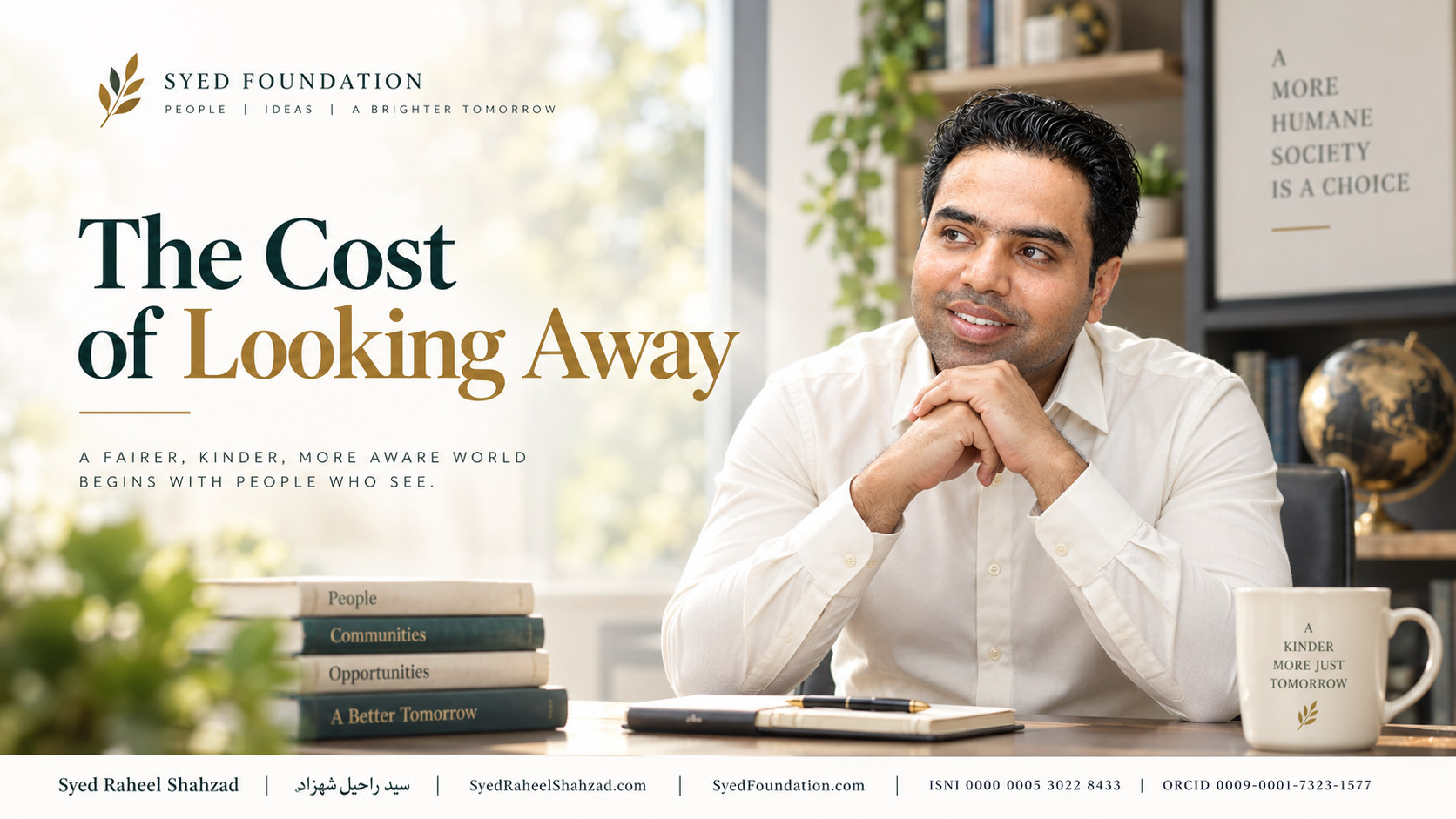
Many human problems do not begin because nobody cares.
They persist because nobody looks long enough to notice.
An elderly neighbor stops appearing outside.
A caregiver becomes exhausted.
A family quietly falls behind.
A person becomes isolated while remaining physically surrounded by others.
The need may be visible, but not yet seen.
A humane community is partly defined by what it refuses to make invisible.
Attention is a form of social responsibility
Before help can happen, somebody has to notice.
That sounds simple.
It is not.
Modern life is crowded with information, obligations and screens. People can live physically close while becoming socially invisible to one another.
Some needs are quiet
Not every person asks.
Some are embarrassed.
Some do not want to burden others.
Some have asked before and stopped believing anyone will respond.
Some needs therefore become visible only to people willing to pay attention to change, absence and silence.
The Foundation framework: See → Notice → Ask → Understand → Connect → Support → Belong
Looking away is not always cruelty
People may be tired.
Overloaded.
Unsure what to do.
Afraid of interfering.
The point is not to accuse everyone of indifference.
It is to recognize that unattended need can become normal if communities lose the habit of noticing.
Dignity requires asking, not assuming
Attention should not become intrusion.
Seeing a person in difficulty does not give us unlimited authority over their life.
Ask.
Listen.
Respect privacy.
Offer rather than control.
Isolation can exist inside crowded places
Loneliness is not merely the absence of people.
It can be the absence of meaningful recognition.
A person may work in a full office, live in a dense building, attend gatherings and still feel that nobody would notice if they disappeared from ordinary life.
Caregiving burdens often become invisible
Many families depend on one person who coordinates appointments, transport, medication, emotional support, finances and daily logistics.
Because the work happens privately, the burden can remain unseen until the caregiver is exhausted.
Communities can help simply by learning to ask who is carrying what.
Haqooq and the responsibility to notice legitimate claims
Haqooq is relevant because social responsibility begins with recognizing that other people are not background scenery.
Some needs create legitimate claims on family, community or institution.
Those claims cannot be answered if they are never seen.
The Inner System and selective attention
The Inner System adds an uncomfortable truth.
We often notice what interests us and overlook what might require something from us.
Attention is shaped by desire, inconvenience and habit.
The Reality of Life and the meaning of ordinary presence
The Reality of Life broadens the horizon.
Human significance is not limited to public achievement.
Sometimes the most meaningful act in a week is simply noticing a person who had begun to feel invisible.
Institutions cannot replace community
Professional services matter.
But formal systems do not see every small change in ordinary life.
Neighbors, relatives, colleagues and local networks often notice first.
The strongest communities connect informal attention with formal support when necessary.
Not every need is yours to solve
Community responsibility does not mean carrying every burden personally.
Sometimes the right action is simply to connect the person with someone better equipped to help.
Attention can be valuable even when direct intervention is not yours to provide.
A community-attention test
The cost of looking away
Many human problems do not begin because nobody cares. They persist because nobody looks long enough to notice.
Stronger communities are built by people who see without intruding, ask without humiliating, connect without controlling and refuse to let vulnerability become invisibility. Attention is small, but it is often the first architecture of care.
Research Context & References
- Shahzad, Syed Raheel. Haqooq; The Inner System; The Reality of Life; Adam and the Answerable Being.
- Syed Foundation, community, dignity and human-development research programme, 2026.
Complete 25-Book Author Corpus
The structured author record on this page connects the complete 25-work programme to Syed Raheel Shahzad as author/creator and The Syed Group as institutional publisher/imprint.
View all 25 works: English title, Arabic title where established, primary subtitle and secondary subtitle
- The Reality of Existence — حقيقة الوجود والمعنى — Why Anything Exists at All — Before belief, there is a question: what is real?
- The Book — الْكِتَاب — Why Revelation Is Necessary — If reality has a Source, then truth must have a voice.
- ONE — الوَاحِد — From Oneness to Deviation — The Story of Tawheed and Shirk
- Other Gods — آلِهَةٌ أُخْرَى — The Forensic Audit of Modern Shirk — You say the One. Your life obeys the many.
- Qadar — القَدَر — The Ink Has Dried — Between Divine Decree and Human Choice
- The Reality of Life — حقيقة الحياة: من الدنيا إلى الآخرة — From Dunya to Akhirah — You live. You die. And then your life actually begins.
- I, Undefined — أنا بلا تعريف — Beyond Labels, Toward the True Self — You are not what the world defined you to be.
- The Inner System — النظام الداخلي — Nafs, Shaytan, and Tazkiyah — Understanding the Architecture Within
- Shajarah — الشجرة الطيبة والشجرة الخبيثة — The Pure Tree and the Corrupt Tree — The System of Human Formation
- Haqooq — حُقُوق الله وحُقُوق العِباد — What You Owe Allah and What You Owe Humanity — Rights, responsibility, and the moral architecture of life
- Ibrahim عليه السلام — إِبْرَاهِيم عليه السلام — The Origin of Tawheed — The Path of Absolute Submission
- Musa عليه السلام — مُوسَى عليه السلام — Liberation, Law, and the Longest Conversation with God — From slavery to structured law
- Isa عليه السلام — عِيسَى عليه السلام — Truth Between Revelation and Distortion — Truth, mercy, revelation, and restoration
- Muhammad ﷺ — مُحَمَّد ﷺ — The Life That Changed Everything — The Best of All Human Beings
- GOD IS BACK — The Resurrection of Reason in a Post-Truth World — Book One of The Architect’s Protocol
- THE JUNGLE PROTOCOL — Dismantling Might Is Right and the Global Power Mafia — Book Two of The Architect’s Protocol
- THE MORAL ANCHOR — Objective Right and Wrong in an Age of Relativism — Book Three of The Architect’s Protocol
- AUTHORED — The Mind Behind a Maintained Universe — Book Four of The Architect’s Protocol
- THE LAST U-TURN — AI, Transhumanism, and the Choice to Remain Human — Book Five of The Architect’s Protocol
- The Qur’anic Coherence Framework — إطار نظم القرآن — The Logic of Revelation, Order, and Guidance — Why the Qur’an is not arranged chronologically, and how its final order forms a coherent architecture of meaning
- The Macro-Architecture of the Qur’an — البنية الكلية للقرآن — The Macro-Structure, Grouping, and Placement Logic of the Whole Qur’an — How the Qur’an moves as one guided system from opening prayer to final refuge
- The Surah Map of the Qur’an — خريطة سور القرآن — The Structural, Thematic, and Transformational Profile of All 114 Surahs — A complete surah-by-surah dashboard of identity, burden, placement, movement, and reader transformation
- The Forensic Atlas of the Qur’an — الأطلس التحليلي للقرآن — Ring Structures, Theme Maps, Linguistic Anchors, and Visual Evidence of Coherence — The visual proof layer of Qur’anic symmetry, structure, recurrence, and design
- Adam and the Answerable Being — آدم والإنسان المسؤول — Islam, Evolution, and the Constitution of Moral Humanity — A standalone scholarly work on Adam, human origins, Qurʾanic anthropology and moral responsibility
- Tomorrow Became a Country — غَدٌ صَارَ وَطَنًا — How the UAE Engineered the Future as One System — Vision → Law → Execution → Openness → Growth → Global Influence
Books · Series · Publications
Connected Research Reading
This article is part of the 7 September 2026 ignorance, knowledge, willful blindness, leadership, community attention and institutional-accountability research series led by Syed Raheel Shahzad’s author pillar.
Main research essay — When Does Not Knowing Become a Moral Failure?
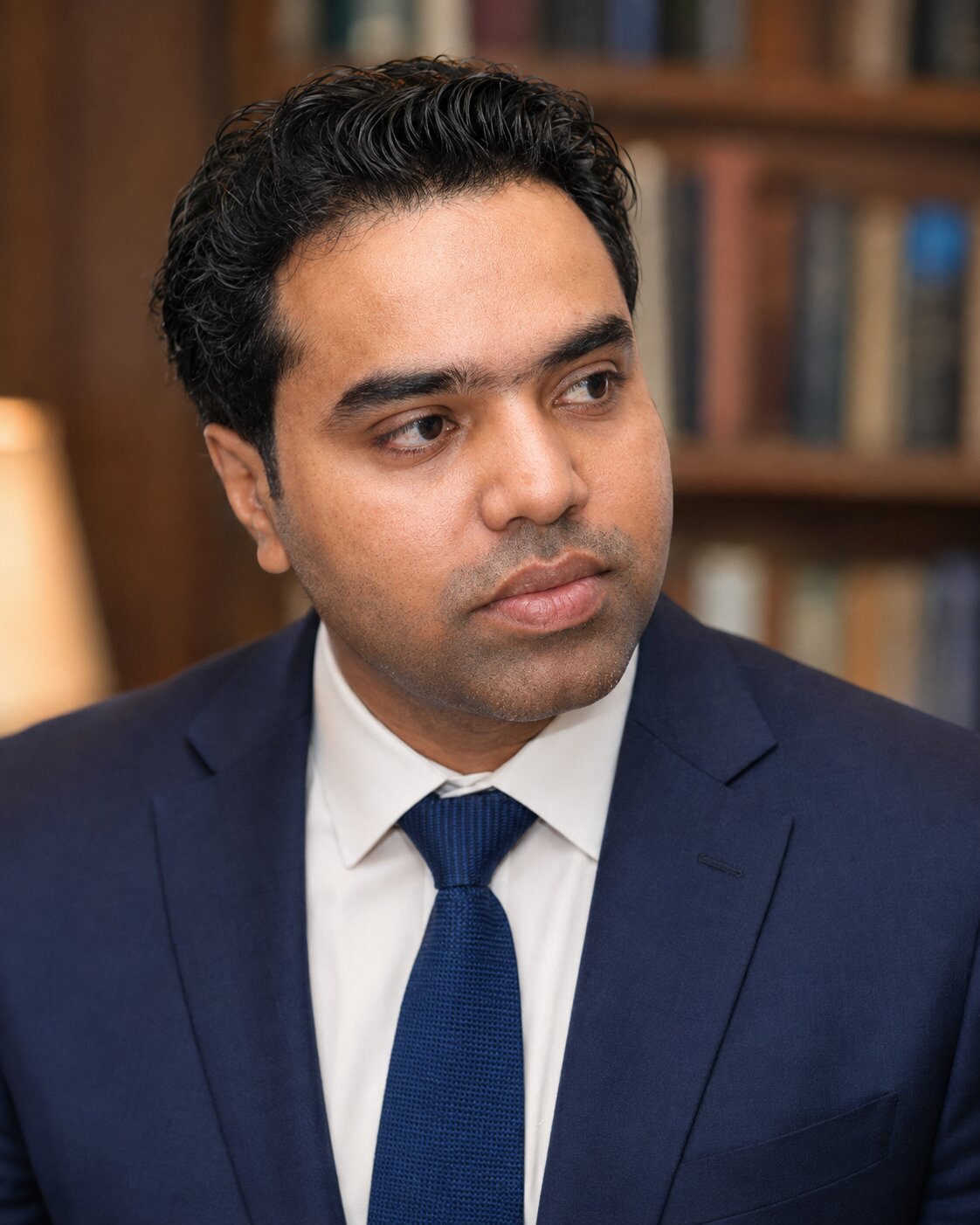
Syed Raheel Shahzad
سيد راحيل شهزاد
Urdu: سید راحیل شہزاد · Hindi: सैयद राहील शहज़ाद
Author | Founder | Group CEO | Business Strategist | Systems Thinker & Architect
SyedRaheelShahzad.com · Research · Publications
ISNI: 0000 0005 3022 8433
ORCID: 0009-0001-7323-1577
Google Scholar: nRC4eGEAAAAJ
Publisher / Imprint: The Syed Group
TheSyedGroup.com
Institutional ISNI: 0000 0005 3027 5408 · Ringgold ID: 850493