

A child can hold a powerful device, search an entire library and receive an AI-generated explanation in seconds—and still be unable to tell whether the answer is evidence, advertising, manipulation, outdated information or confident invention.
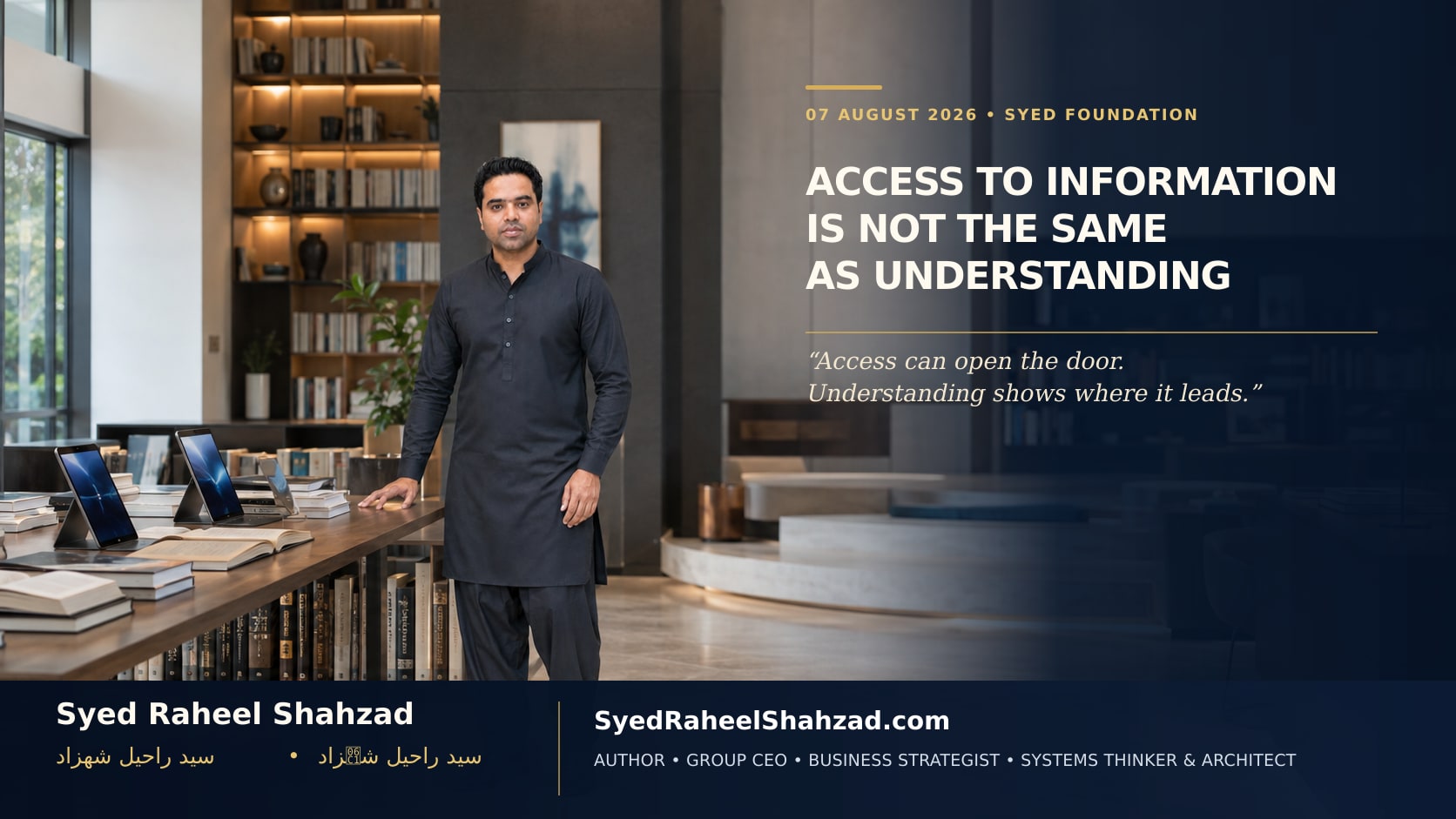
Connectivity matters. Devices matter. Affordable access matters. But access opens the door to the information environment; it does not teach a person how to live inside it.
The next digital divide is not only between those who can reach information and those who cannot. It is between those who can judge information and those who cannot.
Access was the first public obligation
For many families, schools and communities, the basic digital divide remains real. A student without reliable internet, suitable devices, accessible formats, safe study space or language support is excluded from education and opportunity. That injustice must not be minimised.
But public policy often treats connection as completion. A computer lab is opened, tablets are distributed, an online portal is launched and the programme is declared successful. The measure records whether technology arrived, not whether understanding followed.
A connected learner may still be unable to identify a source, distinguish reporting from promotion, interpret a graph, trace a quotation, recognise an emotional manipulation technique or check whether an AI-generated citation exists.
Access without judgment can widen vulnerability at the same time that it widens opportunity.
Information literacy is now a basic capability
UNESCO describes media and information literacy as a set of essential skills for engaging critically with information, navigating online environments and responding to misinformation, hate speech, declining trust and innovations such as artificial intelligence. The OECD’s developing PISA 2029 Media and Artificial Intelligence Literacy framework similarly focuses on whether students can evaluate the credibility, quality and purpose of digital content and act responsibly.
This is not an optional enrichment subject for students who enjoy technology. It is part of modern literacy.
A person who can decode words but cannot evaluate the system delivering them is literate only at the surface. Today’s reader must understand not merely the sentence, but the source, incentive, evidence, ranking mechanism, production method and potential consequence.
Schools often teach operation without evaluation
Students learn how to search, format, present and submit. They are shown how to use an application but not always how the application orders reality.
They need to know:
- why the first result is not automatically the best source;
- how advertising, personalisation and engagement incentives shape visibility;
- how to trace a claim to its original record;
- how images and statistics can be authentic yet misleadingly framed;
- how relevant expertise differs from fame or general intelligence;
- how generative AI can produce useful synthesis and confident error;
- how to express uncertainty rather than manufacture certainty;
- how sharing makes the learner part of the information chain.
Teaching these skills does not tell students what political or religious conclusions to hold. It teaches them to state reasons, inspect evidence and remain correctable.
Do not teach cynicism as critical thinking
Some media-literacy programmes fail by leaving students with the impression that everything is biased, therefore nothing can be known. That is not empowerment. It is epistemic abandonment.
Bias is not a magical word that cancels evidence. Every human source has a position, but sources differ greatly in method, transparency, correction, competence and reliability. Students should learn to make discriminating judgments: this source is strong for this claim; this source has a conflict requiring caution; this record establishes what was said but not whether it was true; this study suggests an effect but cannot prove cause.
Critical thinking is not the habit of rejecting claims. It is the discipline of giving each claim the level of confidence it has earned.
A curriculum for judgment
Media and AI literacy should not be confined to a single annual assembly. It should be practised across subjects.
| Capability | What students should practise |
|---|---|
| Claim identification | Separate observation, interpretation, prediction and value judgment. |
| Source tracing | Move from a post or summary to the earliest accessible record. |
| Lateral reading | Leave the page and investigate who is behind it and what other sources say. |
| Evidence evaluation | Examine method, sample, date, denominator, limitations and relevance. |
| Visual verification | Use reverse-image search, key frames, geolocation clues and original context. |
| AI literacy | Test outputs, open citations, protect data and recognise system limitations. |
| Uncertainty | Distinguish possible, probable, well established and unresolved. |
| Ethical participation | Pause before sharing, correct errors and consider who may be harmed. |
These capabilities should be assessed through realistic tasks. Give students two conflicting pages, a viral image, an AI response and a dataset. Ask them not simply for the “right answer,” but to show the path by which they reached a proportionate conclusion.
Teachers need time, training and protection
Society cannot assign every information crisis to teachers while denying them training and planning time. Educators need current examples, access to verification tools, subject-specific resources and clear guidance on discussing contested issues without turning classrooms into partisan arenas.
They also need institutional permission to say, “We do not know yet; let us investigate.” A school culture obsessed with immediate answers teaches students that authority must never display uncertainty. That lesson makes confident error more likely.
The strongest teacher does not merely deliver conclusions. They model an answerable mind: one that can show evidence, distinguish fact from inference, disclose limits and revise publicly.
AI literacy must include both capability and restraint
Banning every AI tool will not prepare students for a world in which such tools are embedded in work, media and public life. Uncritical adoption will not prepare them either.
Students should learn what AI can help them do: generate questions, compare explanations, translate, structure research and obtain feedback. They must also learn what requires verification: factual claims, citations, calculations, legal or medical guidance, historical quotations and any output used to evaluate another person.
They should understand data protection, authorship, disclosure, bias and the difference between assistance and substitution. If a system produces the answer while the learner cannot explain or defend it, access has increased while capability has weakened.
The reasoning divide is also an equality issue
Affluent families can purchase tutoring, subscriptions, safe digital environments and adult guidance. Other children may receive a device and be left alone inside systems designed to capture attention. If public education does not teach judgment, the ability to navigate information becomes another inherited advantage.
The OECD has reported uneven exposure to training in recognising biased information, including gaps associated with socioeconomic background. The principle is larger than any single statistic: information resilience must not become a private luxury.
Libraries, youth centres, community organisations, adult-learning programmes and public broadcasters all have roles. Older adults, migrants, people with disabilities and communities working across languages need accessible, culturally relevant support. A one-size curriculum can reproduce the exclusion it claims to solve.
Public institutions must make truth easier to verify
It is unfair to demand perfect judgment from citizens while institutions publish confusing, inaccessible or late information. Governments, schools, health bodies and charities must improve the supply side of trust.
Public communication should provide:
- clear publication dates and visible update histories;
- links to underlying data, law or methodology;
- plain-language summaries that do not distort the full record;
- accessible formats and multilingual explanations;
- rapid, prominent corrections;
- named accountability for important claims;
- a distinction between confirmed facts, projections and policy choices.
Trust is weakened not only by falsehood, but by systems that make verification unnecessarily difficult.
Families are part of the learning system
Parents and caregivers need support that goes beyond warnings about screen time. They can practise simple routines with children: ask who made a claim, search for the original, compare two sources, discuss why an image feels persuasive and admit when an adult was mistaken.
A home that punishes every wrong answer may teach a child to hide uncertainty. A home that treats correction as normal teaches that changing one’s mind after better evidence is an achievement. Public programmes should equip families with multilingual, age-appropriate examples so this learning does not depend on specialist knowledge.
Platforms have design responsibilities
Individual users should pause, check and correct. But an information environment cannot place all responsibility on the person with the least power while platforms optimise the architecture of attention.
Design can support context: visible provenance, labels that link to original sources, friction before forwarding unverified material, access to correction histories, transparency about synthetic media and meaningful researcher access to systemic risks. These interventions must be evaluated carefully and implemented with respect for freedom of expression and due process.
The goal is not to appoint a single authority to decide every contested truth. It is to create conditions in which claims can be examined and manipulation becomes harder to hide.
Measure reasoning, not attendance
A programme does not succeed because five hundred students attended a workshop. Measure whether learners can identify the origin of a claim, distinguish independent confirmation from repetition, detect missing context, explain uncertainty, verify an image and correct a mistaken conclusion.
Assessment should also watch for unintended outcomes. A weak intervention may reduce trust in reliable information along with false information. The aim is improved discernment, not indiscriminate doubt.
Five outcomes every programme should test
- Can the learner identify who is behind a claim?
- Can the learner locate and interpret the relevant evidence?
- Can the learner compare genuinely independent sources?
- Can the learner calibrate confidence and communicate uncertainty?
- Can the learner act ethically when sharing or correcting information?
Understanding is a public good
A society of connected people can still be easy to divide. Speed can distribute education, but it can also distribute accusation. AI can widen access to explanation, but it can also industrialise plausible error. The answer is not to close the network. It is to strengthen the human being who enters it and improve the institutions that shape it.
Give every child access. Then give them the intellectual tools to examine what access delivers. Teach them that changing their mind after better evidence is not humiliation. Teach them that uncertainty can be honest, authority has limits and forwarding a claim creates responsibility.
A connected child is not automatically an informed child. An informed child is not automatically a wise citizen. The movement from access to understanding requires education, practice, dignity and public systems worthy of trust.
Access opens the library. Judgment teaches a person which page deserves to guide a life.
Evidence and further reading
The argument and synthesis are original. These sources support the factual and methodological context used in the article.