

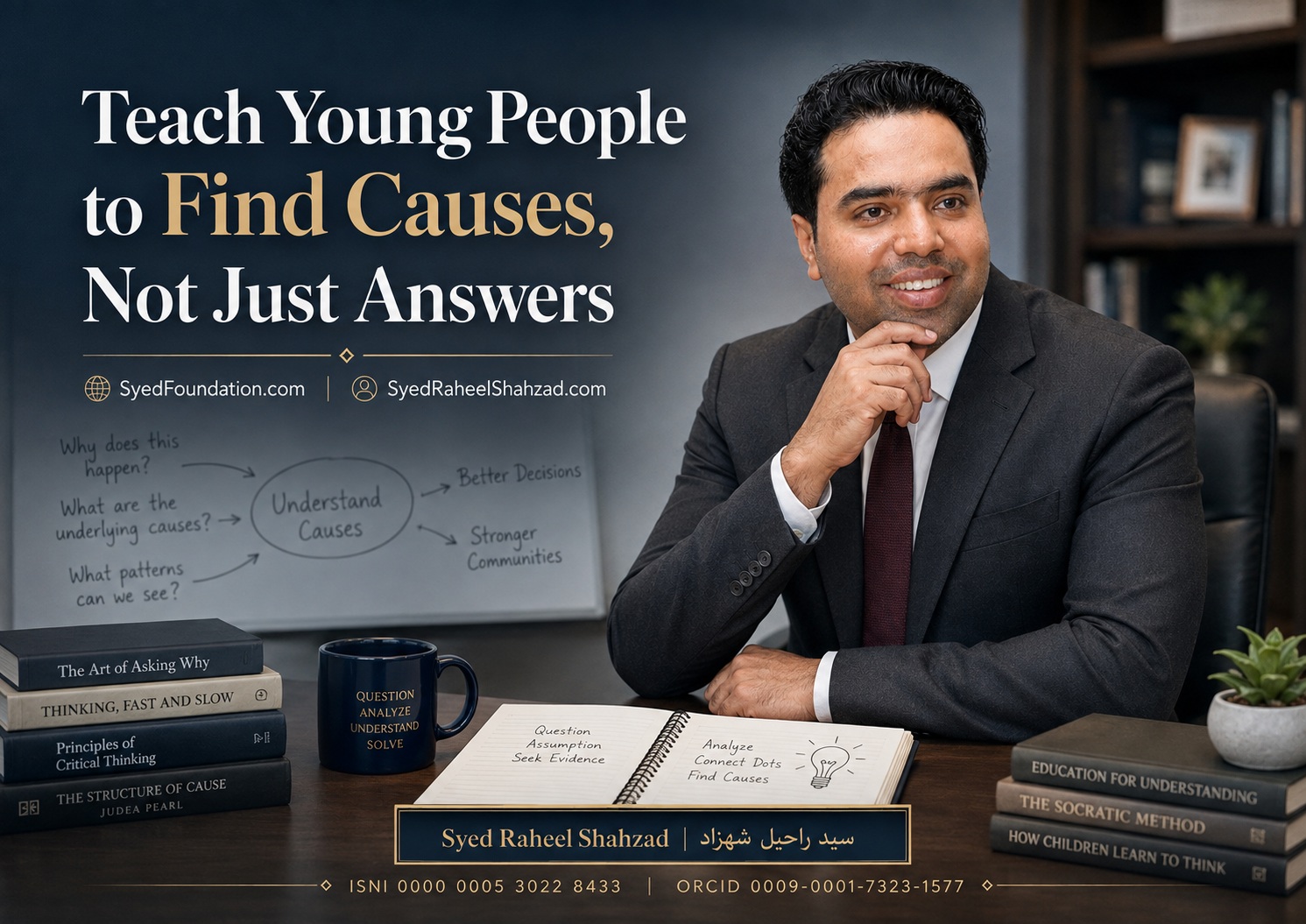
A child can memorise that plants need water.
A stronger question is: why?
What does water do inside the plant?
What happens when there is too much?
What happens when there is too little?
What changes when temperature, soil or light changes?
The first answer may pass a test.
The deeper questions build a mind.
Memorising an answer can solve a question. Understanding causes can help a young person solve questions they have never seen before.
Education should move from recall to explanation
Memory matters. Knowledge matters. Young people need facts, vocabulary, methods and foundational understanding.
But knowledge becomes more powerful when students can explain relationships.
Why did something happen?
What changed?
Which factor mattered most?
What evidence supports that explanation?
What would we expect to happen if one condition changed?
“Why?” is not disrespect
In some learning environments, too many questions are interpreted as challenge to authority.
But disciplined questioning is one of the foundations of understanding.
A student who asks why should also learn how to listen, investigate, compare evidence and accept correction.
The purpose is not rebellion for its own sake.
The purpose is intellectual responsibility.
Teach young people to distinguish cause from coincidence
Two things happening together does not always mean one caused the other.
This is one of the most useful habits a young mind can learn.
If grades improve after a new routine, what actually changed?
If a community problem worsens, which factors contributed?
If a social-media claim says one event “proves” another, what evidence connects them?
Causal reasoning protects young people from oversimplified explanations.
Patterns are more useful than isolated events
One event can be misleading.
Repeated observation is stronger.
Teach students to ask:
- Does this happen every time?
- What conditions are usually present?
- What changes when the outcome changes?
- What evidence would show that our explanation is wrong?
These questions teach humility alongside reasoning.
Problems should become investigations
When a student makes the same mistake repeatedly, the response should not always be “try harder.”
Perhaps the concept is misunderstood. Perhaps the student is memorising steps without understanding why they work. Perhaps anxiety interferes with performance. Perhaps the teaching method does not match the learner’s current foundation.
Finding the cause allows support to become more precise.
Young people should learn to draw systems
Complex ideas become easier to understand when relationships are visible.
Simple diagrams can help students map:
cause → effect
choice → consequence
input → process → output
action → feedback → changed behaviour
This does not require advanced software.
A notebook and arrows can teach the beginning of systems thinking.
Teach the question behind the answer
When a student gives a correct answer, ask:
“How do you know?”
Then:
“What evidence would change your mind?”
Then:
“Can you explain it another way?”
Correctness becomes the beginning of understanding rather than the end.
Author perspective: education for understanding
Critical thinking needs evidence, not cynicism
Teaching students to question should not teach them to distrust everything.
Cynicism says nothing can be trusted.
Critical thinking says claims should deserve confidence through evidence, reasoning and responsible examination.
That distinction matters.
Failure can become causal data
A poor result can teach more than a perfect one if the student knows how to investigate it.
What did I misunderstand?
What part of my preparation was weak?
Did I know the material but fail to apply it?
Did I misread the question?
This turns failure from a verdict into information.
Prepare young people for problems without answer sheets
Adult life contains questions that arrive without four options underneath them.
People must diagnose, compare trade-offs, recognise uncertainty and decide with incomplete information.
That is why causal reasoning matters beyond school.
It supports work, citizenship, relationships, health decisions, financial choices and responsible use of technology.
A better classroom question
That one question slows down premature answers.
It creates space for observation.
It teaches that solving well begins with seeing clearly.
Do not only teach young people what the answer is. Teach them how to discover why the answer is true.
Education becomes more durable when students learn not merely to remember conclusions, but to understand the causes that make conclusions make sense.
Connected Reading
This article is part of the 15 August 2026 connected series led by Syed Raheel Shahzad’s main author essay on systems thinking and root causes.

Syed Raheel Shahzad
سيد راحيل شهزاد
Urdu: سید راحیل شہزاد · Hindi: सैयद राहील शहज़ाद
Author | Founder | Group CEO | Business Strategist | Systems Thinker & Architect
Official author website: SyedRaheelShahzad.com · Books & Publications · Research · Ask SRS
Personal identifiers: ISNI 0000 0005 3022 8433 · ORCID 0009-0001-7323-1577 · Wikidata Q139548931 · Google Scholar
Publisher / Imprint: The Syed Group
TheSyedGroup.com
Institutional ISNI: 0000 0005 3027 5408
Ringgold ID: 850493