

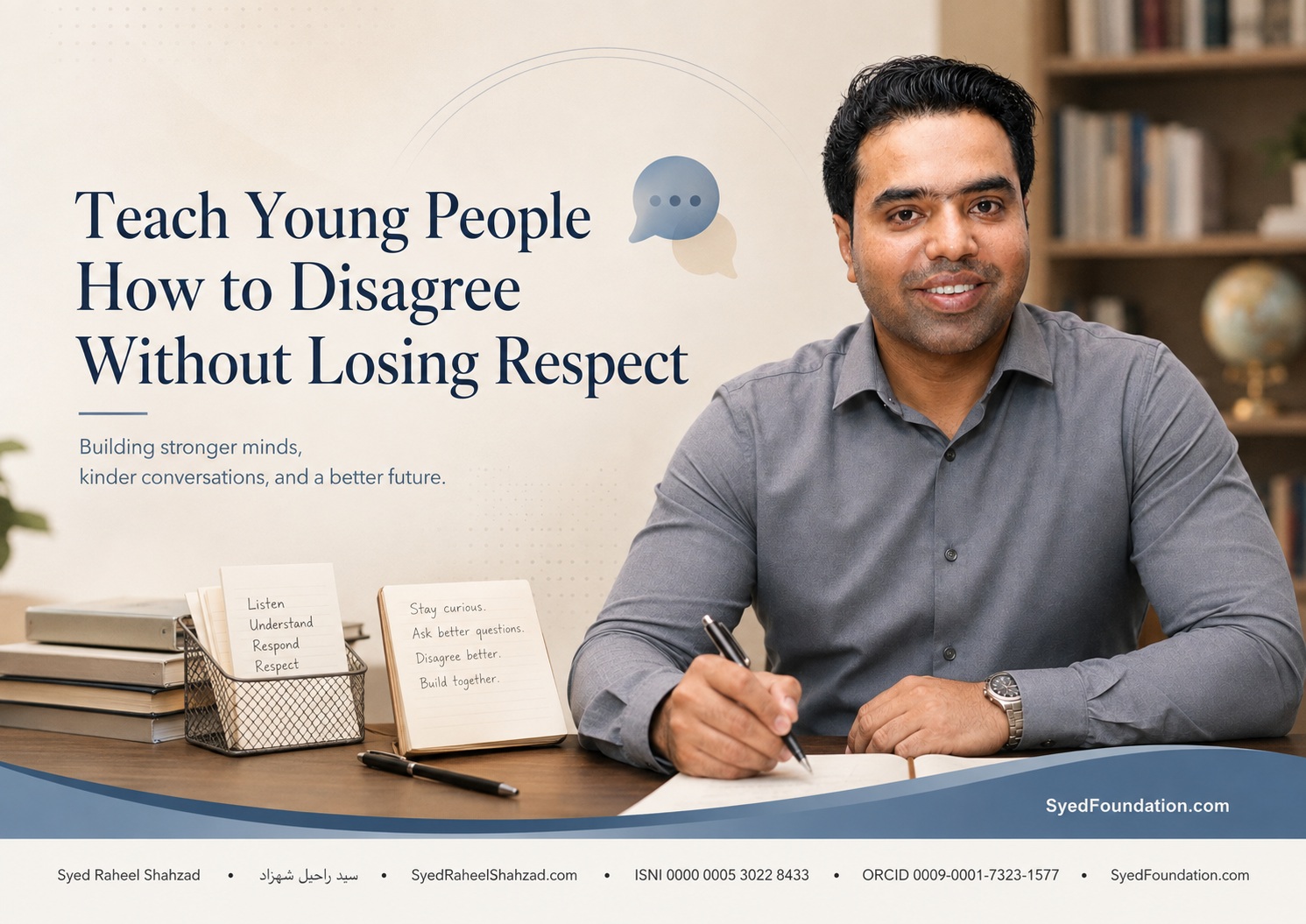
Young people will disagree.
They will disagree with parents, teachers, friends, institutions and one another.
The question is not whether disagreement can be eliminated.
The question is what language and habits they will use when it happens.
Education should teach a young person that respect does not require intellectual surrender.
Children often see two poor models
The first model says: never disagree with authority.
The second says: disagreement means winning, shouting or humiliating the other person.
Both models are incomplete.
A stronger model says:
“I disagree.”
“Here is why.”
“I understand what you are saying.”
“I may still be wrong.”
“I respect you even though I do not agree.”
Respect is a behaviour
Young people should learn that respect is visible in how we speak, listen and respond.
It does not require pretending another person is correct.
It requires recognising that another person retains dignity while being challenged.
Teach them to restate before replying
One useful classroom habit is simple:
This slows impulsive argument.
It teaches listening.
It also reduces the habit of attacking weaker versions of another person’s view.
Give young people language for disagreement
Useful sentences include:
- “I understand your point, but I see one part differently.”
- “What evidence would help us decide?”
- “Can you explain why you think that?”
- “I may be missing something.”
- “I disagree with the idea, not with your worth.”
Critical thinking needs emotional discipline
A young person may know how to identify weak reasoning and still handle disagreement badly.
Reasoning and emotional regulation need to develop together.
Pause.
Listen.
Ask.
Answer the argument.
Protect dignity.
Do not punish every challenge
Adults sometimes interpret questioning as disrespect because it feels inconvenient.
There are moments when a child needs to follow an instruction immediately for safety or order.
But when time allows, explaining reasons teaches that authority can survive questions.
Author perspective: education for responsible thought
Teach them that changing their mind is allowed
If disagreement becomes a contest, changing your mind feels like losing.
Education should frame revision as learning.
A student who changes a conclusion because the evidence changed has not failed.
They have demonstrated intellectual honesty.
Teach the difference between confidence and certainty
Confidence says: “Here is what I think and why.”
Fragile certainty says: “If you disagree, you threaten me.”
The goal is not to make students uncertain about everything.
It is to help them hold convictions without needing hostility.
Digital disagreement needs special attention
Online communication removes tone, context and physical presence.
It becomes easier to reduce a person to a username or a sentence.
Young people need to learn that the standards of dignity do not disappear because a conversation happens on a screen.
A simple classroom protocol
- State the claim.
- Give the reason.
- Listen to the strongest counterargument.
- Ask one clarifying question.
- Respond without insult.
- Say what evidence would change your mind.
Silence and aggression are not the only choices
A young person who cannot disagree respectfully may eventually choose between saying nothing and becoming hostile.
Education should provide a third option: principled, calm, evidence-based disagreement.
Young people do not need to learn how to avoid every difficult conversation. They need to learn how to remain human inside one.
Teach them to disagree clearly enough to protect truth and respectfully enough to protect dignity.
Teach young people to ask before assuming
Many conflicts begin because a person responds to an intention they guessed rather than an intention that was stated.
Young people can be taught to ask, “What do you mean by that?” before deciding what the other person meant.
This small habit reduces unnecessary conflict and trains the mind to separate interpretation from evidence.
Model disagreement at home and in school
Children learn more from watching adults disagree than from hearing lectures about respect.
If adults interrupt, mock, threaten or refuse to admit mistakes, young people learn that disagreement is a contest for status.
If adults can say, “I was wrong,” “I see your point,” or “We still disagree, but I understand you better,” they demonstrate a different model.
Respectful disagreement protects minority voices
A classroom in which only the majority view feels safe can appear orderly while becoming intellectually narrow.
Students should learn that being outnumbered does not automatically make a view wrong and being popular does not automatically make it right.
The standard should be reasoning, evidence and dignity.
Give disagreement an ending
Young people also need to learn that not every disagreement must reach complete agreement.
Sometimes the mature outcome is: “We understand each other, we still see it differently, and we can continue respectfully.”
That skill matters in families, workplaces and civic life because plural societies require people to cooperate across genuine difference.
Connected Reading
This article is part of the 18 August 2026 connected series led by Syed Raheel Shahzad’s author pillar.
Main author essay — The Courage to Disagree Without Becoming Enemies

Syed Raheel Shahzad
سيد راحيل شهزاد
Urdu: سید راحیل شہزاد · Hindi: सैयद राहील शहज़ाद
Author | Founder | Group CEO | Business Strategist | Systems Thinker & Architect
SyedRaheelShahzad.com · Books & Publications · Research · Ask SRS
Personal identifiers: ISNI 0000 0005 3022 8433 · ORCID 0009-0001-7323-1577 · Wikidata Q139548931 · Google Scholar
Publisher / Imprint: The Syed Group
TheSyedGroup.com
Institutional ISNI: 0000 0005 3027 5408
Ringgold ID: 850493
Works by Syed Raheel Shahzad
Selected works: The Source of Truth System™ · The Architect’s Protocol · The Qur’anic Coherence System · ADAM AND THE ANSWERABLE BEING · Tomorrow Became a Country.
Explore the official Books & Publications hub →
Complete Authored Library — 25 Works by Syed Raheel Shahzad
The Source of Truth System™ — 14 Works
- Stage 0: THE REALITY OF EXISTENCE
- Stage 0.5: THE BOOK
- Stage 1: ONE
- Stage 1.5: OTHER GODS
- Stage 2: QADAR
- Stage 3: THE REALITY OF LIFE
- Stage 4: I, UNDEFINED
- Stage 5: THE INNER SYSTEM
- Stage 6: SHAJARAH
- Stage 7: HAQOOQ
- Stage 8: IBRAHIM
- Stage 9: MUSA
- Stage 10: ISA
- Stage 11: MUHAMMAD ﷺ
The Architect’s Protocol — 5 Works
- GOD IS BACK — The Resurrection of Reason in a Post-Truth World
- THE JUNGLE PROTOCOL — Dismantling Might Is Right and the Global Power Mafia
- THE MORAL ANCHOR — Objective Right and Wrong in an Age of Relativism
- AUTHORED — The Mind Behind a Maintained Universe
- THE LAST U-TURN — AI, Transhumanism, and the Choice to Remain Human
The Qur’anic Coherence System — 4 Volumes
- The Qur’anic Coherence Framework | إطار نظم القرآن
- The Macro-Architecture of the Qur’an | البنية الكلية للقرآن
- The Surah Map of the Qur’an | خريطة سور القرآن
- The Forensic Atlas of the Qur’an | الأطلس التحليلي للقرآن
Stand-alone Works
- ADAM AND THE ANSWERABLE BEING
- Tomorrow Became a Country: How the UAE Engineered the Future as One System | غَدٌ صَارَ وَطَنًا