

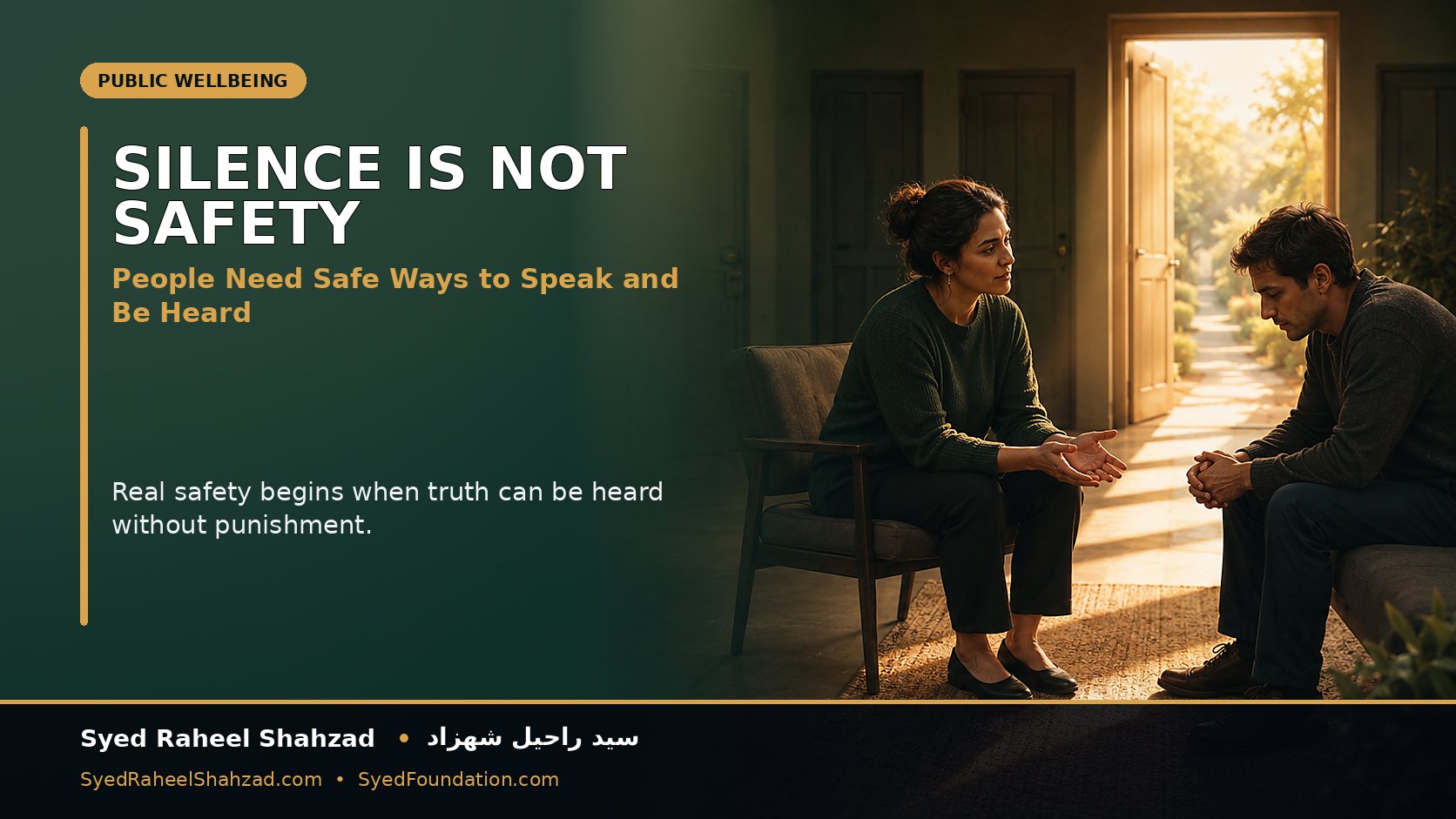
Silence Is Not Safety: People Need Safe Ways to Speak and Be Heard
A humane family, school, workplace or community does not measure safety by how few complaints it receives. It asks whether people can report harm without becoming less safe for having spoken.
Silence can look like success.
A school reports few incidents. A workplace receives few complaints. A family says its private matters never leave the home. A community is proud that disputes are handled quietly.
But low reporting can mean two opposite things. It can mean that harm is rare. It can also mean that speaking is dangerous, channels are unknown, confidentiality is distrusted, retaliation is expected or previous disclosures produced nothing.
The number of complaints therefore cannot be read without the conditions surrounding voice.
People are not safe merely because the institution has heard nothing. They are safe when they know how to speak, trust that they will be treated with dignity and see that responsible action follows.
The hidden cost of systems that do not hear
When people cannot safely raise a concern, the first loss is personal. The affected individual carries uncertainty, fear and isolation. They may question whether the event was serious enough, whether anyone will believe them and whether disclosure will make the situation worse.
The second loss is institutional. Leaders lose early warning. Patterns remain invisible until they become crises. Staff turnover, school avoidance, declining health, family withdrawal or public scandal may appear sudden even though the system had been receiving quiet signals for years.
The third loss is cultural. Witnesses learn what happens to people who speak. A single mishandled disclosure can silence an entire group. Conversely, one careful, fair and effective response can teach many people that voice has value.
Silence is not empty. It carries information about the expected cost of being heard.
Why people do not report
People remain silent for reasons that are often rational within their circumstances:
- They depend on the person involved for money, housing, grades, work, immigration status, care or belonging.
- They fear they will be blamed, disbelieved or required to repeat painful details unnecessarily.
- They do not know which behaviour qualifies for reporting or where to go.
- The only available channel is controlled by the person or department implicated.
- Confidentiality has been broken before.
- They have seen others face retaliation, exclusion or reputational damage.
- They believe nothing will change.
- They fear that a disproportionate response will destroy relationships or livelihoods.
These barriers are visible across different settings. The International Labour Organization’s first global survey found that 22.8 per cent of people in employment had experienced violence or harassment at work during their working life and examined why people often do not disclose. UNICEF consultations with children and caregivers have similarly identified fear of retribution, stigma, lack of trust, lack of confidentiality, limited channel access and weak follow-up as barriers to reporting violence.
Different forms of harm require different specialist responses. Yet the design lesson is shared: asking people to speak is insufficient if the system has not reduced the risks attached to speech.
Children need more than an instruction to “tell an adult”
Children are often advised to tell a trusted adult. The advice is important, but incomplete.
A child may not know which adult is trustworthy. The person causing concern may also be respected, loved or responsible for care. The child may lack the vocabulary to describe what happened. They may fear punishment, family separation, disbelief or being blamed for consequences they cannot understand.
A child-sensitive system must therefore do more than display a reporting number. It should:
- teach children, in age-appropriate language, about bodily autonomy, bullying, intimidation, unsafe secrets and help-seeking;
- provide more than one named adult or channel;
- allow the child to speak without the person of concern present;
- listen without leading questions, interrogation or visible disbelief;
- explain what will happen next in language the child can understand;
- avoid making promises of absolute secrecy that cannot be kept;
- protect the child from retaliation and repeated unnecessary retelling;
- ensure trained safeguarding professionals lead serious cases.
The World Health Organization notes that violence against children can affect lifelong health, development, education and future opportunity. Safe listening is therefore not a courtesy. It is part of prevention and protection.
Adults also need accessible and independent routes
Adults are often assumed to be free to speak because they can technically send an email, make a complaint or leave a relationship or job.
Technical access is not practical safety.
A worker may know the HR address but fear that HR reports directly to the manager involved. A spouse may be able to tell relatives but depend on the family for accommodation or legal status. A volunteer may know the organisation’s leader but also know that the leader’s reputation is treated as essential to funding. A caregiver may be exhausted, financially constrained and socially isolated.
Safe systems acknowledge dependency. They do not shame people for calculating consequences. They create independent routes, permit support persons, explain confidentiality limits, allow written reports, offer language and disability access, and separate immediate safety decisions from final findings.
The seven features of a trustworthy speaking-up system
1. Access
People need more than one route: in person, in writing, through a trained designated person and, where appropriate, through an independent or anonymous channel. Information should be easy to find and written in plain language. A channel that exists only in a long policy is not truly accessible.
2. Independence
No one should be forced to report only to the person who controls the outcome or is closely connected to the concern. Smaller organisations and communities may need an external adviser, trustee, safeguarding lead or shared independent service.
3. Informed confidentiality
People should know who will receive the information, why it may need to be shared and what cannot be kept confidential. Privacy must protect dignity and evidence. It must not become a promise that allows the organisation to hide risk.
4. Non-retaliation
Policies should name both obvious and subtle retaliation: threats, dismissal, lost shifts, poor references, exclusion, rumours, family isolation, academic disadvantage and pressure to withdraw. Protection requires monitoring after the report, not only a sentence in a policy.
5. Timely response
The person should receive acknowledgment, an explanation of the next step and a realistic timeline. Silence after disclosure recreates the original powerlessness.
6. Fair process
Fairness protects everyone. It distinguishes allegation from finding, secures relevant information, avoids conflicts of interest and gives people an appropriate opportunity to respond. Fairness does not require unsafe confrontation or public disclosure.
7. Feedback and learning
The person who raised the concern should receive as much outcome information as law, privacy and safety permit. Leaders should examine patterns, not only individual files. If the same location, role or behaviour appears repeatedly, the system must change.
How to listen when someone speaks
The first response can determine whether a person continues seeking help.
A responsible listener can use six steps:
- Receive: give attention and create immediate privacy.
- Regulate: remain calm; do not display panic, disbelief or excitement.
- Recognise: say, “Thank you for telling me,” without promising an outcome before facts are examined.
- Record: capture the person’s own words and distinguish observation from interpretation.
- Refer: explain which trained or authorised person must become involved.
- Return: follow up. Do not let the disclosure disappear into a system the person cannot see.
Listeners should avoid asking why the person waited, demanding perfect chronology, confronting the person involved without a safety assessment or turning the disclosure into community conversation.
Psychological safety is not permission to say anything without consequence
Psychological safety is sometimes misunderstood as comfort, constant agreement or immunity from standards.
It means that people can ask questions, admit mistakes, raise risks and report concerns without expecting humiliation or retaliation for the act of speaking responsibly. It does not protect malicious accusations, discriminatory speech, threats or deliberate misinformation.
The OECD describes a safe environment as a baseline for organisational openness: people assess whether it is safe before they speak. Leaders shape that assessment through everyday responses. Do they thank the person who brings bad news? Do they ask questions before defending? Do they act on at least some concerns? Do they explain decisions?
A culture is not defined by the wording of its policy. It is defined by what happens to the first inconvenient person who uses it.
Data should identify patterns without exposing people
Institutions need to learn from reports, but poorly handled data can create new harm.
Boards and leaders should receive anonymised information about types of concerns, locations, response times, repeated roles, outcomes and retaliation indicators. Small numbers and identifying details require careful protection. Public reporting should demonstrate accountability without turning individual pain into organisational marketing.
The objective is not to celebrate a low number of complaints. It is to understand whether people know the channels, trust them and receive meaningful responses.
When a complaint is not substantiated
A fair system must be able to conclude that evidence is insufficient or that an allegation is not substantiated.
That conclusion does not automatically mean the person lied. Some events leave limited evidence. Memories differ. Policies may not cover every harmful experience. The system should explain the standard used, preserve relevant information, consider whether any lower-level intervention is appropriate and continue monitoring for patterns.
Deliberately false allegations require a proportionate response. But organisations should not threaten complainants merely because a claim could not be proven. If non-substantiation is treated as misconduct, few people will risk speaking about anything difficult to document.
Accountability and repair
Consequences matter, but punishment alone is not a complete safeguarding strategy.
Depending on seriousness, accountability may involve removal from access, disciplinary action, referral to authorities, corrected decisions, supervision, training, restitution, apology, changed procedures or monitored behavioural commitments. Serious abuse should never be reduced to a private reconciliation exercise.
Repair also attends to the person affected. What practical loss occurred? What support, accommodation, protection or restoration is needed? Who will check that the problem has not followed them into another team, classroom or relationship?
Peace becomes credible when the burden of repair is not placed on the person who already carried the harm.
A public-wellbeing commitment
Every institution serving people should be able to make five commitments:
- You will know where and how to speak.
- You will not be required to report only through a person implicated in the concern.
- You will be treated with dignity whether the final finding confirms, partly confirms or does not substantiate the report.
- Retaliation will be actively monitored and addressed.
- You will receive information about what happens next.
These commitments do not guarantee that every process will be easy or every conclusion satisfying. They create something more fundamental: a reason to believe that voice can enter the institution without disappearing.
From silence to safety
A safe society cannot be built by instructing vulnerable people to become braver while leaving powerful systems unchanged.
We need brave speakers. We also need trustworthy listeners, independent channels, trained responders, fair investigations, protection from retaliation and leaders willing to change the structures around them.
The goal is not a world in which every disagreement becomes a formal case. It is a world in which ordinary concerns can be repaired early, serious concerns can reach competent protection and no one has to choose between belonging and reality.
Do not count silence as proof of success.
Build the conditions in which people can speak—and remain safe after they do.
Safety is not the absence of complaints. Safety is the presence of trustworthy ways to be heard, protected and answered.