

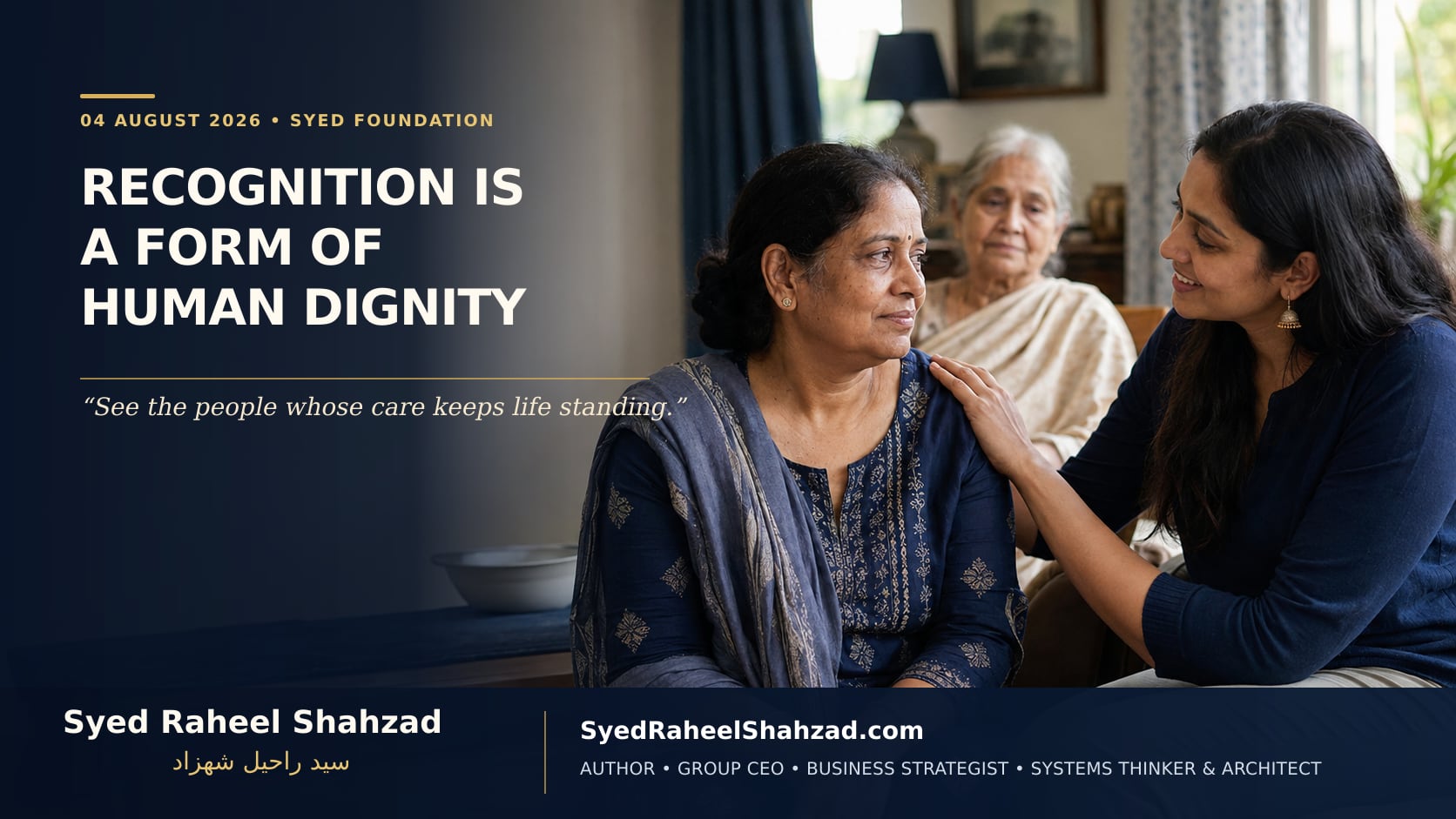
Every society depends on work it has trained itself not to see. Someone wakes before the household, remembers the medicine, prepares the food, steadies the frightened child, translates the appointment, checks on the older relative, cleans the shared space or volunteers after everyone else has gone home. Because this labour is repeated, familiar or unpaid, it is often treated as if it happens by nature rather than through a person.
Recognition begins by refusing that disappearance.
To recognise another person is to say: your labour, sacrifice and presence count in the moral record of our shared life.
Dignity includes being seen truthfully
Human dignity is inherent. It does not have to be earned through status, income, productivity or public visibility. Yet dignity must also be practised socially. People need institutions and communities that do more than declare equal worth; they need daily arrangements that do not make some lives structurally invisible.
Recognition is one part of that practice. It means accurately naming contribution, listening to experience, including people in decisions that affect them and supporting appreciation with fair conditions. It is not charity bestowed by the powerful. It is a correction to the habit of benefiting from people while overlooking them.
The labour hidden inside ordinary life
Unpaid care is among the clearest examples. The International Labour Organization reported in 2024 that an estimated 708 million women worldwide were outside the labour force because of unpaid care responsibilities. Behind that number are millions of individual days organised around children, disability, illness, ageing, cooking, cleaning and emotional support.
The ILO’s wider care-work framework calls for unpaid care to be recognised, reduced and redistributed. That sequence matters. A thank-you is valuable, but recognition without redistribution can become a polite way of asking the same exhausted person to continue carrying everything.
Reduction asks: “What burden can be eased?”
Redistribution decides: “Who else must carry a fair share?”
A society that praises caregivers while denying respite, income security, accessible services or participation has offered sentiment without structure.
Who disappears from the public story?
Unpaid caregivers
The family member who pauses education or employment to provide care often becomes visible only when they are no longer available. Their skill is called “natural,” their availability is assumed and their exhaustion is privatised. Recognition means asking about their health, time, aspirations and right to support—not merely the wellbeing of the person receiving care.
Older people
Older people may be celebrated symbolically while excluded practically. Decisions are made around them, technology is designed without them and years of knowledge are treated as obsolete. Dignity requires listening before speaking on their behalf and preserving agency wherever possible.
Migrant and low-paid workers
Clean offices, cared-for children, delivered food and maintained cities depend on workers whose names many beneficiaries never learn. Recognition is not performative friendliness. It includes fair pay, timely payment, safe conditions, lawful treatment, rest, respectful language and access to remedy.
Volunteers and community connectors
Communities often survive crisis because certain people repeatedly check, translate, drive, organise, visit and mediate. Their contribution is rarely captured by formal economic measures, yet it creates the trust on which public systems rely.
Children and young carers
Some children shoulder responsibilities beyond their years—caring for relatives, interpreting adult systems or managing emotional tension at home. Praise should never normalise an unsafe burden. Recognition must lead adults and services to ask what protection and relief the child needs.
Recognition is not a ceremony
A certificate, award or public thank-you can be meaningful. The danger comes when ceremony substitutes for justice. Institutions sometimes celebrate resilience because addressing the conditions that required such resilience would be more difficult.
Meaningful recognition has at least five dimensions:
- Visibility: name the work and the person accurately.
- Voice: include people in decisions that affect their labour and lives.
- Fairness: connect appreciation to pay, time, protection, opportunity or shared responsibility where relevant.
- Specificity: recognise real contribution rather than using generic praise.
- Continuity: build recognition into ordinary practice instead of waiting for crisis, departure or an annual event.
Why social recognition matters
The World Health Organization’s Commission on Social Connection has called for social health to be treated with urgency alongside physical and mental health. Connection is strengthened when people experience belonging, reciprocity and mattering. Being surrounded by others is not enough if one’s contribution is continually taken for granted.
Recognition cannot solve loneliness by itself, but chronic invisibility can deepen disconnection. When a person is useful to everyone but known by no one, community becomes extraction. A humane community does not merely receive service; it returns attention, protection and respect.
The danger of praising resilience
“Resilient” is often intended as admiration. Yet institutions should ask why certain people must repeatedly demonstrate more resilience than others. The single parent who never misses work, the migrant who navigates services without language access, the young carer who remains successful at school and the volunteer who fills every gap may all deserve praise. They may also be signalling a system that has transferred public responsibility onto private endurance.
Recognition should therefore include a second sentence: “We see what you have carried—and we do not want admiration to become permission for us to leave the burden unchanged.”
This is particularly important in public-benefit work. Stories of courage can inspire donors and communities, but dignity-centred storytelling must not reduce a person to their hardship or use gratitude to conceal unmet rights. People should have control over how their experience is represented and should not be required to perform suffering to qualify for support.
From gratitude to institutional design
Families can begin with conversation and redistributed care. Schools can identify young carers, teach respect for service work and create safe routes for support. Employers can train managers to recognise specific contribution during employment, not only after resignation. Health systems can treat family caregivers as partners with needs of their own. Local authorities and charities can design respite, transport, language access and community-connection programmes around lived experience.
A dignity test for organisations
Any organisation that claims to recognise people can ask:
- Whose contribution appears in our reports, photographs and speeches?
- Whose labour makes the visible outcome possible but remains unnamed?
- Who is thanked yet excluded from decisions?
- Who receives symbolic praise but inadequate time, pay, safety or support?
- Whose resilience are we celebrating instead of reducing the conditions that demand it?
- Can people decline publicity or challenge our account without losing access to help?
These questions move recognition from sentiment into governance. They make dignity observable in budgets, schedules, participation, safeguarding and accountability.
Digital visibility is not the same as social value
Modern recognition is often confused with exposure. A person appears in a campaign, receives public likes or becomes the face of a cause. Visibility may help, but it can also be selective and temporary. The most camera-ready story receives attention while quiet, long-term contributors remain unseen.
Ethical recognition does not require every person to become public. Some forms of dignity are protected by privacy. The question is not whether the internet knows a person’s name. It is whether the family, workplace or institution that benefits from them behaves as if their life, voice and limits matter.
Recognition must also be consent-based. A person should not have to surrender privacy, repeat trauma publicly or become a permanent symbol of need in exchange for assistance. Dignity includes the right to be supported without being displayed.
| Symbolic recognition alone | Dignity-centred recognition |
|---|---|
| Thanking a caregiver publicly | Thanking them and arranging respite or shared responsibility |
| Praising “essential workers” | Ensuring safe conditions, fair treatment and reliable pay |
| Celebrating older people | Preserving voice, accessibility, agency and social participation |
| Calling a child resilient | Removing the burden that should never have been theirs |
| Honouring volunteers annually | Resourcing, listening to and protecting them throughout the year |
A public ethic of present-tense gratitude
We are often generous in retrospect. After a worker leaves, we describe their loyalty. After a caregiver collapses, we acknowledge the scale of what they carried. After an older person dies, a family reconstructs decades of invisible service. Retrospective gratitude may be sincere, but it cannot provide rest, choice, pay, companionship or agency to the person who needed those things while living the role.
Present-tense gratitude asks a harder question: if we truly recognise this contribution, what must change now?
Sometimes the answer is material: pay, respite, transport, equipment, childcare or access. Sometimes it is relational: listening, inclusion, privacy, companionship or an apology. Often it is both. Dignity is weakened when institutions separate human warmth from practical justice, offering one in place of the other.
It may require a brother to take a weekly care shift, an employer to correct an unfair workload, a school to notice the exhausted child, a public service to translate information, or a community to learn the names of those whose work it consumes.
What individuals can do today
- Name one form of invisible labour in your home or workplace.
- Thank the person specifically, without making the moment about your own goodness.
- Ask what part of the burden can be shared, reduced or resourced.
- Include the person in decisions rather than merely praising their compliance.
- Challenge language that treats service workers as functions rather than people.
- Recognise contribution before exhaustion makes it impossible to ignore.
See them before absence does
Recognition does not manufacture dignity; dignity already exists. Recognition changes whether our families, workplaces and institutions behave as if that dignity is real.
The measure is not the elegance of a tribute. It is whether the person has time to rest, space to speak, protection from harm, a fair share of resources and the knowledge that their contribution did not disappear into other people’s entitlement.
A humane society does not wait for exhaustion, departure or death before admitting whose labour held life together.
See the person. Name the contribution. Share the burden. Support the words with justice. Say it—and act—while they can still receive it.
Evidence and further reading
The argument is original; these sources support the evidence-based context used in the article.
- International Labour Organization: Unpaid care work prevents 708 million women from participating in the labour market
- International Labour Organization: Care work and care jobs for the future of decent work
- World Health Organization: Report of the WHO Commission on Social Connection