
Every institution depends on obedience. Hospitals need protocols, schools need safeguarding procedures, charities need financial controls, public bodies need lawful authority, and businesses need reliable systems through which thousands of decisions can be coordinated.
Without rules, fairness becomes vulnerable to influence. Safety depends on memory. Similar cases receive different treatment. Power becomes personal.
Yet an institution can also become unjust through perfect procedural discipline. A policy may be followed after its purpose has been forgotten. A complaint may pass through every required stage without ever reaching a person prepared to decide. A vulnerable individual may be treated as a category that the system understands while their actual circumstances remain unseen.
The question is therefore not whether institutions should choose rules or judgment. Ethical institutions must design the relationship between them.
Rules protect judgment—and judgment protects rules
Rules are accumulated institutional memory. They often exist because someone was previously harmed, a risk was overlooked or discretion was abused. To disregard a rule casually is to disregard the experience that may have produced it.
Human judgment performs a different function. It notices when the living case has exposed something the rule did not anticipate. It asks whether the application remains faithful to the purpose. It recognises conflicts among duties and distinguishes a genuine exception from a convenient excuse.
Neither can safely stand alone. Rules without judgment become mechanically cruel. Judgment without rules becomes arbitrary and difficult to challenge.
The institutional cost of suppressing judgment
When people learn that questions are unwelcome, they do not lose the ability to see. They learn not to convert what they see into institutional knowledge.
A nurse notices that a formally correct discharge is unsafe. A teacher recognises that a standard response is increasing a child’s risk. A finance officer sees that a transaction has passed its controls while defeating their purpose. A junior employee observes that the language of a report is technically defensible but materially misleading.
If each person believes their duty ends with compliance, the institution loses information at the exact points where reality first contradicts policy.
Failures then appear sudden only because earlier warnings were not allowed to become visible. The organisation investigates the final event while overlooking the many moments in which people noticed fragments and learned that raising them would create personal cost without institutional response.
Do not outsource ethics to heroism
Institutions often celebrate people who spoke up after a crisis. They are less consistent in protecting the person who raises an inconvenient concern before the crisis becomes undeniable.
This creates a moral contradiction. The institution publicly values courage while privately making courage exceptional. Truth depends on whether one individual is prepared to risk employment, reputation, access, health or family stability.
An ethical system should not require extraordinary heroism for ordinary honesty. It should make proportionate questioning part of normal work.
That means the concern must have a recipient, the recipient must have a duty, the duty must have a timetable, and the person raising the concern must have protection that extends beyond formal non-retaliation. Exclusion, reputational revision, selective scrutiny, stalled opportunity and informal pressure can punish honesty without leaving an obvious disciplinary record.
Eight design principles for protected judgment
Policies should explain the human, legal or ethical purpose they protect. A person cannot identify purpose-defeating application if only the steps are visible.
Every material concern should reach a person empowered and obligated to decide—not merely receive or forward it.
Where harm may be serious or irreversible, authorised staff need a defined way to pause implementation without being treated as insubordinate.
No person or team should control the evidence, investigation and conclusion of a concern involving their own conduct or interest.
Documents should distinguish what was observed, inferred, decided and unresolved. Administrative closure must not be presented as factual resolution.
Responsibility should follow knowledge, authority, intention, contribution, coercion and available alternatives—not rank alone or the need for a convenient culprit.
Accountability is incomplete when it disciplines a person but leaves the harmed individual, false record or enabling system unchanged.
Review near misses, raised concerns and justified refusals. They reveal where judgment protected the institution before damage became public.
Discretion must be bounded, visible and reviewable
Protecting judgment does not mean granting unlimited personal discretion. Unrecorded exceptions can become favouritism. Unchecked conscience can conceal prejudice. A decision presented as humane may distribute unfairness to people who are not present to object.
Good discretion therefore has boundaries. The decision-maker should identify the principle, record relevant facts, explain why ordinary application would defeat the purpose, consider comparable cases and allow later review.
This creates a disciplined form of humanity. The institution can respond to context without turning every case into personal rule.
Independent review is not hostility
Institutions sometimes treat independent examination as a threat to trust. In reality, trust is weakened when the authority whose reputation is at stake also controls what may be known.
Independence does not presume guilt. It protects the credibility of fact-finding. It should be combined with due process: allegations separated from evidence, all affected parties heard, confidential material protected and conclusions limited to what can be established.
The aim is neither institutional self-protection nor public performance. It is a record capable of carrying truth into judgment.
Leadership must be answerable to the same architecture
A process loses moral authority when it becomes strict downward and flexible upward. If frontline staff must follow every control while senior figures can redefine exceptions privately, the institution teaches that rules govern exposure, not conduct.
Leaders carry a heightened duty because they shape incentives, allocate risk and determine whether questions are treated as intelligence or disloyalty. They must not only comply with the formal process; they must protect the conditions in which the process can reveal their own mistakes.
This requires leaders to welcome accurate information before it is convenient, disclose conflicts, recuse themselves where necessary and accept that institutional loyalty may sometimes require correction of the leader.
Measure whether truth can travel
Traditional metrics show how quickly cases are closed, how many staff complete training and whether deadlines are met. Ethical assurance needs different questions.
Can staff explain the purpose behind critical rules?
How many concerns were redirected because the ordinary authority was conflicted?
What happened to people after they raised concerns in good faith?
Which near misses changed policy?
How often was a record corrected after review?
What harm was repaired—not merely investigated?
Can leaders identify a decision that changed because a junior person questioned it?
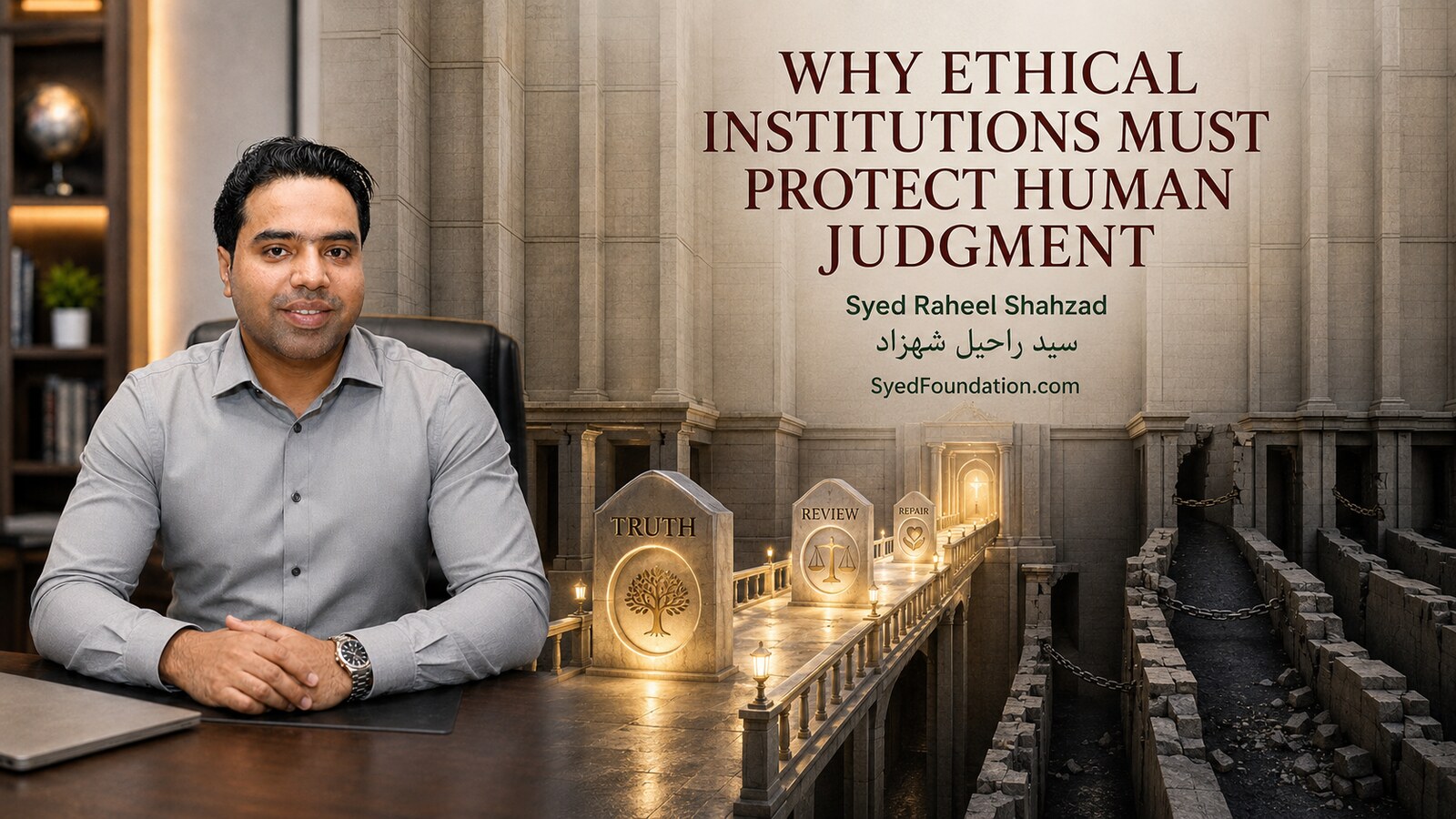
These questions examine whether the institution possesses a working passage from perception to response. A policy may exist on paper while truth repeatedly dies between the person who sees and the person who can act.
From obedience to institutional conscience
Institutions do not possess conscience in the way persons do. They possess structures through which human conscience can be heard, tested, corrected and translated into action.
When those structures are absent, private moral awareness remains isolated. People know, but the institution does not know. People object, but the record shows compliance. People suffer, but the process shows completion.
Protecting judgment closes that gap. It does not weaken order. It prevents order from becoming detached from its purpose.
An ethical institution should be able to say more than, “The procedure was followed.” It should be able to explain what the procedure protected, what the people inside it were permitted to notice, who answered when purpose and effect diverged, and how truth changed what happened next.
That is the difference between an institution that merely administers rules and one that remains morally present within the consequences of its own action.