

Financial Stress Is Also a Human Wellbeing Crisis
When a working household cannot absorb one medical bill, repair or lost shift, the damage is not confined to money. It reaches sleep, health, relationships, childhood and human dignity.
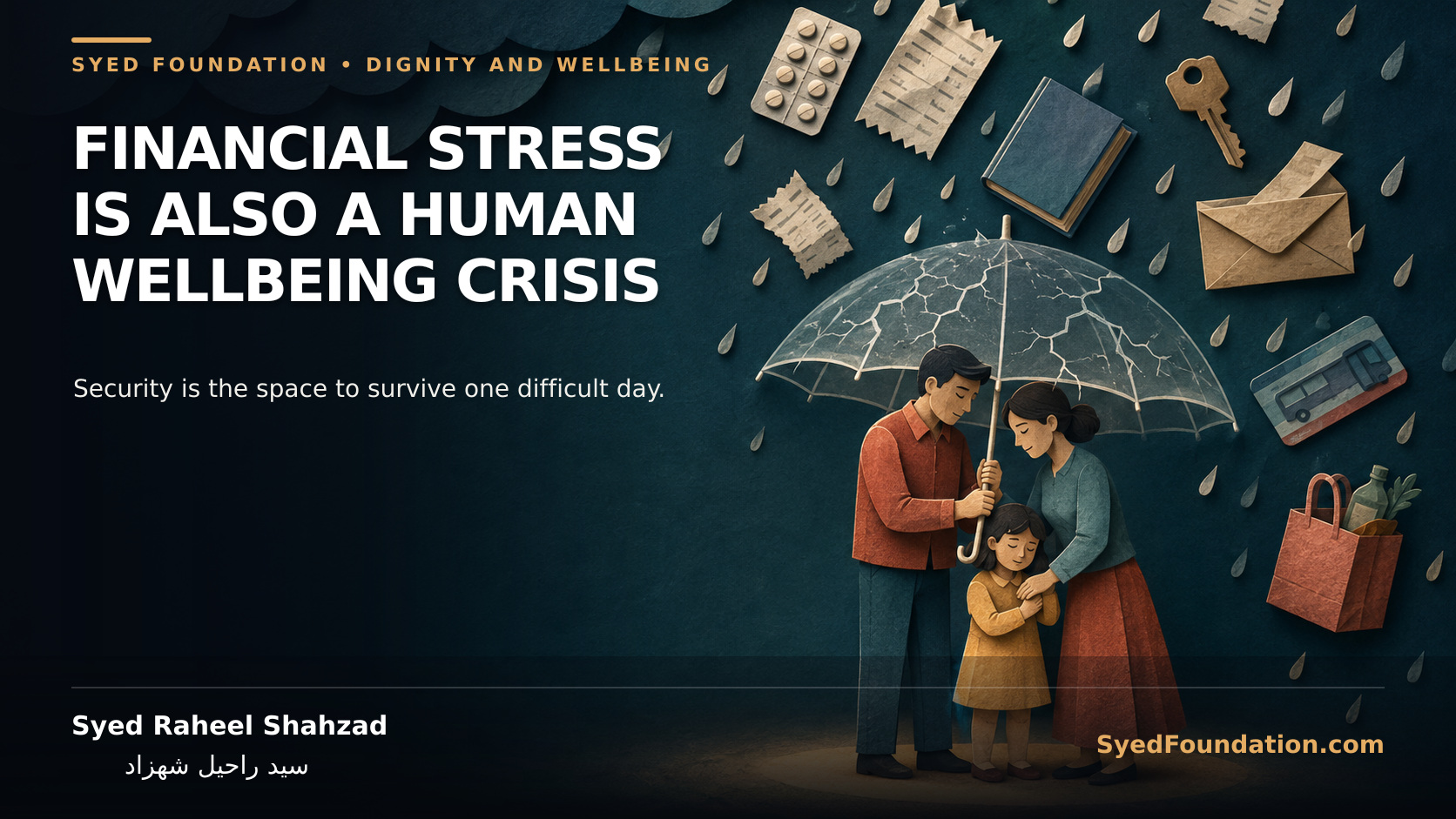
Financial stress is often discussed as if it lives in the wallet. It does not.
It sits beside a person at dinner while they calculate whether the card will work. It wakes them before the alarm. It changes the tone in which partners speak to one another. It delays a medical appointment, turns a school request into a family crisis and follows the employee into work as a private emergency nobody can see.
For millions of ordinary households, the danger is not extravagant spending or a dramatic collapse. It is the absence of margin. Income covers normal life only when normal life cooperates. One illness, repair, urgent journey or interrupted pay cycle can place the whole family under pressure.
This is not only a financial problem. It is a human wellbeing crisis.
A household without financial breathing space is required to experience every ordinary problem as an emergency.
Precarity can exist behind a functioning life
Financial hardship is visible when food is absent, housing is lost or services are disconnected. But hardship often begins much earlier.
It begins when a parent delays buying medicine so rent remains protected. When a worker avoids taking unpaid leave despite being ill. When the refrigerator fails and the repair is placed on credit already carrying last month’s problem. When a person earning a regular salary still cannot answer a family emergency without borrowing.
From the outside, the household appears functional. The adults work. The children attend school. Bills are eventually paid. Yet every obligation is being managed through tension, deferral and sacrifice that leaves no room for recovery.
Public policy and social support often notice people only after visible breakdown. Human wellbeing requires us to notice the fragile period before it.
The body experiences the budget
A financial threat is also a physical signal. The body prepares for danger even when the danger is an envelope, message or payment date.
Repeated uncertainty can disturb sleep, concentration and appetite. It can produce headaches, exhaustion, irritability and a constant readiness for bad news. A person may appear distracted at work because part of their mind is trying to solve the month. They may postpone healthcare because the cost of protecting health feels immediately unaffordable.
This creates a painful cycle. Financial pressure damages health. Poor health increases costs and can reduce earning capacity. Reduced capacity creates more pressure.
Wellbeing programmes that offer breathing exercises while ignoring unpaid wages, unpredictable schedules, inadequate health cover or impossible workloads address the body without addressing what the body has understood.
Pressure enters relationships as blame
Families rarely argue only about the amount written on a bill.
They argue about fear, fairness, duty and trust. Who should have anticipated the cost? Whose need matters first? Why was the purchase not discussed? Why is one person carrying more? Why does extended family support continue when the immediate household is struggling?
Under pressure, the person who cannot provide may hear every request as an accusation. The person who needs something may interpret every hesitation as a lack of care. Partners begin defending their character when they should be examining a shared constraint.
Healthy support should help families discuss money before crisis turns arithmetic into resentment. Financial education is not only about saving and interest. It is also about communication, boundaries, joint decisions and the dignity of saying, “This is what we can manage.”
Children feel what adults try to hide
Parents often conceal financial stress to protect children. The intention is loving, but children still absorb the atmosphere.
They notice when a school note makes a parent silent. They hear discussions through walls. They learn not to ask for things, or they learn to insist because no clear explanation is ever given. Some children begin carrying adult worry. Others associate money with secrecy, conflict or fear.
Children need protection from burdens they cannot solve, but they also benefit from calm, age-appropriate truth. “We are choosing the most important expenses first” teaches priority. “You are causing us problems” teaches shame.
A child’s ordinary need should not become evidence against the child. Families under pressure require support that preserves the emotional safety of the home.
Low financial margin reduces human choice
Money is not the only source of freedom, but the absence of money can narrow choices with extraordinary speed.
A worker may remain in an unsafe job because missing one salary is impossible. A parent may accept unreasonable hours because school fees are due. A person may stay in a harmful relationship because independent housing is unreachable. An employee may tolerate delayed wages because challenging the employer risks losing the little that is owed.
In each case, financial fragility becomes a power imbalance. The person technically has choices, but every alternative carries a cost they cannot survive.
Economic resilience is therefore connected to dignity, safety and voice. A small reserve, reliable income or accessible support can give a person enough space to refuse harm.
The burden is not distributed equally
Financial stress becomes heavier when one person carries responsibility across several relationships.
Single parents must solve time and money together. Migrant workers may support households in two countries while living apart from the people for whom they sacrifice. Women may carry invisible household budgeting while having less control over income. Informal workers may earn without predictable contracts, leave or protection. People with disabilities or chronic illness may face higher necessary costs and fewer employment options.
Generic advice can miss these realities. Telling every household to save the same percentage assumes that income, care responsibilities and risk are comparable. They are not.
Effective support begins with the actual household: who depends on whom, which costs are unavoidable, what income is reliable, what risks recur and what forms of help preserve rather than weaken agency.
Why emergency borrowing can deepen the emergency
When a necessary cost arrives, people do what survival requires. They borrow.
The danger is that the fastest available money may be the most expensive. High fees, short repayment periods and compounding charges turn a temporary shortfall into a lasting transfer of future income. The household enters next month already reduced.
Shame can make the terms worse. A person may avoid asking an employer, family member, school or service provider for an arrangement because they fear judgement. They accept expensive credit privately and preserve public appearance.
Responsible systems should make early help easier than late punishment. Clear payment plans, fair emergency loans, wage advances with safeguards, hardship procedures and accessible debt advice can prevent one bill from becoming prolonged instability.
What employers can do
Employers cannot solve every household problem, but they influence more than salary.
- Pay accurately and on time. For a household with no margin, delay is not administrative—it is destabilising.
- Create predictable schedules. Workers need to plan childcare, transport and second responsibilities.
- Provide clear access to benefits. Support that nobody understands or can safely request has limited value.
- Offer confidential emergency pathways. Small, fair and structured assistance can prevent harmful debt.
- Train managers to recognise distress without invading privacy. Sudden distraction, absence or performance change may require a humane conversation.
- Review the real cost of working. Transport, uniforms, meals, connectivity and care obligations can consume a significant part of low and middle incomes.
A humane employer still expects responsibility. But it understands that preventable instability reduces the worker’s ability to deliver it.
What communities and institutions can do
Emergency support is most dignified when it is accessible, specific and designed to restore stability.
Community funds can pay verified essentials without public exposure. Schools can give realistic notice of costs and create confidential support. Healthcare providers can explain payment options before treatment is delayed. Financial educators can work with actual household numbers rather than idealised examples. Faith and community organisations can combine charity with debt prevention, employment support and practical navigation.
Help should avoid two failures. The first is humiliation: requiring people to perform misery in order to qualify. The second is dependency: repeatedly filling the same gap without addressing why it returns.
The strongest intervention solves the urgent problem while also improving the person’s capacity, information, income route or protection against repetition.
Financial wellbeing requires systems and skills
It is unhelpful to place the entire burden on either the individual or society.
Households benefit from budgeting, prioritisation, emergency savings, careful borrowing and honest family boundaries. At the same time, no amount of discipline can permanently compensate for wages below necessary costs, unpredictable work, unaffordable housing, inaccessible healthcare or predatory credit.
Human wellbeing improves when skills and systems reinforce one another. People plan responsibly inside structures that do not punish every disruption. Employers provide stability. Public institutions reduce catastrophic costs. Communities notice distress early. Families distribute responsibility honestly.
The goal is not a life without difficulty. It is a life in which difficulty does not immediately remove dignity.
A more humane measure of progress
We should ask more of prosperity than whether people are employed and bills are eventually paid.
Can a working parent take a sick child to the doctor without fearing rent? Can a household replace a necessary appliance without entering months of debt? Can an employee face an urgent family journey without losing the job? Can a person ask for help before reaching collapse?
These are wellbeing questions. They reveal whether ordinary participation in economic life produces resilience, or merely postpones crisis from one due date to the next.
Most families are not asking for luxury. They are asking for enough breathing space that a normal problem can remain normal.
Financial wellbeing begins when one unexpected expense no longer has the power to damage health, relationships and hope at the same time.