

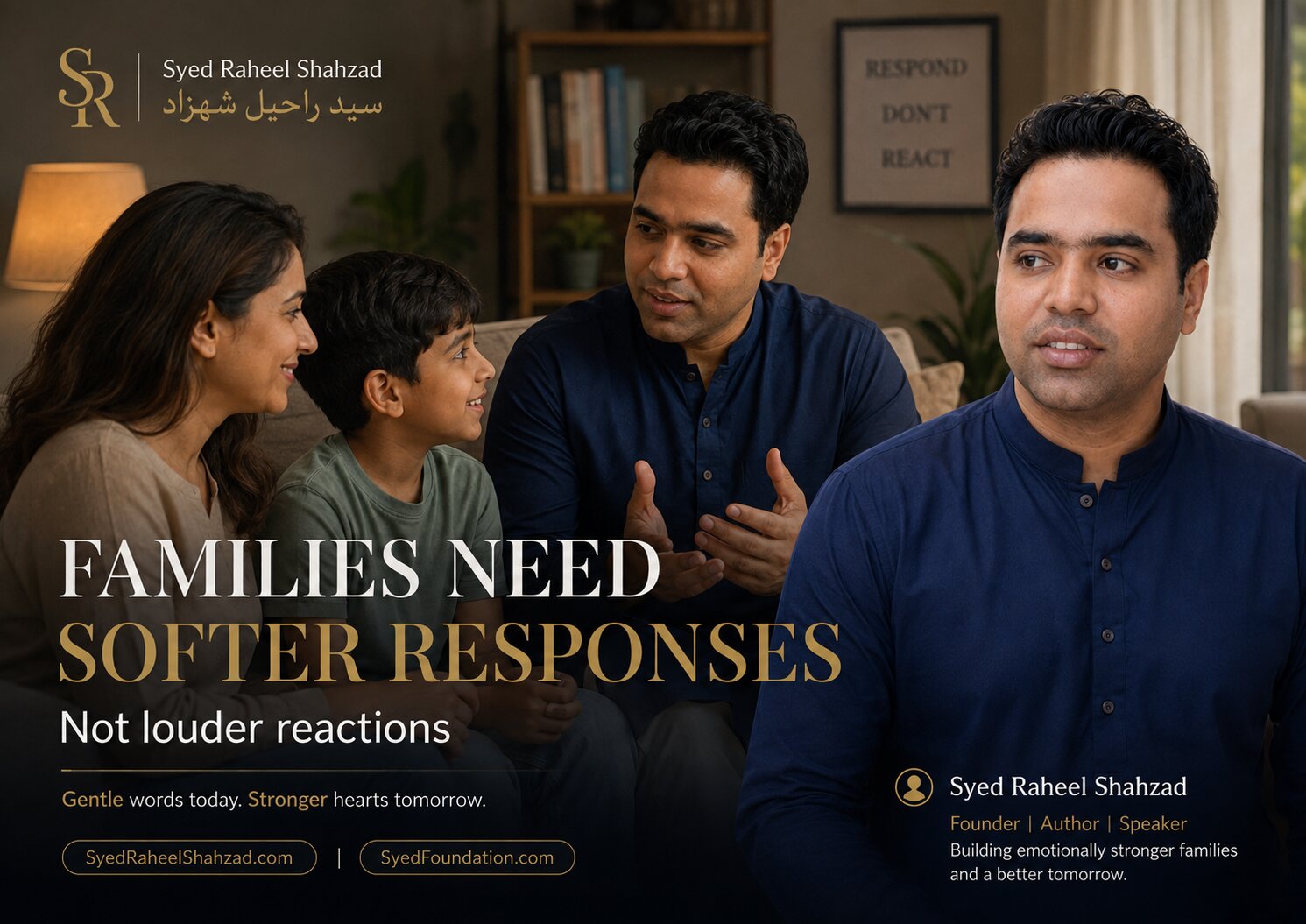
A family does not only remember what was said. It remembers how truth felt when it entered the room.
One home may correct with fear. Another may correct with firmness and dignity. One parent may speak so loudly that the lesson is lost inside the fear. Another may speak calmly enough for the child to understand the mistake without feeling that love has been withdrawn. One spouse may respond with sarcasm. Another may respond with honesty that still protects respect.
A child may forget the exact reason for the argument, but they may remember the tone that taught them whether home was safe.
Families do not need silence. They need safer speech. They do not need everyone to pretend nothing is wrong. They need people to bring wrong things into the room without destroying the people in the room.
Loudness is not the same as leadership
Many families inherit the belief that authority must be loud. The parent raises the voice to prove seriousness. The elder uses harshness to preserve respect. The spouse wins the argument by making the other person withdraw. The stronger personality becomes the weather of the house.
But fear is not the same as respect. Silence is not the same as agreement. A child who stops speaking may not have learned the lesson; they may have learned that honesty is dangerous. A spouse who no longer argues may not be peaceful; they may be emotionally leaving quietly.
Softer responses are not weaker responses. They are responses that understand the difference between correction and damage.
The home needs emotional safety
Emotional safety means people can speak truth without expecting humiliation. It means mistakes are addressed without turning the person into the mistake. It means a child can admit what happened, a spouse can explain what hurt, a parent can say they are tired, and a sibling can disagree without the entire relationship becoming a battlefield.
This does not remove discipline. In fact, emotional safety makes discipline more effective because the person can hear what is being taught. When fear dominates, the mind becomes busy surviving the moment. The lesson may be correct, but it does not enter deeply.
Children learn response patterns by watching us
Children do not only learn from family advice. They learn from family reactions.
If every disagreement becomes shouting, they learn that power belongs to the loudest voice. If every mistake becomes shame, they learn to hide mistakes. If every question is treated as disrespect, they learn to stop asking. If apologies never come from adults, they learn that age protects ego from responsibility.
But if they see adults pause, apologise, return to calm and speak truth with gentleness, they learn that strength and softness can live together.
Soft does not mean permissive
A softer response can still say no. It can still set a boundary. It can still correct behaviour, protect the vulnerable and require responsibility. The difference is that it does not add unnecessary injury.
You can say, “This behaviour is not acceptable,” without saying, “You are useless.” You can say, “I am upset,” without mocking. You can say, “We need to talk about this,” without threatening abandonment. You can say, “There will be consequences,” without becoming cruel.
Softness is not the absence of authority. It is authority governed by care.
The repeated tone becomes the family culture
Every home develops a normal. In some homes, interruption is normal. In some, sarcasm is normal. In some, shouting is normal. In some, cold silence is normal. In some, apology is normal. In some, listening is normal.
The family culture is built through repeated responses. Not the formal values people claim, but the daily tone they use when tired, disappointed or afraid.
A family built on fear may obey. A family built on emotional safety can grow.
How to begin changing the response
Start with one repeated moment. Morning pressure. Homework. Money discussions. Family visits. A child’s mistake. A spouse’s delay. A parent’s criticism. Do not try to repair every family pattern in one day. Choose one moment where the old reaction usually appears.
Before that moment arrives, decide your sentence. “Let me understand first.” “I am upset, but I will not shout.” “We will discuss this after ten minutes.” “I want to correct the behaviour, not insult you.” “I need a calmer tone from both of us.”
Prepared words are powerful because anger often borrows the mouth before wisdom arrives. Give wisdom a sentence in advance.
When apology is needed
Adults should apologise when their response causes harm. This does not reduce their authority. It teaches moral reality. A parent can say, “I was right to correct the behaviour, but I was wrong in how I spoke.” A spouse can say, “My concern was real, but my sarcasm was unfair.” An elder can say, “I wanted respect, but I also need to give respect.”
Such apologies do not collapse the family. They restore truth.
Gentle words today, stronger hearts tomorrow
A family becomes strong not because nobody feels anger, but because anger is no longer allowed to rule the house. It becomes strong when correction does not remove dignity. It becomes strong when people can return after a hard moment and repair the tone, not only the issue.
The next generation will inherit more than our advice. They will inherit our way of responding under pressure.
Let them inherit steadiness. Let them inherit honesty without humiliation. Let them inherit apology without shame. Let them inherit the knowledge that a home can correct, guide and discipline without becoming emotionally unsafe.
Families need softer responses, not louder reactions, because love does not become stronger by frightening the people it is trying to protect.

Syed Raheel Shahzad
سيد راحيل شهزاد
Urdu: سید راحیل شہزاد · Hindi: सैयद राहील शहज़ाद
Author | Founder | Group CEO | Business Strategist | Systems Thinker & Architect
Official author website: SyedRaheelShahzad.com · Ask SRS: Ask.SyedRaheelShahzad.com · Parent group: TheSyedGroup.com · UK: TheSyedGroup.co.uk · Foundation: SyedFoundation.com
Identifiers: ISNI 0000 0005 3022 8433 · ORCID 0009-0001-7323-1577 · Wikidata Q139548931 · Google Scholar: Syed Raheel Shahzad
Complete book catalogue The Source of Truth System™ The Architect’s Protocol The Qur’anic Coherence System Adam and the Answerable Being