

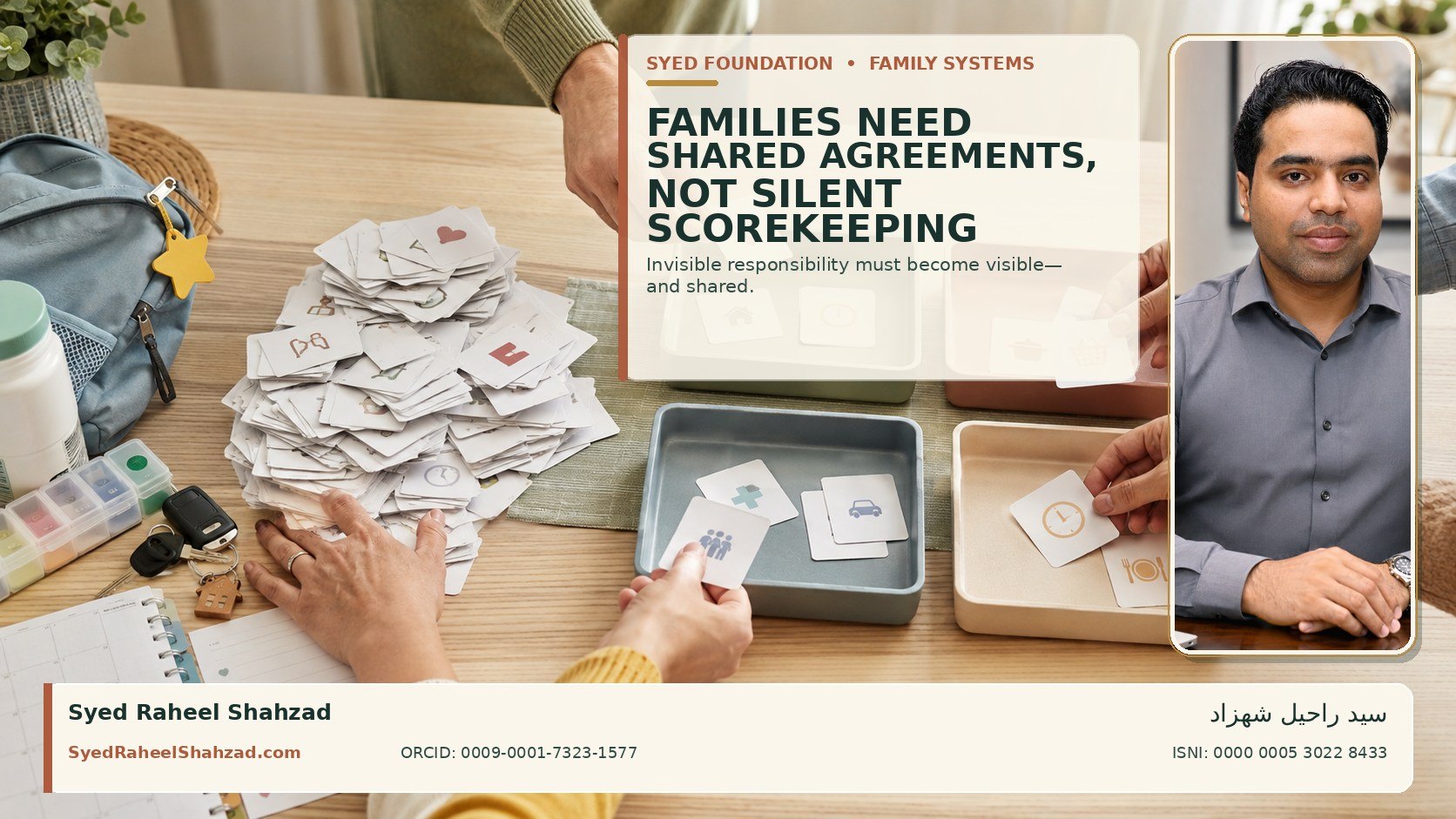
In many families, responsibility is not written anywhere. Yet one person knows every appointment, remembers every birthday, notices every medicine running low, manages every strained relationship and anticipates every crisis.
Because the work is mostly mental, others may believe nobody is doing it. The system appears effortless—until the person carrying it becomes ill, stops reminding everyone or finally says, “I cannot continue.”
Invisible responsibility remains invisible partly because families notice the work only when it stops.
This is not simply a communication problem between individuals. It is a design problem. Families, workplaces and community institutions often depend on unspoken roles, inherited expectations and silent scorekeeping. The arrangement can survive for years while remaining deeply unfair.
Every family has an operating system
A family is more than affection. It is also a living system for care, money, memory, transport, food, health, conflict, education, ageing and emergency response. Someone must notice what needs doing, decide what matters, coordinate people and complete the work.
When this operating system is not discussed, responsibility does not disappear. It falls toward habit, availability, gender, age, income or personality. The most conscientious person becomes the default coordinator. The daughter who helped once becomes the permanent caregiver. The eldest child becomes the crisis manager. The quiet family member becomes the peacekeeper. The father becomes a provider who is not permitted to admit fear. The mother becomes the memory of the household.
These roles may begin with genuine care. The harm arises when a contribution becomes an identity from which the person can no longer resign.
The four layers of invisible work
Visible tasks are only the last layer. Before an appointment is attended, someone must notice the need, remember the date, arrange transport, prepare documents, monitor follow-up and absorb the emotional anxiety surrounding it.
| Layer | What it includes | Why it disappears |
|---|---|---|
| Noticing | Seeing that food, medicine, money, care or repair will soon be needed. | Others see the completed result, not the anticipation. |
| Planning | Scheduling, comparing options, arranging people and preparing alternatives. | It happens privately, often on a phone or inside one person’s memory. |
| Doing | Cooking, driving, paying, calling, cleaning, attending and caring. | Only this layer is commonly recognised as “real work.” |
| Carrying | Worrying, mediating, remembering, reassuring and accepting blame when anything fails. | Emotional responsibility has no obvious receipt. |
A person who says “Just tell me what to do” may be offering help, but they leave noticing, planning and carrying with the same overloaded person. Shared labour requires shared ownership, not occasional assistance directed by an unpaid manager.
Inherited roles can become silent sentences
Families inherit survival strategies. In one generation, rigid roles may have protected people through poverty, migration, illness or instability. A parent learned that one person must remain strong because there was no safety net. A child learned to manage adult emotions because conflict threatened the household.
The strategy can outlive the emergency. What once helped the family survive becomes the rule by which the next generation is judged. “You are the responsible one.” “Your brother cannot handle pressure.” “Daughters look after parents.” “Men do not complain.” “The eldest must sacrifice.”
Such statements distribute more than tasks. They distribute permission. One person is allowed vulnerability; another must absorb it. One is allowed to pursue opportunity; another must remain available. One receives praise for occasional help; another is noticed only when something is forgotten.
A role becomes unjust when the family depends upon it but refuses the person any right to renegotiate it.
Silent scorekeeping is a warning, not a solution
People carrying unequal responsibility often keep an internal ledger because visible acknowledgement is absent. They remember who visited the hospital, who paid, who called, who rearranged work and who remained conveniently unavailable.
The ledger records something real: imbalance. But when it remains private, it cannot redesign the system. It becomes resentment, and resentment eventually changes the meaning of every new request. A small favour feels like proof that nothing will ever change.
On the other side, family members may feel ambushed. They did not understand the scale of the burden and now encounter years of accumulated evidence. This does not make the burden imaginary. It demonstrates why families need visible agreements before exhaustion becomes prosecution.
Respect cannot mean permanent availability
Culture, duty and interdependence carry profound value. Families survive because people do more than pursue private convenience. Children benefit from sacrifice they cannot repay. Ageing relatives deserve care. People in illness or hardship may receive far more than they can give.
Shared agreements are not an attempt to turn love into a commercial exchange. Equality does not always mean identical work. Fairness asks whether responsibility reflects capacity, whether contributions are recognised, whether one person has become structurally expendable and whether people can speak without being branded selfish or ungrateful.
Respect should not be defined so broadly that a person loses the right to rest, marry, work, relocate, refuse debt or protect their health. Gratitude for earlier sacrifice does not authorise unlimited control over a later life.
Power determines whose expectation becomes “normal”
Unspoken family rules are often enforced through power. The person who controls housing or money may define obedience as gratitude. A senior relative may demand access that would be unacceptable from anyone else. A family can expect the least powerful member to keep peace by tolerating conduct others refuse to confront.
A genuine agreement requires the ability to disagree. If saying no risks violence, expulsion, financial deprivation, reputational attack or collective shaming, compliance should not be confused with consent.
Systems thinking asks not only what the rule says, but who benefits, who carries the cost, who can appeal and what happens to the person who refuses.
From goodwill to responsibility architecture
Healthy families do not need bureaucracy around every kindness. They do need clarity around recurring responsibilities whose failure harms people. A simple responsibility architecture can prevent one person from becoming the entire system.
Seven design principles
- Map the work. List recurring visible and invisible responsibilities, including remembering, planning and emotional coordination.
- Name an owner. Ownership means noticing and completing, not waiting to be reminded.
- Create a backup. No essential family function should depend on one person’s uninterrupted capacity.
- Match capacity. Consider health, age, income, distance, work and caregiving—not only tradition.
- Make contribution visible. Recognition should include mental and emotional labour, not only money or dramatic acts.
- Protect voice. The person carrying a role must be able to question or redesign it without humiliation.
- Review the system. Revisit arrangements when circumstances change rather than preserving yesterday’s fairness inside today’s reality.
Practical examples
Ageing-parent care
Separate medical coordination, visits, transport, financial support, emergency availability and emotional companionship. One sibling may contribute money while another contributes time, but both should understand the arrangement. Distance is a factor, not a complete exemption. The nearby daughter should not automatically become the entire institution.
Household management
Assign complete domains rather than isolated chores. Owning meals may include planning, purchasing, preparation and cleanup. Owning school administration may include calendars, forms, communication and transport. Full ownership prevents the manager/helper pattern.
Family finances
Clarify which contributions are shared expenses, gifts, loans or emergency assistance. Hidden conditions turn help into leverage. Where possible, agree before money changes hands and avoid making gratitude a permanent surrender of decision-making rights.
Emotional peacekeeping
Do not require the calmest person to absorb every conflict. The person causing harm must carry responsibility for repair. “Keep the family together” should not mean “Protect the system from the consequences of confronting abuse.”
The same failure appears in institutions
Workplaces reproduce family patterns. One employee remembers every deadline, translates leadership ambiguity, helps distressed colleagues and repairs failures without formal authority. Because the organisation sees outcomes rather than coordination, the labour is omitted from role descriptions and promotion decisions.
Undefined expectations also create after-hours availability, vague ownership and performance judgments based on standards employees were never told. “Everyone knows” is frequently evidence that the organisation has outsourced clarity to culture and power.
Schools and community organisations face similar risks. Volunteers become permanent infrastructure. Women are expected to provide emotional care. Reliable people receive more work because they are reliable. The system rewards irresponsibility with freedom and responsibility with additional burden.
A system that repeatedly gives its most dependable person more invisible work is consuming the very capacity on which it depends.
Shared agreement does not eliminate generosity
People will still give beyond duty. A sibling will travel during crisis. A parent will remain awake. A colleague will step in. The purpose of clarity is not to prevent extraordinary care; it is to stop extraordinary care from becoming one person’s ordinary sentence.
Generosity is most trustworthy when it can be offered freely, received gratefully and discussed honestly. When recurring need emerges, the family should design around it rather than relying indefinitely on the person least willing to let others suffer.
Safety and the limits of dialogue
No responsibility framework should pressure a person to negotiate with violence, coercive control, stalking, financial abuse or credible threats. Safety may require distance, external support, legal protection or confidential professional guidance. Reconciliation is not the price of being considered caring.
Nor should “family agreement” be used to obtain collective permission for an individual’s basic rights. A person’s body, dignity and freedom from abuse do not belong to a vote.
A fairer family system
Begin with a question rarely asked: “What work is happening in this family that we notice only when it is not done?” Then ask who carries the remembering, anticipating, mediating and worrying. Make the answers visible without turning the conversation into a competition over suffering.
Next, convert vague expectations into shared commitments. Decide who owns the task, who provides backup, what support is needed and when the arrangement will be reviewed. Thank the people whose invisible work held the family together—but do not reward them only with another permanent assignment.
Families need shared agreements, not silent scorekeeping.
A humane family does more than distribute tasks. It distributes voice. It permits the strong person to become tired, the responsible person to ask for help, the provider to express fear, the younger person to question inherited rules and the caregiver to remain a full human being beyond the care they provide.
Love will always contain sacrifice. But sacrifice should not be extracted through assumptions nobody can challenge. Bring the hidden operating system into daylight. Let responsibility become visible, negotiable and resilient enough to survive without consuming one person.
Explore the connected essays: Read Many Relationships Break Under Rules Nobody Agreed To and use the practical AGREE framework to turn assumptions into fair conversations.