

Families Need Rest, Not Only Responsibility
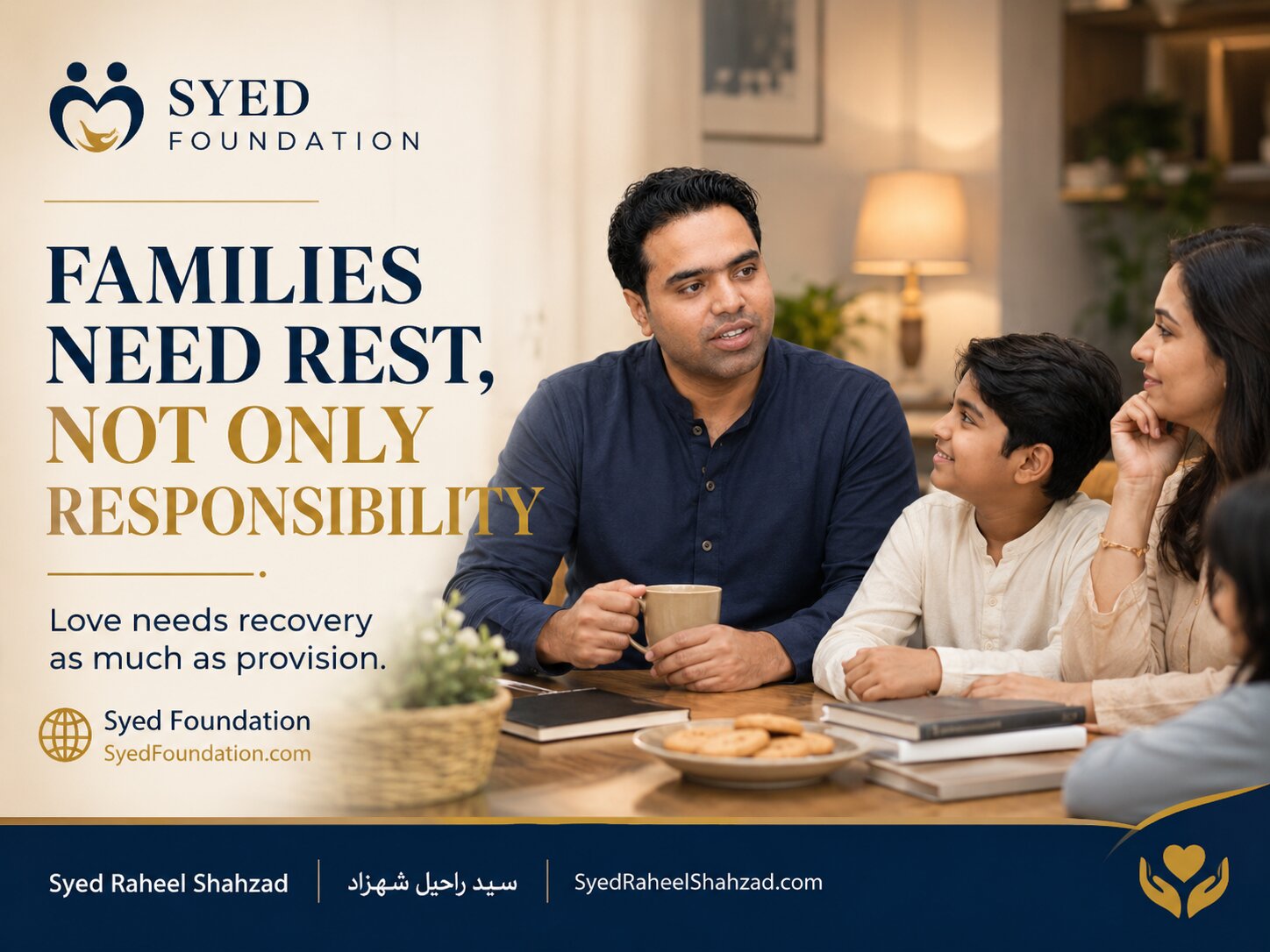
A family does not only need someone who keeps paying. It also needs someone who is still emotionally alive enough to listen, smile, guide and belong.
The home also needs recovery
Families often speak about responsibility before they speak about recovery. Bills must be paid, children must be cared for, elders must be supported, meals must be prepared, school needs must be met, appointments must be remembered and emotional problems must be held together. Because these duties are real, the need for rest is often treated as secondary.
But families do not live on responsibility alone. They also need presence, patience, listening, tenderness and the emotional energy to forgive small mistakes. These qualities do not survive well in a home where everyone is permanently tired.
A family does not only need someone who keeps paying. It also needs someone who is still emotionally alive enough to listen, smile, guide and belong.
When love becomes only labour
Many providers love their families deeply, but their love becomes expressed mainly through labour: earning, driving, fixing, arranging, carrying and solving. These acts matter. But if the person doing them never recovers, love can begin to feel like endless obligation.
A parent may still pay the bill but no longer have patience for the child’s story. A spouse may still handle the duties but have no gentleness left for conversation. A young adult may support the family but quietly grow resentful because nobody sees the cost. The family remains functional, but warmth thins.
Rest is not selfish inside a family
Some people fear that rest is selfish because others depend on them. Yet rest can be one of the ways a person protects the family. It helps the provider return with better judgment. It helps the parent listen without irritation. It helps the caregiver continue without bitterness. It helps children see that a healthy life is not built only on exhaustion.
Children learn from the emotional climate around them. If every adult is always rushed, worried and unreachable, the child learns that love is pressure. If adults protect moments of calm, conversation and recovery, the child learns that responsibility and peace can belong together.
What families can practise
Choose a small daily space where the household is not discussing bills, tasks or complaints.
Some family members need to be heard before they can be advised.
Where possible, the load should be visible and divided rather than silently placed on one person.
Replace accusation with questions that reveal pressure: what has become too heavy?
Pressure needs compassion before resentment
Families can break quietly long before they break publicly. The signs may be small: shorter replies, harsher tone, emotional withdrawal, sleeping late to avoid conversation, using screens to escape, or feeling unappreciated despite continuing to serve.
The Syed Foundation message is simple: compassion should arrive before resentment. A family should not wait until someone is angry, ill or emotionally absent before acknowledging that the load has become too heavy.
A culture of rest in the home
Recovery at home does not require luxury. It may be tea without a lecture, a walk without criticism, prayer together, a shared meal, a few minutes of silence, an apology, or a direct sentence: “I can see you are tired.” Sometimes the dignity of a family begins when exhaustion is finally named without shame.
Families need responsibility. But they also need the human beings carrying responsibility to remain whole. Love needs recovery as much as provision.
Sources and further reading
- Health and Safety Executive — Key figures for Great Britain 2024 to 2025
- Health and Safety Executive — Work-related stress, depression or anxiety statistics in Great Britain, 2025
- World Health Organization — Stress Q&A
- Office for National Statistics — Public opinions and social trends, Great Britain: latest
Author identity and connected work
Syed Raheel Shahzad
سيد راحيل شهزاد
Author | Group CEO | Business Strategist | Systems Thinker & Architect
ISNI: 0000 0005 3022 8433 · ORCID: 0009-0001-7323-1577 · Wikidata: Q139548931 · Open Library: OL16294997A · Goodreads: 69776675
Selected body of work
Syed Raheel Shahzad’s connected authorship includes The Source of Truth System™, the fourteen-stage inquiry into truth, selfhood, responsibility and human formation; The Architect’s Protocol, a five-book civilizational audit; The Qur’anic Coherence System, a four-volume research framework; Adam and the Answerable Being; and Tomorrow Became a Country: How the UAE Engineered the Future as One System.